
Sidebar Header

Sidebar Header

Sidebar Header

Sidebar Header

    LIVE 2.0 review

    jp | Music, Reviews, Software | Friday, 26 July 2002

    live 2
    Birds as big as humans have flapped our skies. Giant wings in slow motion through a nectar haze. Sometimes we glimpse these times gone by with our modern pollution enhanced sunsets. In downtown Berlin for example, the Ableton software company would no doubt stare out their windows, lamenting the lack of winged beasties feathering the horizon. Luckily they manage to keep themselves busy, coding one of the best audio applications to emerge in recent years. Founded by Monolake, Ableton have tried to provide flexible software which accurately reflects the needs and processes of contemporary electronic music making – and with Live & now Live 2.0, they’ve hit the jackpot.

    Droppin’ The Live Sequencer Bomb
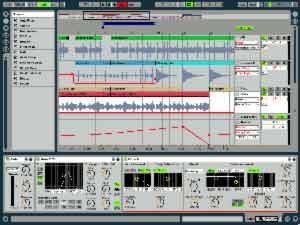
    Late last year Ableton updated Live to version 2.0, their crankin’ audio sequencer for Mac OS9, Mac OSX, and Windows. Live 1 & 1.5 both offered excellent capacities for live music performance, and were also recognised as fantastic studio tools because the quick and flexible ways ideas could be executed and recorded. Live 2.0 continues refining the performance and jamming features, and adds multitrack recording and editing, making Live even more suitable as a tool to use both in production and performance.

    Features
    Best bet’d be to browse the online manual for Live 2.0 at ableton.com to get an idea of just how flexible and powerful this baby is. Even better? Try the demo version also available at the site. At a snap, some of Live 2.0’s key features include: – the addition of multi track recording and editing, advanced automation handling – DJ-like cross-fading – easy tempo ‘tapping’ during performance or recording to adjust tempo on the fly – easy ability to assign most software parameters to midi or your computer keys – new FX and plug-ins – presets to save and recall effect settings – and what Ableton term ‘elastic audio’.

    Elastic Audio
    Elastic Audio refers to Live 2’s unique ability to treat audio as being totally malleable and to independently control tempo and pitch. This feature allows tempo to be set at anytime during recording, performance or playback. In addition, users can drop in recordings, loops and complete songs that will play in sync direct from disk. Live 2 makes it possible to synchronize loops and recordings of any length at any point in a session or performance. Time stretching is no longer limited to loops but can now be applied to any audio material.

    Data Be Smooth
    From the seamless way Live accesses files on your machine without missing a beat, through to the way it handles real-time effects, loop control, tempo warping and recording of sounds to be re-used almost immediately, everything happens fluid, everything happens fast. The interface is very well thought out and very effectively allows quick access to files or the programs various ways of treating samples or your arrangements of them over time. When you use Live, it’s easy enough to understand it was developed by experienced computer music makers, but you also get the impression this has been well coded too – it works fast, and it’s yet to crash on me.

    Requirements
    Mac: – Any G3 or fasta, 256 MB RAM, OS 9.1 or later, also OS X.1.5 or later.

    PC: 400 Mhz CPU or fasta, 128 MB RAM, Windows 98/2000/XP
    Windows compatible soundcard (preferably with a DirectX or ASIO driver)

    And you’ll needing around 399 Euro to grab Live 2 from www.ableton.com. Alternately you can get it from it’s Australian distributors, majormusic.com.au. (02) 9545 3540

    Verdict
    Completely fun to use straight out of the box ( or modem). Samples are easily looped, matched, mutated, it’s simple and quick to record directly into the Live window and start playing with this material. Easy mapping of parameters or samples to your keys, means for easily customisable and very flexible performance. Great for jamming and mutation, great for composition and recording. And it all really works. Fun, fun, fun.

    See Also:
    Ableton Live 7 Suite Review
    Ableton Live 6 Review
    Ableton Live 4 Review

    Share/Save/Bookmark

    Audiovisual Sync-ing With Jasch

    jp | Audiovisual, DIY, Interviews, Music, Software, Video, Vj-ing, electronic art | Wednesday, 24 July 2002

    Most Swiss people are vampires. You can see it by the teethmarks they leave in their cheese. Sinking his fangs well deep into the visualisation of music and the live performance of inter related audio and video, is the krazy kat: Jasch, who relayed these insights from his northern hemisphere rooftop.

    Describe Dyad?
    Dyad is my duo-collaboration with video-artist Johnny Dekam. Central theme is improvisation with visual and sonic material. We both work within the same paradigm/software: max/msp/nato. This shared syntax for sound and visuals makes communication on several levels possible. Much of the collaboration deals with finding bridges between hearing and seeing. We’ve developed a set of rules describing events and processes and the communication about them via a network link. We’ve been focusing on live-shows, where we roughly know beforehand where we want to go with the material, but improvise all of the treatments and mixing in real time. The big challenge is that there’s no guarantee to hit the right combination of materials at the right moment. But that keeps the thrill in the performances and lets us develop new things from show to show. In a way Dyad is like an improv combo, except that the instruments are silicon-based and the expressions span visual as well as acoustic phenomena.

    How do you approach creating for audiovisual performance?
    Along two axes: structural and emotional. The structural level deals with form and the shaping of the flow of sounds and images in real-time. The development of personal software-tools is an important part of that, another is using the appropriate hardware to interface with the processes. The emotional level is about atmosphere. All sonic material can project a context and evoke feelings. It’s essential to have at my disposal a large palette of such material and treatments and intimately know it. To me that’s the key to improvising with electronic media, basically feeling the material and be able to expressively apply it. It’s still very much like an instrument that wants to be practised and demands a considerable level of dedication. The preparation-effort oscillates between creating and refining the (soft and hard) tools and collecting and organizing new materials and processes to work with. It sounds paradoxical that the time spent programming and researching tools and materials is directly linked to the level of intuitive control. But it’s the only way to reach a state without thinking about the processes and control. The real test can only be in performance, when all elements collide and hopefully merge.

    What interesting issues come up with AV performance and composition?
    The crucial issue is time. Composition is thinking about structure and sound by organizing it in time, working in a detached sphere outside of time where decisions can be examined and revoked. AV-performances happen in actual, ‘forward-running’ time. The experience of composition does help in perceiving structure and temporal evolution in the moment, but doesn’t tell how to act and react to the situation. Intuition is the key, the non-linear access so to speak, to the past experiences without the need of analytical thought. Improvisation is tapping into the experience-base formed through perceiving, performing and composing. AV-performances are unique in that the shaping of visual and sonic structures happens simultaneously with a high degree of flexibility. Composition for the visual and the sonic media do have a lot in common, but there are also rules of perception based on disparate physiological phenomena: the ear, for example reacts differently to dense layering than the eye. Improvising in a open and undefined visual and sonic context demands a high degree of awareness both from audience and performer.

    How do you try to transcend the limitations of laptop based performance?
    By moving away from it. By finding ways to give back meaning to gesture and physical presence. Using sensors and controllers away from the typewriter-interface helps play the machine like an instrument. Projecting presence with physical action rather than thought and click.

    What was your role in the development of the AV software, VDMX?
    small, actually marginal, since jdk did all the coding himself. my visible contribution to VDMX2 was a small interface-hack. conceptually of course a lot of the lfo-vfo ideas and routing architecture were developed in parallel in my sound-tools and vdmx. Many ideas developed in common between me and jdk stemming from performance-experiences were filtered into and implemented in VDMX.

    What software interests you at the moment & why?
    Max/msp with it’s growing set of visual extensions: nato/jitter/softVNS and my own. I’m also following with interest the development of Pure Data, a cousin of max/msp on linux/windows/ and OS X.

    What software would you like to develop?
    More advanced and powerful 3D-sound and 3D-visual improv-tools, auto-generative and autonomous sound and visual architectures.

    Current/ future projects?
    Working on ‘codespace’ – a system for abstract 3D-graphics and sound in realtime. I’ve been doing shows and developing software-pieces with abstract 3D-drawing and sound control, integrating ideas from generative arts and minimalist electronic music with the realtime aspects of improvised performances. www.kat.ch/jasch/codespace.html Laying down tracks for a CD release of my material.
    Future projects include a feature length DVD with dyad, development of a full surround projection system and immersive sound/visual installation and a lot of hardware development in the field of wearable interfaces for gestural expression. http://www.kat.ch/jasch

    Share/Save/Bookmark

    War Games

    jp | Musings, Sustainability | Friday, 19 July 2002

    Sheeeeeeyat, how much fun was Gulf War news footage? Delivered to be sure, from one of the sides at war, but at least the US made it entertaining. Apparently seeing human casualties of war in Vietnam footage changed too many opinions about that war, and so Gulf-viewers got missile-cam. And thanks to www.americasarmy.com, today we’ve got a computer game to play.

    www.americasarmy.com
    Why bother with one of the huge range of Osama Bin Laden game-clones available at google, when you could be shooting terrorists in a computer game made by the US army themselves??!! Players can undergo basic training and fight in 10 multiplayer missions, including one to defend an Alaskan pipeline. Now available for download, and soon to be packaged with popular game magazines and in Army recruitment centres, ‘America’s Army’ not only let’s you hunt terrorists but also doubles as a recruitment tool.

    “With this game we hope to educate young Americans and present them with a realistic, engaging view of today’s modern Army and its opportunities,” said Lt. Col. Casey Wardynski. Stay tuned – On 25 July, they’ll release the first of many updates, U.S. Army Sniper School.

    Rambo Vs Osama
    Post S11, the Pentagon tracked down several Hollywood screenwriters including Steve de Souza ( Die Hard ), to discuss ‘left-field, off-the-wall ideas’ about America’s war. The man they should’ve been speaking to, Sylvester Stallone, is reportedly working on a script for Rambo IV which sees him kicking some Taliban Butt (TB).

    Arnie For President
    While Ronald Reagan may have seen merit in the Rambo movies, like Sylvester, he was an actor. Politics these days needs more muscle, such as beefy ex-wrestler Jesse Ventura, a currently elected US Governor. Ain’t no finer branded beef than Mr. Schwarzenegger though, and rumours persist that he is preppin his way to the White House. Watch this space.

    The War On Terrorism
    ” If they do it it’s terrorism, if we do it, it’s fighting for freedom,” said a U.S. Ambassador in Central America in the 1980s, when asked to explain how U.S. actions such as the mining of Nicaragua’s harbors and bombing of airports, differed from the acts of terrorism that the U.S. condemned around the world.

    Since World War II, the United States has dropped bombs on 23 countries. These include: Korea 1950-53, China 1950-53, Indonesia 1958, Cuba 1959- 60, Congo 1964, Laos 1964-73, Vietnam 1961-73, Cambodia 1969-70, Guatemala 1967-69, Grenada 1983, Lebanon 1984, Libya 1986, El Salvador 1980s, Nicaragua 1980s, Panama 1989, Iraq 1991-1999, Sudan 1998, Afghanistan 1998, and Yugoslavia 1999, including Civilian targets during the Gulf war, Vietnam, Panama, Philippines, Korea, Hiroshima and Nagasaki. 100,000 Iraqis died in the Gulf War and the suffering continues. 6,000 Iraqi children die every month from hunger and disease – the same number as died in the attacks on the WTC and Pentagon.

    Share/Save/Bookmark

    Nomadic Research Labs

    jp | DIY, Interviews, Sustainability | Thursday, 11 July 2002

    Beyond ants born on a merry-go-round, beyond yourself being born on the back of a galloping horse, lies the question of whether you choose to be born – or if it just happens to you. Not sure which side of that fence long-time pedaller and tech-nomad Steven Roberts sits. As you can see at www.microship.com, he’s certainly mobile though.

    How hard was your transition to becoming nomadic?
    Pretty easy; Central Ohio inspires long-distance travel. As this coincided with my somewhat antisocial desire to combine all my passions into a lifestyle (which can be a bit rough on relationships), the pre-launch phase was 6 months of exuberant stress. Departure was something of a relief, and since I actually moved to the bicycle, there was no easy way to quit when my knees hurt. After a while, the road became home… or, more accurately, the Network did, and I spent my time wandering around my huge neighborhood, dropping in on friends.

    Why did u choose a recumbent bicycle, instead of say a skateboard?
    I don’t like pain.

    What are some of the benefits / pitfalls of being a tech-nomad?
    Well, when you’re a technomad, your physical location is irrelevant. These days, that’s a pretty easy concept to grasp, since a growing percentage of the population more or less “lives” online anyway, but back then it was a bit of a shock to people. A technomadic lifestyle is immensely liberating, of course, though it’s hard to accumulate vast quantities of stuff.

    Presume u must meet many online friends while travelling. Do many of them join you for a while on the road?
    In the bike era, it seemed to be a sort of all-or-none situation: I did the first 10,000 miles solo (with occasional friends joining me for a day or two). The next 6,000 was with a girlfriend, then the last little
    trip with BEHEMOTH was more or less solo but for an unforgettable on-the-road 3-week romance.

    I am approaching the Microship project quite differently. Two boats (canoe-based amphibian pedal/solar/sail micro-trimarans) are under development here in the lab, but the plan is to travel as a technomadic flotilla of 4-8 travelers, with other nomads joining the group for varying periods over the 2+ year expedition. We are building the wireless network and other toolsets to accommodate a
    variable number of participants in the community.

    Strangest encounter u’v had on the road / waters?
    The band of convicts in the woods who plied me with pastries from a truck wreck is right up there…

    Why a solar powered linux server on a boat?
    Well, how else would I manage pier-to-pier networking? Solar because I don’t have a big diesel engine to crank up whenever I need power, and Linux because it’s wonderful what you can do with commodity
    hardware when you install a decent operating system. Besides, the open source community is a rich resource of clever people who like to build interesting tools. (My personal productivity machine is a Macintosh 14” iBook running OS X.)

    What sort of environmental data-collection are you doing in your expedition around North American waterways?

    I’m collecting dozens of time- and location-stamped telemetry channels, streaming them to a publicly accessible server, and publishing all the tools and protocols with the hope of inducing other travellers to do likewise. Some of this is purely pragmatic (system diagnostics and the like), but the real goal is creating a huge amorphous archive of environmental data. Think of it as corporate urinalysis. In the
    current political climate, it’s more important than ever for us to use our technology to expose environmental abuses and keep people suspicious. That’s not the central theme of the expedition, though: I’m actually doing this for fun.

    How nomadic was your partner b4 u coaxed her to join u travelling?
    Well, the partner you are probably referring to split in December… a 10-year development project is rough on relationships. There is a position vacant…

    What would bring u back to the city?
    Hmmmm. Free symmetrical broadband? A geek commune? Actually, it would be very hard to get me back to the city… my development lab is on a forested island in Puget Sound, and I only make it to Seattle about twice a year. I like calm places, one of the reasons I’ve migrated from road to water.

    The best 3 pieces of hard earned advice you�d give someone wanting to become a pedalling nomad?
    1. If you think too much about where you’re going, you’ll lose respect for where you are.
    2. The greatest risk of all is taking no risk.
    3. Don’t underestimate the importance of your hospitality database.

    Future plans?
    I’m currently working on a book about the Microship project for O’Reilly & Associates, and expect to launch the expedition in the Spring of 2003. I welcome flotilla participants, project volunteers, and other input… see http://www.microship.com/latestnews/live.html for a new photo and short text update almost every day.

    Share/Save/Bookmark

    Blogs, Blogs, Blogs

    jp | Musings, Networks, distribution, Software, online art | Friday, 05 July 2002

    Blogging. It started as web-logging – a convenient way of recording your daily trawl through web esoterica and current affairs for others to see. Now all manner of news sites, embarrassing online diaries and gossip sites are using blogs of sorts to keep their site freshly updated.

    Just Another Buzzword
    Well yeah, of course it is. Web-critters do love to add new bookmarks in their vocab. But give blogs a chance? For starters, ‘Blog’ sticks a little better than ‘frequently updated personal commentary’. The word has also become the glue of sorts for a whole treasure of sharply written, informative, often hilarious and mostly daily updating website authors. Exploring only a few of the following blogs will quickly show you just how interwoven their links can be, and the extent to which people are banding together around the concept of the ‘blog’.

    Do It Yourself
    Probably the best thing about a ‘blog’ is that it facilitates very easy online publishing and continual updating. A thriving collection of online software allows you to create and maintain your own website merely by visiting a particular webpage and typing in your new entry and sending it off. Voila. Your website now has a new commentary pushed to the top of your page for all to read. www.blogger.com is one of the more prominent offerings, although for a thorough listing of blogging tools, u needs to be chekkin:
    www.lights.com/weblogs/tools.html & for blognews – http://blogdex.media.mit.edu

    Cream of Da Blogs?
    Like beer, taste in a blog is a personal thing. Some though have floated to wider recognition within the blogger community, even flirted with earning an income for their authors. Cult bloggers include Metafilter, milkandcookies, Memepool, fuckedcompany.com and Boingboing.net, but while their relentless delivery of weird to profound bounty impresses the socks off me, my barefeet do prefer to be tickled by some of the more offbeat blogs you can find in the side caverns linked by these or other blogs.

    Guess What The Date Project is?
    http://thedateproject.blogspot.com/
    One computer types online diary of his attempts to get a girlfriend. On Saturday, June 29, 2002 he writes – ‘K’ and I have gone out a few times more, things are getting serious and continue to look promising. Of course, the journey is often more important than the destination, and this romantically entrepreneurial coder wants to keep going. “The introverted side of myself enjoyed the challenge of having to start three new conversations a day and go out to meet people”. See? Rivetting, isn’t it? Tha boy wants to keep these social experiments up though, so maybe keep your blog dial tuned for how this will affect him and ‘k’.

    A Popular Blog
    www.metafilter.com deals tha juice nicely, with a wide assortment of unusual stories and links. Catching my eye halfway down the page was their link to another blog ‘Supermodels Are Lonelier Than You Think!’, which combines ‘two of the best things in the world, blogs and beautiful women’, giving all manner of weird model related stories and updates. Clicking through to this blog, www.saltyt.com, showed them proudly noting their link from metafilter and commenting on an extra 16,000 visitors in the day since it was added.

    NonBloggers
    Ok, just gotta add – to anyone with a sampler, do chek www.CelebrityPrankCalls.com and please – run riot.

    Share/Save/Bookmark