
Sidebar Header

Sidebar Header

Sidebar Header

Sidebar Header

    This is Not Art Turns Ten

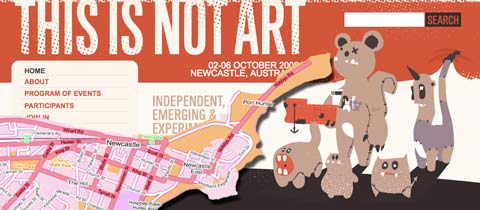
    tina2008 marks a decade of the TINA festival, which each year brings together people from all ends of the country ( and globe) to Newcastle for a weekend of gigs, workshops, exhibitions, installations, panels and general mayhem. It’s actually an umbrella for Electrofringe, National Young Writer’s Festival, Sound Summit and more, and this time round is happening from Thu 2nd Oct to Mon 6th Oct.

    As usual, there’s too much going on ( and much of it simultaneously ) for any one person to catch all of, so best bet is prioritising those sessions you really want to attend, and remain open to being swept along by the tides of stuff happening afterwards, be it the official sessions or the impromptu jams / meanderings / debates / disc swapping frenzies spread across the unique charm ( Baghdad as country and western surf town?) of Newcastle’s central business district.

    Renewable Energy
    Nice to note a festival in the steel city and one of the world’s biggest coal ports, running a trio of sustainable energy related workshops :

    Going Green: Solar Power for Electronic Arts & Culture – Learn about benefits of solar power for artists, media makers, researchers & others involved in electronic arts & culture. Get equipped with all the information you need to assemble an environmentally responsible & creatively liberating solar power system.

    Windmills workshop – Lock-up & Electrofringe artist-in-residence Chris Poole presents a hands on workshop exploring self powered & sustained micro-projectors. Learn to use wind power for guerilla style public art. Chris will also demonstrate & explain his innovative laser based projector. ( & later – Chris will create & install wind powered micro-projectors around Newcastle over the course of the festival. Keep an eye out for kinetic light emitting sculptures anywhere a little breeze might be blowing … )

    The End of Travel?
    Peak Oil’s coming; time’s running out to jump on a plane & see the world. How will this affect our relationship to place? What literary possibilities are afforded by a radical change in pace? What will it mean for the processes of globalisation that inform travel writing today? (( Cheery, eh? Luckily there’s also bicycle repair workshops happening @ the festival. Really! ))

    Gigalicious
    Aye. Many. There. Are. Including, in venues such as The Anti-Social Social Club, the following acts in various states of emotional and literal undress :
    Antony Milton, Ben Byrne, Cotti, Curse ov Dialect, Hosebeast, KK NULL, Lucky Dragons, Maruosa, Rose Turtle Ertler, Western Synthetics, Birchville Cat Motel, Tranny Cops Rave Safe Team, b12shot, Ultra Violet MC, Oojah & the Trash, Fannyfighters, Pig & Machine, Press Eject, DJ Svensimu, DJ Baku, Pikelet, Fabulous Diamonds, Jim Denley, Kim Myhr, Matt Hoare, Naked On The Vague, Mt Eerie / Microphones, Subsketch, Boxed Voices ( and yes, more.. ).

    What Else?
    Solder Girls is a soldering circle with a whiteboard, for those who got a doll instead of a physics kit for Christmas. Take a spoken word tour of some of Newcastle’s most fascinating hidden locations. Tired? Chances are you’re suffering from ‘Artistic Fatigue.’ Come to the NYWF doctor’s surgery. Checkout an overview of Interactive Cinema Projects from the iCinema Centre for Interactive Cinema Research at University of New South Wales. Explore ways computer based systems can interpret, track & relate movement through a camera. Quartz composer? Two workshops. ( see also workshops for pure data, reaktor, ableton live etc ) Soda_Jerk launching Killer Mix Vol 2 & discuss their remix-based art practice. A midi controlled animatronic penis mask. Join Lucky Dragons (U.S.) as they workshop ideas on collaboration & theories behind participatory art making. Flipbooks & locked groove vinyl? Tick. Publishers from Neural.it (Italy) & Metamute (UK)? In the house. Large slabs of white plasticine to create depth & distortion for a projected image? Uh huh. Interactive video installation reframing real life as a classic noir comic book? You know it. Information Aesthetics? A chamber recital for robots? A chorus composed for 16 bluetooth enabled mobile phones? Japanese festival screenings? Etc etc etc…

    Share/Save/Bookmark

    DVD Review : Transiterations by Ian Andrews

    jp | Audiovisual, Cinema, DIY, DVD, Reviews, Video, Vj-ing, electronic art | Monday, 22 September 2008

    Another disc launches out of the demux audiovisual label, this one the collated efforts of Ian Andrews, long-time Sydneysider sonic manipulator / video perculator.

    transiterations
    Twentieth Century Warehouses
    Aside from the factories filled with people making / printing Kurt Cobain tshirts, Sydneyside warehouses in the nineties were often filled on weekends with Pink Floyd scale light and sound systems and thousands seeking to lose themself in that sensory overload. Glancing back at a catalog of flyers for these, and many events of a more intimate and experimental scale, Ian Andrews can be found under many guises :
    on the video front, he was part of the seminal Video Subvertigo act with John Jacobs and Marco Fante ( whose video rigs were in spectacle in themselves, a literal truckload of electronics improbably clustered in the corner of a space for one night only ), working the speakers, Ian has been known alternately as Hypnoblob ( frenzied drum ‘n bass ), Disco Stu, Dormative Hypothesis, and The Horse He’s Sick.

    Plus One
    Fast forwarding to the current millenium, Ian’s purchase of a small 3 chip DV camera in 2005 delivered him the ability to capture banal events in everyday life, at quite reasonable quality – something he sought to exploit with a series of what he prefers to call ‘video field recordings’ rather than film shoots. By locking a shot off and having no camera panning or zooming, whatever comes into frame, whatever sound happens at the time, is in a sense, Ian argues, found. Having settled on a range of formal rules to limit what he may find, and using no additional music or sound effects, Ian gathered his found footage and pursued the challenge of wading through this material, editing it according to sound and image qualities, then arranging and repeating it in rhythms. ( hence Transiterations – iterative capture and cutting of sound and images in transit. )

    Leaving the DVD on in the background, the sounds drift over you… levels and tones ebb and flow, occasionally cutting in and out in more jolting fashion, with an overall effect akin to rain on a roof, or rain on the windscreen of a car halfway between two distant towns on a country road, a long country road, mostly straight, with only the slightest of bends to challenge your desire to sleep. Which is to say, given only recorded location sounds have been used, some nicely choreographed ambience flows over time.

    Visually, the DVD sticks to its rules, displaying a range of banal everyday moments, each of the dozen clips exploring a few simple visual editing techniques over time. “A collection of fragments, manipulated field recordings, gradual transformations, and banal repetitions” – isn’t going to be everyone’s cup of tea no matter how well edited, but to his credit Ian manages to coax compelling moments out of his micro-slices of Sydney life, slowly working through a range of editing ideas, the repetitive explorations building a cumulative impact over time, the gentle visual hypnotism reinforced by the swelling sounds.

    Favourite clips include waterlevels – shot in harbour, perhaps from something bobbing in the waves, then letting camera panning vertically to emphasise the water’s rise and fall, then playful extending that when the camera approaches the sky, another view of the sky pushing the original image down the screen, and when the camera pans back down to the water, this image is pushed upwards, by other footage shot of the water. Simple, but nicely executed. Platform 2 allows draws on harbour footage, splitting the screen vertically three times to present views of the Sydney harbour bridge in the distance from Circular Quay train station, being interrupted by fast moving trains, allowing nice layers of edited rhythms to emerge. The bells uses silence and black nicely to build rhythms and pedagogy repeats a loop which is probably only one second long, but retains interest by continuing to compose and crop it in various ways, jumping between these in ever more complex patterns over time.

    (( see also, previous demux reviews : Wade Marynowsky – Interpretative Dance, Peter Newman – Paperhouse ))

    Share/Save/Bookmark

    Net Lag : Vapour Trails Oct 9th

    While we can enjoy the fruits of being hyperconnected today – we have each other’s reading, listening and viewing habits at our fingertips, we can distribute globally on a whim – what creative performance options exist for real-time collaboration?

    Remember ResRocket?
    As long ago as 1997 ResRocket was developed by Willy Henshall (Londonbeat), and Tim Bran (Dread zone), as software to allow musicians to jam online, each represented by an avatar, and able to either play along in real time or perfect their part locally and add it to the mix later on – as long as you were playing MIDI instruments or traditional instruments rigged up for MIDI protocol translation. Some 65,000 users later in 2003, it was shut down by the Steinberg company who had bought it earlier. Various ex-rocket members cobbled together http://www.jamwith.us in 2004 which continues extending online jamming software to date.

    Rocket tangent?
    cold cutDuring their Australian tour in May 1999, Cold Cut agreed to perform a netcast from London to the Electrofringe festival in Newcastle Australia in October that year. Through a stroke of luck, the ISP sponsor for the festival had recently bought a warehouse beside the gig venue, and said “netcast? no worries, we can run a fibre optic cable across the carpark into the venue..” Bandwidth sorted ( which delivered us a 100kbs real video stream, luxurious at the time ), Cold Cut suggested doing an online jam at the end of their set with Resrocket. We hooked them up with beatmakers from Elefant Traks, who had been playing with their own online jamming software DASE ( Distributed Audio Sequencer Environment ), and the two groups jammed for a few months beforehand in preparation. On the night the ColdCut stream went fine ( with some of the loudest cheers for the text being written at bottom of screen ), but when it came time to have the jam, the Resrocket studio was inaccessible. The problem? Apparently a participating Resrocket sound engineer in San Francisco had fallen asleep, and the others couldn’t log into the room with the way he’d set it up.

    Online Jamming Today?
    Compared to Resrocket, the http://www.jamwith.us/ software is more a song production tool than a jamming tool, allowing musicians to synchronize and exchange audio material with most DAW platforms. “It has communication features to simplify the production process and keeps track of your tracks. You don`t need to be online at the same time as files are hosted on servers. The file exchange is optimized by compressing via the lossless flac algorithm.”

    http://ninjam.com (Mac OS X and Windows) is a program to allow people to make real music together via the Internet. Every participant can hear every other participant, and tweak their personal mix to his or her liking. Since the inherent latency of the Internet prevents true realtime synchronization of the jam, and playing with latency is weird, NINJAM provides a solution ( as did DASE back in 1999) by making latency much longer. The NINJAM client records and streams synchronized intervals of music between participants. Just as the interval finishes recording, it begins playing on everyone else’s client. So when you play through an interval, you’re playing along with the previous interval of everybody else, and they’re playing along with your previous interval.

    Similarly, ejamming.com imposes a delay on your instrument to keep you in sync with other musicians. The amount of delay is bandwidth and distance dependent. The better everyone’s upload speed and the closer the other players are to you, the lower the delay. The site recommends connecting with musicians close to you so you can adapt to the sync delay, and with their capslock on :
    “DO NOT TRY TO CONNECT TO MUSICIANS 5000-10000 KILOMETERS OR MILES AWAY THE FIRST FEW TIMES YOU TRY EJAMMING.” They also recommend headphones to minimize the sound level in the room of your instrument so you can focus on the delayed sound of your own instrument and the sounds of the other players coming over eJamming AUDiiO.

    http://networkjamming.com is an Australian developed networked interactive software application aimed at introducing schoolchildren to play in a virtual ensemble and jam with audio and video.

    Wiki for jamming online : http://en.wikiversity.org/wiki/Jamming_Online

    Beyond Midi And Timezone Drift
    Open Sound Control (OSC) is a protocol which attempts to transcend the limitations of MIDI, and provide a way of connecting machines more suited to modern networking technology, bringing with it greater interoperability, accuracy, flexibility, and enhanced organization and documentation. Much of today’s audio ( eg audio mulch, reaktor ) and VJ ( eg VDMX ) software is OSC capable, so online jams can include advanced ways of connecting parameters on machines located in different places. More sophisticated patch based software such as max/msp and pure data multiplies these capacities, as exemplified by the likes of Max Neupert’s Video Sampler where remote artists are both able to control an interface and see the other’s simultaneous adjustments, allowing a live remote jamming ( based on both sides having the same local set of media to start off with ).

    And aye, haven’t even touched on games, the vastness of online multiplayer games somehow daunts me. I like to think though, there’s a bunch of rastafarian orcs singing acappella tunes together in some hidden corner island of World of Warcraft, a gathering of Grand Theft Auto gangsters making music with avatar gunclicks, and others tweaking out weird audiovisual levels with unreal tournament game engines.

    And all kinds of remixing media possibilities have emerged with the widespread adoption of media storage sites online. Using a specific tag such as ‘melb2008digitalfringe’ on media uploaded @ pool.org.au, flickr, blip.tv or vimeo.com allows contributing artists from different locations to remix each others work during performances ( see below). Most media storage sites also tend to feature RSS feeds of media that can be subscribed to and utilised within software, and API’s ( programmer friendly code which provides database access to media for custom uses ).

    And So..On Oct 9th – NetLag : Vapour Trails
    vapour trails
    In the Digital Fringe leg of the Melbourne 2008 Fringe Festival, Plug N Play Melbourne, and Share Outpost will be hosting an event simultaneously with others in Brisbane, Perth, Tokyo and New York, where we’ll be trying to milk some of the collaborative possibilities, and trying to provide some introductory way of linking our events. Aside from a range of performances that night @ Horse Bazaar, we’ll be using the streaming software at mogulus.com/netlag, to select feeds from the other cities at various times, and to send an overall mix out to the web and to those at other events. The mogulus software allows live chatting via web, and anyone watching can also send twitter messages from their phone or web to twitter.com/netlag and these will scroll across the bottom of the netcast.

    The Mobile Projection Unit will be wandering around Melbourne projecting some of this, and also beaming back to the venue, and web, camera views of these projections. Crazy kinds of feedback loops possible to play with there – artists painting walls in NY say, being beamed through mogulus to our event, we select their feed and send to the mobile van, to project their art onto walls around Melbourne, video camera sends footage of this back to us, and back to the web, where the artists in NY can see how their work is being recontextualised in Melbourne, and adapt to it. The mogulus software is pretty good too, for allowing easing cueing and transitioning from feed to feed, so each member can send a feed to the web from their location, and the admin user can easily select which feed becomes the main feed. Should be fun at least, to cut in snippets from elsewhere, to our event in Melbourne, and hopefully fun for others to receive some of ours. And fun to see what kind of remixes emerge from the tagged media everyone has access to.

    In the end, just an experiment at linking events, but will be interesting to see where it goes… ( esp with the end of travel being predicted and all.. )

    Share/Save/Bookmark

    Abre Ojos, Big Square Eye, Digital Fringe 08

    Amusing as the U.S. election is to watch on news channels, or terrifying if you’re watching it via the Comedy Channel’s Daily Show, just sometimes, you don’t feel like having a herd of cattle flying overhead, dumping manure on you from great heights. A few abstract video antidotes then, to counteract the visual political overload of late.

    Abre Ojos
    Scott Baker, aka Abre Ojos, graced Melbourne Plug N Play recently with a fine audiovisual set, blending together well richly textured drones of ebb of flow with ethereal video footage, and appropriately stylised live animations. Walking into the venue though, one of the first things noticed was his rig, as he tends to use a range custom analogue equipment, and on this occasion had an impressive modular synthesiser embedded in a suitcase, spaghetti patchwork of cables arcing out of it everywhere, flanked by a range of controllers and a laptop for controlling video. A desk microphone let him use his voice to provide raw sound for filtering, processing into a swell of buzzing insects, mid ocean waves or a distant rumbling volcano. All the while letting slow and atmospheric video drift by on screen ( or into the screen in the case of road journeys into a floating cloud of mist ), or smoothly shifting animated light patterns over time.

    Abre Ojos
    Nice stuff, and he has a DVD out, a compilation of 4 AV tracks – all tracks are improvised, vision and sound recorded in a single pass, no overdubs, then minimal mixing/mastering / compressing / EQ etc. Visually, he works by taking photos and video with a consumer grade digital still camera ( the growing video quality on cheap still cameras continues to amaze and surprise me ), manipulating them in photoshop / after effects / motion and then layering these with quartz composer animations that are audio responsive and midi controllable. His work is also creative commons licenced, so you can both view and remix it over at abreojos.net.

    Big Square Eye
    Received this impressively realised DVD compilation in the mail recently, it having been produced for the Brisbane Festival 2008 at the tail end of workshops with 15 young Queenslanders given access to a range of gear, mentors and two things that help most projects – a deadline and a budget. The end result is surprisingly sophisticated, in both conceptual and aesthetic realms, and well supported by the DVD packaging and menu interface. The clips range from shimmery plays of light to stop-motion political critique, clip art animations, absurdist puppetry and abstraced visual effects. There are few visual cliches scattered amongst it all, but on the whole an impressive effort, and more so for the ways it is being distributed and displayed across many parts of regional Queensland in various non-gallery contexts like retail displays. Clips, artist information and related essays viewable online.
    brisbane square eyes
    Digital Fringe
    Happens in Melbourne soon ( Sep 24 – Oct 12 – digitalfringe.com.au ), bringing together a range of events, a mobile projection unit ( van with projectors, solar-charged batteries, online laptops, projector and video camera ) which travels around projecting onto Melbourne walls and sends the resulting footage onto the web in real-time. Anyone wanting to have their work projected with this, and on many screens all around Melbourne during the festival, can upload video at the Digital Fringe site ( you can also view / download other submissions for remixing ).
    digital fringe

    Share/Save/Bookmark

    Robo-Guts

    jp | Interviews, Sustainability | Thursday, 04 September 2008

    Today’s headlines routinely borrow from the sci-fi pages of yesteryear. Once upon a time an author probably chuckled as he wrote about genetic engineered tapeworms that would allow gourmet food lovers in the far future to gorge as much as they want. Out to prove this wasn’t hare-brained speculation, are the Melbourne based biotechnology firm, Roboguts. ( Full product range available at www.roboguts.com)

    I’m curious – how do the Robogut tapeworms ‘work’ ?
    In simple terms, one Robogut pill taken with a meal will neutralise any weight gain. Enjoy the taste without the calories!! And if you can’t choose between the lamb roast and the beef lasagne, why not have both and let Roboguts take care of it for you?

    But how do Roboguts ‘take care of it’?
    Wonderfully! Our tapeworms are genetically designed with a very limited life span, which usually means when they have finished your meal, they switch off, or are rendered benign.

    What does it feel like to eat with Roboguts in your stomach?
    The consumer wouldn’t feel anything different from their usual meal. Except of course they will be just as hungry at the end of the meal as they were at the start. Which means you can double the fun for your tastebuds, or fit that extra dessert in without any worries.

    20 million Africans face the worst famine in a decade (see www.plan.org.au). How can you justify developing Roboguts when so many have no food at all?
    The miracle of biotechnology will end mass starvation in our lifetime, I kid you not. The benefits of projects like ours will eventually trickle down to those in need, and everybody will have abundant food to explore the delights of.

    Aren’t you afraid people will be too squirmish to go for Roboguts?
    Not at all. Why put up with petty limits? Our market research for Roboguts showed us that people are ready to take body modification to the next level, and will pay top dollar for biotechnology enhancements that put them more in control of their feelings, emotions and body processes. You know, people used to ‘see’ witches in the sky, but now they ‘see’ machines. I think we need to be aware of our attitudes to machines, accept their existence, and make them work for us. Who do you want to be today?

    Have you heard about those giant worms in the tropics that grow up to a metre long inside you, then tunnel through your flesh to get out?

    Yes, but our tapeworms are genetically programmed never to exceed a certain size, and really – they are more truthfully thought of as little robots.

    Do you think that Roboguts might contribute to creating a divide between skinny=rich and obese=poor people?
    That divide already exists. Those with a low income tend to have low nutrient diets high in fat and sugar – the standard fare of most burger franchises. Roboguts simply allows those with discerning tastebuds to enjoy even more of their good taste.

    Inevitably the public will encounter some unusual side-effects. How do you see future of Roboguts?
    Really, what we are doing isn’t that radical or dangerous, it’s simple science applied for the benefit of the consumer. We are confident about the safety of our products and hope to expand our Robogut weight-loss range in the near future.

    Bon Appetit bunnies~!

    (( doh-ski~! this was an interview done in ye olde times, transferred to skynoise just now and forgot to datestamp it in the prehistories… ))

    (( + what a difference 2008 makes, as soon as it’s posted, the weightloss spam comes in… pingback on your post #425 “Robo-Guts”URI : http://blahblah….dailytidbit.com/weight-loss/robo-guts/ ))

    Share/Save/Bookmark

    Scott McCloud Draws Google

    jp | Musings, Networks, distribution, Software, comics, online art | Monday, 01 September 2008

    google chrome
    Google, as part of fanfare for their new open source web browser, Google Chrome, released a comic to explain it, detailing their views on the problems with browsers to date, and their take on solutions. Radly, the comic was made by everyone’s favourite instructional comic maker, Scott McCloud ( why are his instructional comics about how to make comics so great, and his actual comics not so? ), who reliably manages to distil the complexities of web technology into an easily comprehensible visual form. It’s a 38 pager and includes a host of new features ( eg separate processes per tab so if one tab crashes the whole browser doesn’t ) and underlying technologies that aim to improve the overall browser experience, and let’s face it, maximise uptake of google technologies. After reading through it though, and having had to deal with teaching HTML workarounds to students because of Internet Explorer’s refusal to adhere to International Web Standards, gotta say the Google Overlord approach seems much more beneficial to everyone than that of the Microsoft Overlords.

    The Google Chrome browser itself is due out in a few days. ( Like that logo too!)

    See also, Francis Bear’s comic-book take on Scott’s latest book, Making Comics.

    UPDATE : Says Franz, ‘for those too lazy to click through the comic you can download it as an ebook PDF here‘. Or check the 4-Chan-ned remixes.
    google chrome

    Share/Save/Bookmark