
Archive for March, 2008

Bicycle Hi-5s For Joel Schlemowitz

Tuesday, March 25th, 2008

You are total strangers, have never even seen each other before, and yet as you ride towards the man further up the road, at the very last moment, you both know the right thing to do at this point, the only thing to do, is to stretch out your palms, and as your bike whizzes past, let a satisfying skin-slap be heard by the late night congregators on the footpath nearby. You keep riding, don’t even turn around, that was then, this is now, and now you are on a different part of the road, and you are grinning.

Some storyboarded narrative film could try, but would have a hard time conveying what the rest of your bicycle ride actually felt like. Not what it looked like, but how it felt, the shift of internal gears, the slight electric buzz that comes with being in the right place at the right time. Nope, your best cinematic hope for conveying those feelings, would be to forgo the usual plot devices, transcend the usual visual techniques, and harness visual surprise as a way of describing your own experience.

Which leads us, down an unnecessarily windy garden path to the back shed of cinematic tinkerer and visual explorer, Joel Schlemowitz. If in doubt of just how busy Joel has been, how dirtily his fingers have been covered in film chemicals over the years, check his dot com, for a huge list of short experimental films, ‘cinepoems’ that explore the everyday in efforts to reach beyond them.

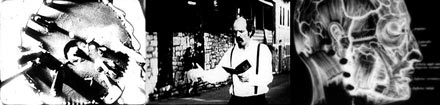
microcinema.com, bless their independent distributor socks, have been amassing a gigantic collection of experimental DVDs for distribution and recently added a triple-disc set of Joel’s work to their swelling catalog. “Joel Schlemowitz : short experimental films” gives what it suggests, 45 of them even, showcasing the scope and terrain of Joel’s work over the years. Definitely some room for improvement with the DVD authoring though – differences between the booklet and what appears on each disc, no easy menu that allows continuous play of all films, only a clumsy bottleneck of an interface to access each film and as it turned out on my copy – disc 3 containing all the same films as disc one, despite what was printed on it. But that’s not the point… that’s computer accountant land. We need the smell of a pine forest, a chimney with smoke rising out of it, homemade window sills, tool benches, vintage equipment, a film explorer’s den.
schlem2.jpg

Disco One : Short Experimental Films 1 Through 20

Some favourites?

Abrasions – a bound and blindfolded man stands before the camera, and the film of this event is slowly scratched to oblivion.

Bacchanale – Characters wearing masks, that moment before a party goes to another level. Warbling, perspective warping camera.

Bagatekke Biolique – A animated beating heart, various anatomical imagery filmed, and the film itself hand painted to create motion through a body, complete with sound effects.

Bagatlle in Neon – Playful long exposure explorations of city lights, then hand painted over with a soft limited palette. (Technicolour vibes! )

Doris’ Garden – A baby’s voice wandering, a song. Buddhist garden statues and images baby superimposed over explorations into a near junglish backyard.

Extemporized – Wild camera movement wandering in a city of snow, sound effects added to suit mime artists who are performing in various parts of the city.

Eye Music – Silent film zooming in on an old turntable, using hand-painted splashes to convey the sonic scratch of the jumping needle.

schlem1.jpg

Disc 2 – Short Experimental Films 21 through 40

Invitation to a Voyage – fast overlaid shapes elegant silhouettes extravagant fonts… solarised image of a naked man… zoom in…

slowly avalanching sound… curious little piece.. exactly what should be found somewhere on an experimental video compilation.

Little Nothings – poem by Wanda Phipps.. nicely overlaid footage, on top of the poet reading her work… reaching for cinepoetry…

Morris Engel Time Sculpture – gorgeous close-ups of weird timepieces… visual aesthetics associated with that weird human trait of measuring time.
the closer we zoom in, the louder the sounds get, until finally we zoom out, sound softens, and the piece’s time has run out.

Pillowbook – Black and white scene. the book is opened – we get red tinted flickery imagery suggesting entangled limbs, skin sliding over skin, panning vertically fast, images overlaid densely enough so that what feels lurid and pornographic, is also able to wash over the eyes like some gentle breeze.

Poem for the Past – Film strips twisted, decayed, overlaid

Purple Candle Poem – colour painted film, scratches, overlaid on footage of candles… lot more compelling than that suggests… flair for composition, motion… colour control… limited palette…

Reverie – more candles, statues in candlelight, old classical nude drawings given a perspective warping… offset by exotic string and percussion instruments in an echo chamber.. a hand, a desk, spectacles..

Silo – time lapse… of people at some filmic event, old projection systems, complete with burnt holes in film, accompanied by various laptop noodlers, guitarists… hey look – its an audiovisual happening… lying in the grass, the vividness of the colours in the outdoor projections are flanked deliciously by the silhouetted tree branches…

übel – fast flickering overlays of machinery turned abstract – metal scraping sounds in background hypnotic in their choreography over time… a pendulum of light playing on machinery to form shapeshifting shadows… shapes blended in.

Disc 3 – Collaborations and Experimental Documentaries – sounded interesting in theory, but in practice, turned out to contain the same data as disc one, which is a shame, because one of the shorts, Teslamania, like all good films exploring the aesthetics of tesla coils and violent bursts of electricity probably deserve a good viewing.

Close the door, leave the shed, the cine-laboratory concoctions still bubbling away, smell the air, blink anew at the world and wander away. And if you want to hi-5 Joel..

Performing with DFUSE (UK) on Thu @ ACMI

Monday, March 24th, 2008

surface.jpg

Have been wandering about with London media collective D-Fuse over the last few days in Melbourne, in the lead-up to a live performance this Thursday, that has DFUSE and local artists exploring video about Melbourne in part of a larger work about cities across East Asia. Reviewed the ‘VJ : audio-visual art + VJ culture’ book by Michael Faulkner from DFUSE sometime ago, so it’s been pretty fun to meet up and see some of their process. Should be an interesting ( + free! ) dual-screen gig:

Surface, live performance by D-Fuse

Thursday 27 March, 9pm BMW Edge, Federation Square

Also related on Sunday :

Onedotzero Graphic Cities film screening, a collection of short films curated by UK digital producers onedotzero, which compare and contrast urban futures in real and imagined cities, and Re-Imagining the City panel discussion with UK creatives Shane Walter (onedotzero Director), Barney Steel (D-Fuse), and Australia’s Marcus Westbury (This Is Not Art festival director, writer and media maker).

Sunday 30 March 3pm onwards, ACMI Cinemas

All Free but tickets required + available on the day from the ACMI Box Office.

Wolves, People in Tokyo

Wednesday, March 19th, 2008

Another round-up of visual treats. Some with fangs.

Recent Work From Soda Jerk

Following on from their epic, feature length, I mean really, epic, compositing job in Pixel Pirates II, Soda Jerk have made a couple of shorts that again transcend most mash-ups with their pro-level recompositing of characters into various scenes. ‘Picnic at Wolf Creek’ ( as you may guess ) combines a whole swagger of iconic Australian cinema ( guest stars : Mad Max, Steve Irwin, Russell Crowe, Ned Kelly, Lindy Chamberlain, the drag queens from Priscilla Queen of the Desert, Skippy the Bush kangaroo and a few high school girls at Hanging Rock. Some greatly combined scenes here. More details and pics at the Soda Jerk HQ.
picnicwolf.jpg

Astro Black: A History of Hip-Hop [episode 1]kicks off a hopefully long running series about the intergalactic origins of hip-hop turntablism. I haven’t seen this one yet, but there was something about the way the blurb was batting it’s eyelids at me:

“Set in the Bronx in the mid seventies, this video remix kicks off with the alien abduction of the three pioneers of the hip-hop “old skool”: DJ Kool Herc, Grandmaster Flash and Afrika Baambattaa. Once on board the Mothership with Sun Ra and George Clinton, the three DJs are transported to Planet Rock where they are skilled in a secret alien technic – the scratch.”

Tokyo Streets

via microcinema.com

tokyo_streets.jpgIf the names Shibuya, Omote-Sando, Harajuku, Yoyogi, Shinjuku and Meguro light up neon-bells inside your head like some winning sequence in a Daft Punk poker machine, then it’s feasible this disc from fashionshow.ch will provide some amusement, and or satisfaction, in your life. The premise holds potential – a snapshot of life on the streets in one of the largest, densest and most colourful cities in the world, and given Tokyo’s range of crazy cosplay characters and weird-fashionites already well documented in the likes of the Fruits books / magazines, given the fact that well – it’s Tok-(e)-YO! – one of the world’s best examples of the future wedged firmly into the present, then surely, it’d be possible to edit together an exhilarating snapshot of super-sugoi critters wandering about in their natural terrain? Editing however, would suggest the makers had a range of decent footage to start off with, and some overarching threads / ideas or just flair for weaving this together. Unfortunately the DVD comes off as really flat – poorly shot ( not a sin in itself, but it doesn’t help the disc ), and badly edited – extended sequences of drab audiences looking on meekly at amusingly half-assed street-performers, a few random camera wanders past colourful characters, some live bands on the street, dreary pan and tilts over up-market building facades, etc etc. There are a few nice sections, but it would’ve been vastly improved by being edited down to 5 or 10 minutes. Get your hands on the classy ‘Tokyo Noise’ feature length doco instead.

Ryuke

ryuke.jpgAlso from Tokyo, and the latest release from VJ label Light Rhythm Visuals, Ryuke provides a collection of works by native Tokyo pixelists VJ Reel and K-Mixx, a whirlwind of ‘experimental 3D animation and explorations of virtual space’ – a description which admittedly makes me feel queasy straight away – possibly limiting the disc to being another collection of motion graphics for some information technology current affairs program, with a little science fiction thrown in for good measure. As it turns out – only some of the disc is like that, the rest is densely packed with visual ideas and it’s nice to see Light Rhythm Visuals continue their tradition of including visual remixes on each disc, as well as keeping the discs region free and including quicktime clips ready for use within VJ software. The disc also loops without returning to the menu screen, savvily positioning the disc as a possibility for various venue owners or acknowledging that it can run continuously in the background occasionally provoking interest rather than needing to be watched all in one sitting. The stand out piece on the disc for me was the angle 2 remix by Kevlar of VJ Reel’s “illmatic chopper” – it playfully extended VJ Reel’s obsessive look at horizontal movements, adding plenty of innovative variations over time, used masks and black space fantastically, shifted to a tasteful 3D section ( ie – it wasn’t doing some generic object deconstruction / reconstruction, or moving camera around some mechanical 3D object ) and managed to be both beautiful and visually surprising. It helped I guess that VJ Reel’s original piece was quite strong, especially the nice overlayed silhouettes against the fast panning and chopped up horizontal movements.

Also worth a mention – the Ben Sheppee remix of K-mixx’s “Beautiful destruction”, taking the stock 3D disintegration to new places by nicely overlaying glitched masks and stripping back the palette to a less garish black, white and pink – simultaneously enhancing the effectiveness of various silhouettes blacking out portions of the screen. VJ Anyone’s remix of VJ Reel’s ‘gravith’ also has merit, with a wealth of fine edits and sophisticated compositing techniques on show – even exquisite in places, but the overall piece suffering by lapses into information age visual cliches and the addition of some unfortunate text that reeks of a transhuman bent that surely even sci-fi readers find hard to swallow today ( Advocating uploading of the human psyche to machines as a solution to global warming? C’mon … ). It’s an accomplished piece despite these shortcomings, but could’ve been that much stronger.

*sparkin’ it up

Thursday, March 13th, 2008

London’s audiovisual Howlin’ Wolf ( it’s a sideburn thing ), Toby Harris (aka *spark), has been steadily building strong live video performances since the turn of the century, exploring his real-time video skills at countless festivals, sophisticated audiovisual performances and most recently on giant touchscreen plasmas within motor shows. He also founded AVIT, the real world spin-off of vjforums.com that prompted festivals around the world, so it was a pleasure to meet him @ Sonar in Barcelona mid 2007, as well as get his reflections on audiovisual possibility. Lotta words to follow, but worth the read for the pixel-inclined…

What appeals about real-time video manipulation, about ‘live cinema’?

sparkx.jpgThe world is catching up with vjs in enjoying a spot of real-time video manipulation: just watch people using PhotoBooth on any modern Mac. It’s compulsive, it’s fun! That term ‘Live Cinema’ is something close to my heart though: I reckon you can specifically and deliberately combine a lot of whats good in established cinema and clubbing to give a completely new way of expressing yourself as a VJ-esque performer while engaging with audiences’s own creative thoughts. The key to it is an improvisational use of narrative, rather than forcing a fixed story down their throats, you could be a cinematic incarnation of the oral storytellers of old, weaving tales on the fly, or providing the scenarios and juxtapositions that people find themselves compulsively mapping their own narratives onto. Stepping back from that, I’m interested in anything that uses media to make people interact or think in unexpected ways, which has taken me from playing with the conventions of one-man theatre to storytelling installations. And the tools are really hotting up at the moment, things are getting interesting.

Describe the live show you’ve developed and have been playing at various festivals…

‘rbnesc’ is a project fusing cinema and live experimental visuals. Presenting a series of character scenarios, it invites the audience to construct narrative and cultural critique: rbnesc >> urban escape. So its about the urban condition; whats happening, the forces acting on it, whether we should be accepting it. Some of this is overt, such as pasting up provocative quotes, some of it you can’t miss, given my visual obsession with CCTV cameras (hard not to living in the UK) and some is for the audience to map their own actions and consequences from the loose narrative arc I present. I hope they wonder whether the escape in rbn_esc is a valid solution…

rbn_av__4x3.jpg

How does it come together technically ?

I use Ableton Live talking to Vidvox’s VDMX on a macbook pro, with two behringer control surfaces. It allows a sophisticated audio-visual mix, and a template for the performance means I can somewhat improvise the mixing while keeping it together as a whole. I’m really happy that we’re at a point where an ‘engine’ to churn it out in realtime is clearly achievable, but boil it down and its only semi-live, its far from my ideal of being that proverbial oral storyteller, drawing on an archive of memories to make something new every time. Still haven’t seen the kind of interface to be able to truly improvise a fresh take each time. Well, ironically enough, that is except at the cinema in films such as Minority Report.

If you can produce content and have an ear for a soundtrack, it really isn’t that difficult to make an audio-visual setup for yourself with a modern laptop that can quite adequately get you to a ‘semi-live, semi-meaningful’ state, akin to rbn_esc as-is. Get some kind of audio sequencer that you can program in the building blocks of a DJ mix and sound effects, load the shots of your ‘film’ into a vj program that can perform your editing and montage on the fly, and tie it all together with as much midi and ‘knobs and sliders’ as you see fit.

spark_avsetup_small.jpg

What lead you to dedicate such efforts exploring narrative within live video?

Even starting out as a VJ, I found myself dividing a night of club visuals into discrete sets, each with some kind of theme, playing with hook and flow. Then I got involved in a little theatre outfit, and we explored how my responsiveness onstage with laptop and camera could enhance the act of a stand-up storyteller. Soon enough, we were delving into tv-like documentary sections with b-roll footage edited live to the storyteller’s semi-improvisational speech, we were having the storyteller interact with pre-filmed snippets of his other characters, not to mention many a coup de théâtre switching live cameras with staged pre-recorded chunks… it was a fun time, and really showed the potential of live, improvisational audio-visual media.

What differences emerge from playing similar set of audiovisual material, as opposed to playing a similar set of music again?

You can listen to that cd seemingly ad-infinitum, but the dvd will only get a play or two. there’s just something different in the way we experience a film to music. i don’t have the answers here, but thats kinda the point: there’s space between these two forms and that’s what we’re exploring. it could be that the film’s devotion to a all-consuming narrative and its set up to deliver an exact experience to you as you watch it means it leaves nothing to interest you on a second viewing, or it could be that the visual image is literal rather than abstract and once you’ve seen it, well, you’ve seen it. at the moment, I can only perform one route through my live-cinema piece, and so i have to rely on fresh audiences – not so hard given its a niche entertainment form – but my next big project is about giving me the tools as a performer to truly start exploring this.

As though to prove the live video performer is not checking their email, you were involved with an innovative trade show presentation with large touch screen technology, can you explain that?

I was asked to work with a production company developing a vj installation to be used as a central attraction of a motor show stand. A groundbreaking project as a whole, working on three 65” touchscreen plasmas surrounded by the public was quite something. Imagination, the production company, created a bespoke application that allowed us to playlist content submitted from the public around us, which we then published and imported into the vj setup I created on the central screen. The real innovation though was in the project’s raison d’être: interacting with the audience to create films that embrace them, putting the audience up alongside the über-produced brand films playing on the mighty LED walls. For that, and for realising it was vjs who could make the magic there, Imagination deserve a lot of praise.

tobytouch2.jpg
tobytouch.jpg

How did it feel to VJ in that kind of spotlight?

We were making a five minute mix every twenty, all day, every day, in front of people who’d never seen anything like it. It was quite something, especially when they saw themselves on the six meter high led wall we were outputting to, or heard their voice booming over the stand’s PA. What really impressed me, was how working on that kind of surface really transforms the act of performance – arms flailing everywhere – and how an interface designed specially for it can really communicate to the public just what it is you’re doing.

Relentlessly, digital tools are making it easier to make music or video. Who are VJs producing work you admire, and why do they stand out?
– the Light Surgeons for so early on nailing the idea of an audio-visual performance broken out of the screen and into the fabric of the venue.
bauhouse for so perfectly realising what I see as the vj/av approach in their high-end ‘montage on the beat’ productions.
visualnaut, a good friend and collaborator over the years first with avit and then with narrative lab. Simply put, he’s a genius.

and I recently bumped back into ameoba, whose been trailblazing crazy-yet-superrefined a/v for years now. A welcome meeting, he’s a true original.

What attracts you to Quartz Composer?

If you look at a modern Mac desktop running Motion, you soon realise we’ve reached some kind of threshold in the development of all this realtime stuff: we can proverbially vj with after effects. Translating that to the realities of what you need as a performer, Vidvox’s VDMX combined with Quartz Composer seems the dream ticket. Still in beta, and with an interface that is yet far from streamlined, it does the magic trick of handing you the keys to the studio, where every bit of kit is free. Want another preview monitor? There you do sir. And if there’s some visual trick or bit of interactivity it can’t do, chances are you can make it yourself in quartz composer and it will load in as if it were coded by Vidvox themselves. At the high-end, thats pretty empowering. And if your needs are more specific still, you can take your “plug-in” QC knowledge and make native Mac apps yourself with a bare minimum of code, or if you’re willing to take the plunge (and its well worth it), then you’re extending QC itself with custom coded plug-ins or partnering QC based rendering engines with bespoke interfaces. If you’re on a PC and feel the ninja-fu, go immerse yourself in the world of VVVV. You won’t have the system-wide integration enabling things like VJ apps using it for plug-ins, but you’ll get a much richer environment to build your own castle with.

Video content and improvisational abilities are important for Vjs, but beyond those aspects, what ways have you enjoyed video artists involving themselves in simple or sophisticated ways within events / environments?

The ford project certainly grabs a handle on the future we were promised, where it isn’t just about ever bigger tvs broadcasting ever more channels with ever fancier graphics: its embracing of the audience through user-generated content and face-to-face interactivity really changes the relationship between media and the masses at events. The VJ set that was the most pleasant surprise to see last year was a beautifully simple operation from exyzt, who took a little wireless camera and ran around the clubspace and stage with it, always getting nice motion and feeding it into a framebuffer on a laptop, controlled by a playstation controller. So their performance was the two of them dancing, one with controller and one with camera, sampling and triggering on the fly and wiggling the joysticks to overlay graphics on the action. Fun and a consistent visual flow that fed the club back onto itself in the best way. As exyzt are a bunch of supertalented renegade architects with a string of huge installations and production pedigree to their name, it was doubly interesting to expect some mapped space super production and instead see something so simple. And of course, they hit the same theme of embracing the audience there.

What’d you learn from your AVIT experiences, and how do you feel about the global network of VJs today?

AVIT marked the moment in time when VJing transitioned from people-inventing-vjing-in-isolation to VJing being a recognised term and vjs being networked up in their home towns and beyond. Fuelled by the internet, there was a mounting pressure for VJs to meet each other and actually see VJ practice that wasn’t their own, and avit was one of the main releases for that: it started as the physical spin-off or incarnation of the then-new and skyrocketing vjforums.com. In the UK, three years after our first event we produced a week long symposium that really hit home to us that we’d met our objectives and the vj world was established: the work was good, the networks were in place, organisations were forming and taking up the baton. So now, for me, the focus has to be delivering on the potential of VJ practice, which means groundbreaking works, which means putting rocket boosters on interesting projects and talented people. Who and how, thats an interesting project, and a continuing one.

( below – rocking it old school VDMX stylee.. )

sparkvdmx.jpg

Francis Bear Vs Sylvester Stallone

Tuesday, March 4th, 2008

Well not quite, but a guest post by the author of Francis Bear*, Silent Army comic artist Gregory Mackay ( Francis Bear, Terminal, Syndrome, Morrisey Minor etc ), flexing his military-buff chops here to dissect Sylvester Stallone’s latest military entertainment fireworks. ( *Week in and week out, Francis Bear’s review of Scott McCloud’s Making Comics remains one of the most popular posts on skynoise. )

rambo.gif

The fourth film in the Rambo legend has a few, perhaps unintentional qualities which make the film more entertaining than first intended. As an action film the story is generally secondary but in this version of the Rambo myth, Rambo is redeemed back to his former self by enacting the will of a Christian organisation going to its doom in the jungles of Myanmar. Rambo once again employs his typical Green Beret load out from previous films. In this case however Stallone revisits the blacksmith qualities of Rambo, cut from previous films, to make a handy Machete from a truck leafspring. It reminds a little of the Jawbone of a donkey used by Samson to smite some heathens. The famous knife maker Gil Hibben, who was responsible for all previous Rambo knives, was also asked to create this new monstrosity. It takes a great craftsman; it seems, to turn to a lump of truck into a sharp Rambo lump of truck. Rambo also makes a handy propeller for his boat out of some rebar.

The film takes advantage of the Digital Intermediate process, which enables digital manipulation and colour grading before a negative is printed. The cinematographer takes full advantage of this method showing of skills he learned on the Martin Short masterpiece “Jiminy Glick in Lalawood”.

In interview Stallone has remarked on the subtlety of the Christian overtones of this film. The crucifix hanging from his wrist as he performs the last rites of the heathen with a 50 calibre machine gun is about as subtle as you can get. Also rescuing a bunch of peace loving missionaries from themselves is also pretty righteous, as long as you have a bow and arrow. Why does Rambo carry a bow anyhow? In particular a Hoyt recurve bow. Firstly the fisherman angle of hunting fishes out of the river, secondly the silent a deadly state-trained mass murderer angle. The bow does not reveal your position to the enemy and nothing says ‘situation pear-shaped’ like an arrow in the head.

One thing really intrigues me about this film. The evil militia are forcibly recruiting soldiers from the villagers the missionaries are trying to brainwash. Rambo then has to save the Missionaries and villagers from the assaulting evil militia. This means that Rambo is in fact killing the villagers who are working against their will for the militia, and is indirectly performing the ethnic cleansing the militia has been tasked to complete. Thus the moral fibre of the enemy is reversed, they look like militia but are mostly villagers forced to be such, sort of a ‘reverse terrorist’ or unwilling combatant. This makes Rambo’s twilight world of post traumatic stress a little easier to understand as he attempts to redeem himself as some kind of righteous warrior in an obviously confusing scenario. It also helps that the evil militiamen’s commander is a paedophile and must be killed! The use of large calibre rifles and machine guns is also interesting. The film is rated R in Australia because of limbs and heads flying off after the catastrophic attentions of a Rambo commandeered Browning M2 machine gun. The realistic effect of these weapons is more disturbing than simple limb and torso detachment widely seen in the film. In reality bodies in contact with this type of high energy round are dispersed rather like gel or other similarly dense liquid. A bullet like this passing close to you carries enough energy to kill you, mostly from pulmonary barotrauma (exploding lungs). Limbs flying off are far more ‘Rambo’ then someone simply disintegrating or dropping dead.

Made under protection in Thailand from the Thai army, the film borrows heavily from the plight of the entirely underrated Free Burma Rangers who it is said inspired the movie. The first minute of the film is filmed by the FBR in Burma. The FBR is kind of represented in the movie as the rebels who show up now and again in the film somehow attached to the plight of the missionaries and generally saving the day. A great Rambo flashback is also incorporated into the early stages of the film with the use of an unused alternate ending from First Blood where Rambo is killed by his creator Col. Trautmen.

The film ends with a five minute continuous take of Rambo walking along a country road and disappearing into a far off building presumably to be meet his dad; it’s pretty much a shot of grass growing, unless you’re distracted by the credits. It represents a kind of fin de siècle for the Rambo legend with Rambo finally getting to where he was going to before Brian Dennehy pissed him off in the first movie. Stallone however will now go on to write and direct his next feature ‘Poe’ about the great and varied life of Edgar Allen Poe (no machine guns) (( Apparently this is true – jp ))

**

( Am inserting obligatory reference to Rambo death chart here, in which the “Woody Hayes Chair of National Security Studies at Ohio University” neatly maps the evolution in violence across the Rambo franchise. In short – everything increases exponentially, except for the number of men killed by Rambo wearing no shirt ( decreases dramatically ), and the number of Rambo sex scenes – a steady zero. )