
Archive for October, 2007

i3L - iPhone as Wireless Touchscreen Midi Controller

Wednesday, October 31st, 2007

Aside from it’s wii-like accelerametor ( movement gestures as data for controlling software ), the iPhone’s touchscreen interface and hard-drive with internal operating system, makes it a potentially awesome device for manipulating software. Say hello then, to the i3L MIDI BRIDGE for the iPhone by artificialeyes.tv, software developed to work with their upcoming 3D software 3L (‘thrill’). Software that translates the sliding and pressing on the touchscreen into midi information, which is sent wirelessly to a small piece of software on the desktop, which in turn can be routed to the software application of your choice. In my case below, this was VDMX. Is it fun to use? Hell yeah!

Though they developed it to work on their upcoming app, full credit to artificialeyes.tv for releasing it as freeware to work with any software. More details and download over at artificialeyes.tv.
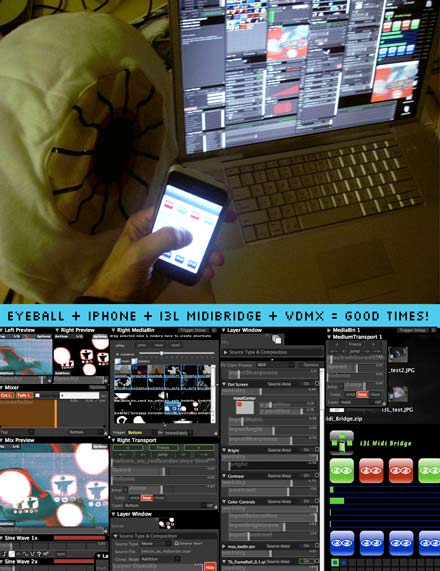
iphonevdmx

Jean Poole’s International Month of Gear Testing

Tuesday, October 30th, 2007

Seem to have found myself at the sticky centre of some kind of reverse-big-bang for video controllers. I wake up covered in cables, each footstep to breakfast triggers all kinds of devices, and there’s some kind of gravitational force that keeps sucking even gadgets into the orbit. And so, finding myself in the heart-lab of artificialeyes.tv, figured this way a unique opportunity to test and compare some of this gear side by side. I’ll be trying to get a small review up of each of these over the next month, “or so”.

gear
1 – Canon XL1 video camera

2 – Canon XL-1 wide angle lens

3 – Synesthete custom stompbox w/ Doepfer Pocket Electronic guts

4 – Superaon 6” LCD preview monitor

5 – Camera – Fuji FinePix S2 Pro w/ Nikkor 14mm Wide Angle lens

6 – Camera – Nikon D70S w/ Nikkor 12-24 mm Wide Angle lens

7 – GPS Unit – Garmin GPSmap 60CSx

8 – Edirol V-4 with a Vestax CF-PCV optical cross fader mod

9 – Korg KAOSS PAD entrancer

10 – NYKO Air Flow EX joystick

11 – Korg KAOSS PAD

11.5 – Alesis Photon X25 Midi controller

12 – JLCooper CS-32 MIDI controller

13 – Canon Digital IXUS 850 IS

14 – Evolution UC-33 midi controller

15 – M-Audio Trigger Finger midi controller

16 – Edirol V4 video mixer

17 – 60Gb 5th gen iPod (Video)

18 – M-Audio MicroTrack recorder

19 – iPhone

20 – uDMX – USB to DMX cable

21 – MidiMan MidiSport 2×2

22-23 – M-Audio Mid-Air transmitter and receiver

24 – Wii Remote controller

25 – Korg microKONTROL

26 – Codanova VMX VJ midi controller

27 – Vixid VJX16-4 video mixer

28 – Canopus ADVC-110 Video A to D convertor

29 – VMS VMU-5 with NEC LT-35 Projector attached, controlled by DMX

3L software by artificialeyes.tv

Monday, October 29th, 2007

Aye, my Istanbul hosts are getting close to releasing their quite rad and ground-breaking real-time 3D software, 3L (aka Thrill). It’s caffeine-o-clock as bugs are ironed out, features are refined and interfaces re-jigged. An OS X beastie, it harnesses the 3D power within recent graphics cards to provide a modular, realtime 3D environment. Inside this, multiple objects can be positioned and moved around, as can the camera position, or the whole scene itself. Video textures can be composited as backgrounds or on objects, effects can be applied to textures or the final output. And it’s all happening in real-time, super-fast frame rates and with plenty of depth to explore.

Unique to the program is a cleverly coded and killer capacity to record your real-time experiments at full DV resolution – eg 720×576 pixels for DV-PAL. Play, manipulate, refine, record. Like most contemporary VJ software it also comes with a full range of adjustible sliders, each controllable by mouse input, audio analysis or a large range of oscillators and maths functions. It’s the well thought through detail with a lot of these though, that makes the software quite powerful. And sequencer modules. And a module for controlling those VMS ( video mirror systems that allow the projected image to move around the room ). And lots, lots more, ( wonderful capacities to interpolate between various complex sets of parameters, wet and dry FX levels for R,G and B etc etc etc ), but that’ll come in a later review – this is just a note to say there’s something on the way. 3D graphics fiends who give good constructive feedback are highly encouraged to bug AE into putting them on their 3L Beta-testing list, muchos recommendo.

3L

Curse Ov Dialect and Emile Zile in Istanbul

Monday, October 29th, 2007

curse ov dialect

Australian hiphop in the Turkish hood, reprazent! Esp those in freak-folk costumery, on crazy-dense Euro-tours with resident VJ on stage chopping up clips and playing video files of tour-absent DJs scratching their vinyl riffs! myspaz/thecurseovdialect has music and throwing the name into youtube brings a scattering of this latest X-continental dash. Interestingly their VJ, Emile Zile, was running the back-up music through the VDMX software, and out through a soundcard. Which worked especially fine on the videoclips of pre-composed scratching. As always, the stage couldn’t hold the Curse MCs, who sprang around both Istanbul venues they played at like the hyperactive Mad Max pixies, they really are. Look forward to seeing them develop further synchronised AV material. Good times.

United, Visual, Artists in Istanbul

Friday, October 26th, 2007

uva

Best known for their Massive Attack concert visuals, UK’s UVA were recently gifted the chance to provide some opening night light and sound at Santra Istanbul, a major new contemporary art museum ( and accompanying energy museum ) set in a sequence of multi-storey buildings that were once upon a time, a crackling power plant for the region. Lots of that electricity making infrastructure has been kept in place, both inside and outside the buildings, a ripe canvas for the prominent lighting and graphics crew to do their thing.

And so, light and colour sequences were introduced, the building being lit up inside and out, the light sequences gradually becoming more complex ( choreographed by UVA’s custom software ). The large outdoor sound system was finely milked by Jude Greenaway ( who often does music with The Light Surgeons – who btw – have a new project related blog rolling along… New Adventures in Folklore), and finally high-powered video projectors were added to the mix, with a blend of archival footage relating to the site, abstract graphics and at the climax a series of video sequences custom made to fit exactly, then oscillate between certain sections of the architecture. Almost over before it started, it was a smooth display, but lacking some magic to carry their reputation as far as previous projects have. Apparently the system will be a permanent installation however, able to be utilised in various ways for different events. A recent UVA interview highlights their greatest hits of late ( with video links), alongside good insights into their processes.

Monolake Atlantic Wave Balloons

Thursday, October 25th, 2007

Monolake plays Istanbul with The Field soon enough, and a quick visit to his page shows plenty of busy projects extending his music ( & Ableton Live involvements etc ). First up, he’s been writing “small max + jitter patches.. to create interesting video for my monolake concerts. The complexity is low, but all is generated in real time and constantly morphing, which is a very different asthetic than the usual live mixing of pre prepared video footage. but faster laptops will allow more complexity and higher resolution in the future.”
monolake

Screenshots look simple indeed, but undoubtedly match well the vast number of sonic parameters he relentlessly tweaks live. The Atlantic Waves project also features a heavy visual component, being a networked sequencing project that allows online remote jamming, and an intricate, stylised interface which allows audiences to see ( guess at?) the processes being played with. Most interesting though, is Monolake’s recent Atom performances – where balloons are arranged in a grid and connected to tubes that allow them to be filled with certain amounts of helium. The balloons also have LED lights inside, which can vary the brightness of the balloon. The end result is a computer controlled three dimensional display that can shuffle between arrangements in time with the soundscapes being triggered. The gallery of photos look great.
monolakeballoons

UPDATE:

Greg Smith points out in the comments, this related Monolake interview :

“VT: ‘How does visual representation of sound (i.e. waveform editors) changes our perception of it?’

RH: Visual representation of sound is evil. A waveform editor is an enormous help when editing sound but at the same time it has the potential to keep the composer effectively from listening. The visualization by nature stresses the abstract formal quality of a work but makes no statement about its content. The result is obvious, a lot of music these days works correctly according to a formal scheme but lacks beauty within. It takes quite some courage to work against the visual scheme, because oddly structured parts look so wrong. The timeline always tells us how long a piece is in bars or seconds but it knows nothing about our perception of time. We might think a part is too long because it looks long on screen but in fact it is interesting enough to be much longer and we would not shorten it if we could not see it but just listened. I often turn off the screen or close my eyes when listening to my edits because the visual representation is a false friend.”

Music For Hatters - Mad-EP

Friday, October 19th, 2007

Point a big X-Ray machine at all the connected rabbit holes of Matthew Peters, and you’ll find the following scampering skeletons : Mad/EQ ( glitch/hiphop with MC ), the Manhattan Gimp Project ( plays cello ), the Psychasthenia Society ( live audiovisual theatre & storytelling trio ), and the stuttery honey of Mad-EP. There are trapeze artists, breakdancers and movie soundtracks lurking in there somewhere too, but this’ll have to do for this week.

What kind of processes do you enjoy for creating music (live or studio) with your current tools/instruments?

madepCurrent composition studio is pretty basic – an old G4 tower, still running OS9. No outboard gear, just a couple MIDI controllers for VSTi’s or to perform live (using an iBook & Ableton Live in OSX). Am constantly recording with my microphone and minidisk – grabbing as many sounds as I can to chop up and blend with others to create my own. Also like to create my own physical instruments – but so far, most’ve been for sound sources rather for performing in real-time (that’s the next step!)

Sometimes I have melodic or chordal ideas that I want to turn into a piece, but usually the inspiration comes from creating & sculpting the sounds. Once I have the right palette of sounds, the music just plays itself out in my head and it is a race for my hands to keep up, arranging it all in a sequencer. Once I have a rough sketch, I just keep refining and reworking till it matches the original idea in my head.

How are software and hardware transforming the ways traditional instruments are being played?

Well they’re certainly transforming the way music is composed for those instruments. With the current ease of micro-editing, one almost doesn’t need to have much more than a couple 1-note samples of an instrument. By re-pitching and arranging, phrases can be assembled that had never been played at all. I can play piano pretty well, but I haven’t owned a piano in years, so I found some single note samples from a few different models of grand pianos, re-pitched them into as many different notes as I needed, and created my own chord progressions and melody lines. This technique also allows me to create melodies from instruments I don’t play. It doesn’t however, create phrases natural to a true player of an instrument. There can be both pro’s & con’s to that, but it does offer a new level of freedom to the composer without being confined to the limitations of an instrument (or instrumentalist).

The Psychasthenia Society blended theatrical productions of storytelling, video, and live music – what was interesting / challenging for you within this?

I was first interested because Jon Brunelle was ‘sampling’ movies to help tell his story the same way that I sample musical notes to help create my music. Dan Vatsky’s live video work and my sound helped create a new way of telling multimedia stories – but really, it wouldn’t be what it was without Jon’s stories. At the final night of our month-long residency at the Collective:Unconscious theatre, after at least a hundred hours of rehearsals and several performances, I was still laughing at all the jokes because it’s just so funny. He is the DJ Shadow of video-sampling – always getting the very best one that is so perfect, you have to remind yourself it wasn’t originally created for his purpose.

It was challenging because in addition to technical issues, the three of us were constantly rotating between primary & secondary roles, so it was a delicate choreography of sight and sound. I told Jon and Dan it reminded me very much of playing in a string quartet – and considered our performances to be a new form of chamber music.

How well did it operate live (and who steered)?

I think it worked quite well – especially because the 3 of us rehearsed quite thoroughly. Before our month-long residency at the Collective:Unconscious theatre, we rehearsed a few times per week for several months in preparation. It paid off though – we played to capacity crowds and it was really well received. Steering? Jon – his creation, he writes all the stories, and guides the performances with his narrations. However, there are always a few ‘audio/video jam sessions’ between Dan & I… and those are very collaborative. He and I bring our own ideas & preparations to the jam, but we also react to and bounce off each other very much.

What would you do differently in another AV project in the future?

I would much rather try to find a way for the three of us to continue collaborating across the new geographic distance rather than try to recreate it with different people. We are talking to some festivals and hoping to get involved on that circuit – and I think there is a future online for what we do, as well as in live settings.

What feels different when producing soundtracks to accompany video?

The main difference for me, is that when I write music to be listened to by itself, I still write it with the hopes that it will create images & feelings for the listener to lose themselves in – and with the addition of actual video, the weight isn’t purely on the music itself to create that experience. Subtleties can be even more delicate, and act as a support to the video (or vice versa). As long as the ideas aren’t completely contrary, a lot of give and take can be had between the video and the music.

Upcoming releases / events of interest for you?

My next full length CD is coming out in Dec on Ad Noiseam tentatively called “Bass.hed”. Also in December, am playing on an Ad Noiseam label showcase in Rotterdam, which will be coupled by a 12” compilation on NGM records. In 2008, I have a 12” with the Shadow Huntaz also coming out on Ad Noiseam, plus I’ve been working on a new CD for Hymen, a full length Manhattan Gimp Project album and a number of other projects.

Condoms, Microphones and The Death of Death

Friday, October 12th, 2007

Condoms on microphones, the Yangtze river dolphin, Douglas Adams, audiobooks & wondering what archaeologists in the future will think of this era.

Poker Machines in the Future

Measuring 5.6 on the richter scale, 1989 in Newcastle introduced many people to the idea that an earthquake was even possible on the East Coast of Australia. It was certainly news to my brain, which had instantly attributed the sudden shifting of the houses walls, to the neighbours next door, who who had been reversing a caravan into their driveway a short while ago. Rushing outside of that previously stable house, enabled the sight of everyone else on the street rushing outside of their previously stable houses. And the radio revealed this to be a Newcastle wide phenomenon, an actual earthquake, with all the fear and panic it brings. A few suburbs away, The Newcastle Workers club, a den of bad carpets, bad music and poker machines, was apparently the worst hit building, with many feared dead. In the end, the earthquake claimed 13 lives, and over 50,000 damaged buildings. Interestingly a US academic claimed in early 2007 that the Newcastle earthquake was probably set off by stress changes in the earth’s crust, after two centuries of coal mining. And the poker machines were not long without a home.

Douglas Adams @ The Newcastle Worker’s Club 1999

douglasadams
(the above photo is from one of Douglas’s many speaking engagements elsewhere )

The Hitchhiker’s Guide to the Galaxy is the main way people have encountered the absurd and deadly sharp wit of Douglas Adams. Like most absurd science fiction, his work also serves to interrogate the present, gently reminding us just how strange our behaviours and societal habits actually are. In conversation with Robyn Williams ( ABC’s champion science reporter ), and charming all at the revamped Workers Club, it became clear that the science fiction of Adams was built upon mountains of scientific reading, an incredibly broad knowledge of the sciences, and a relentlessly curious brain. And something about being a very, very funny man. When he died in 2001, Douglas Adams left behind a rich collection of fiction, and only one work of non-fiction, a meditation on death, or rather the ‘death of death’, a book exploring the threatened extinctions of many species.

Last Chance to See

last chancePublished in 1990, and co-authored by Mark Carwardine, this is a book that details the exploits of Douglas and Mark ( a zoologist ), as they travel the globe attempting to witness actual living examples – in the wild – of some of the world’s most prominent endangered species. Along the way, we learn about what makes each of those species unique, filtered by Adam’s eye for the absurd, and discover the factors contributing to the disappearance of each species. A kind of comedic thriller whodunnit – where humans are always the bad guys. The book is a great jolting reminder of the biodiversity that exists beyond our urban centres, and the escalating threats our footprints are placing on species everywhere. Threatened species I remembered most from the book was the Yangtze river dolphin, because of the BBC audio recorder’s technique for trying to record that dolphin – placing a condom over a microphone, thereby allowing the recording of underwater sounds. As it turns out, there’s an audiobook torrent for this floating around online, read by Douglas himself, the storytelling humour amplified even more by his rich, comedic delivery. And supposedly, a follow-up TV series is due in 2008. This will unfortunately feature no new footage of the Yangtze river dolphin, as in August this year, this species was declared to be extinct.

Distinctly Extinct

And so, the Yangtze river dolphin can die no more, a fate that happens to many species over time. What disturbs in 2007 thought, is the rate at which species are being wiped out, forever. Archaeologists and biological historians point to five eras of mass extinctions during the earth’s history, and many scientists argue that the current rate of extinctions sees us on the cusp of a sixth era of mass extinction. Time will tell.

Honey For Eyeballs

Monday, October 8th, 2007

Visual curators and connoisseurs abound on ze web, scraping together ‘news services’ for the wow brain. A few faves of late below.

Dark Roasted Blend(.com)
Presumably takes a special breed of hyper-caffeinated noodler to maintain this kinda relentless flow of delicious. On a given day, spectacular cloud formations, bizarre roadsign collections, an amphibious cars photo series, and it was worth subscribing for one picture alone this week – a photo of someone dressed up as a robot holding a cup for spare change and a sign that reads “Replaced by CGI, please help”.
darkroast

Generator.x: Generative strategies in art & design
Evolutionary architecture, interface exploration, interactive design, snapshots and provocations related to generative art. Thumbs up.
generatorx

Suzanne G
Squirrels, squids, and not for the squeamish. Victorian era delicacies slipped into a macabre sci-fi blender. A browse of the archives will reveal cuteness and blood in equal measure, an animal kingdom perverted, mechanical oddities, regular snapshots of gorgeous contemporary art, and ultimately, the very quirky yet refined tastes of 1 x Suzanne G.
suzanneg

Ektopia
Hiphop and grafitti flavoured filter for all things visual. This might be a plastic toy design, an album cover, a Japanese robot, street art in South America, or whatever else tickles at the time.
ektopia

notcot.org
Bit heavy on the fashion/gadget stakes, but the sheer volume of links inevitably unveils a daily wonder.
notcot

Diburtimentos
Ongoing sketches uploaded for others to goggle at – whimisical, perverse, improbable.
dib

VADE
New York based VJ who regularly posts video snippets of his max patch experiments, and recently linked to an eyebeam video interview where he discusses his process.
vade

The Perry Bible Fellowship
Nicholas Gurewitch brings the absurd pen and ink noise webside with weekly comics including such hits as ‘Boy Scout Condom badge, The Dreamcatcher 3000, & trampoline hero.
perrybible

Activate Comics Collective
Rad collection of weekly updated comics by a rad crew, including Dan Goldman of ‘Kelly’ and ‘Shooting War’ fame. We’re talking a dozen or so fine comics updated everyweek in the one convenient location. Bellisimo!
activate

ffffound

Discovered this recently via kottke, and it’s a pretty addictive eyeball fix, each click taking to another array of related imagery. Some social-web functions as well, can get lost in here. Wonder if sites like this will be made redundant to some extent when digg.com finally launches it’s image ranking functions.

ffffound

Would Subscribe In a Heartbeat
To : a sketchbook by runwrake.com.
To : an extension of the stupendous Leviathan comic by Peter Blegvad.
To: a blog of dream cartoons by Aleksandar Zograf, a Serbian cartoonist with a unique capacity to capture and transmit his vivid dreamlife.
And you have to like someone who has work in an exhibition titled POOR IS A COUNTRY THAT NEEDS SUPERHEROES TO SAVE IT.

( Prefer real life superheroes? Welcome some of these people into your life. )

Dairy Shout Outs :

cheese

Or, last night a slab of cheese saved my life, buon giorno : ‘mozzerella de bufala‘.