
Archive for March, 2007

Quartonian Visuals

Saturday, March 17th, 2007

roger bolton

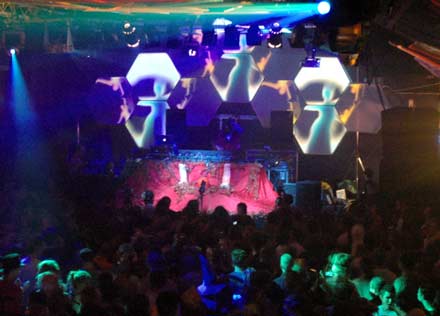
Visual FX veteran, software developer, VJ and live audiovisualist Roger Bolton ( www.quartonian.net, www.inside-us-all.com )
is playing a 1 hour live AV set in Melbourne soon ( Thu 22 Mar @ Plug n Play Melbourne, 201 Smith st, Fitzroy 8-11pm, alongside Burbage and sdzeit ), and took time out in between gigs to email these replies:

>What differences do u enjoy about studio work vs real-time performed visuals ?

I was attracted to visual effects by the desire to see my name on the credits of big budget feature films. I achieved that in a few years but found the actual creative opportunities offered on big budget productions are very few for the average visual effects artist. You are creating work to someone else’s brief, your work might get seen by millions of people but the brief has come through a committee of producers and supervisors. Sometimes it takes weeks for the director to see your work, then you make a tiny change and wait and wait again. Sometimes a shot thats on screen for three seconds in a film takes up several months of your life, you get sick of the sight of it.

Live visuals allow more creative input and immediate response from the audience. I can create a new combination of images, put it on screen straight away and then see how people react. It’s very exciting to have so much immediacy.

What sort of work were you doing on Lord of the Rings?

Digital Compositing – lots of the shots where the actors were digitally shrunk so that the hobbit actors looked small compared to the other people. I also created several of the shots where the flames roll across the ring during the Council of Elrond. The strangest thing I had to do was removing an Orc’s underpants. The actor was wearing white underpants and when he raised his leg to kick a door down you could see them clearly on the screen under his loin cloth, I had to darken it down so you couldn’t see them.

>What do you enjoy about the software Flame and Shake?

That I get paid to use them? They’re just tools to create imagery, I’ll happily use any software to get a job done. Flame used to dominate the high end post production field so anyone who knew it could get lots of work. Nowadays the desktop software from Adobe and Apple is just as good if you have enough time. It’s more about the pictures you create rather than which tools you know.

>What does the group Inside-Us-All do?

Inside-Us-All is firstly a VJ and video activism collective, but we always try and put the emphasis on designing the whole space, not just creating visuals. The core team is myself Roger Bolton, video artist and techie, Mark Calvert, networker extraordinaire and designer, Ralph Lambert, camera and editing and Dave Green, VJ, 3d artist and programmer. There’s another eight people with skills from stills photography to rigging which we bring in on larger productions. We work very closely with promoters a long time before the event to create custom screen shapes and to work the video design into the decor. We’re now expanding to take on more styles of video installation work under the Pixel Addicts umbrella.

>How did your live AV-set develop / come about?

Would you believe that a Himalayan Griffin told me to do it? I was in India in November of 2005 and rode an old enfield motorcycle alone up to the top of the Rohtang La pass, 4100 meters high and on the road from Manali to Leh. I was watching the huge birds of prey circle high above me and thinking about how I could use my skills to make a difference in the world. That’s when I had the idea to come back to India and try to make a VJ piece about the plight of Tibetan Refugee’s who have lost their country and their culture. I went back to the UK and gave a proposal to the other guys in Inside-Us-All and they were blown away. Six months later we returned to India and shot video for a month in Ladakh and Daram Sala. Three months of editing later we had a one hour HD audio visual piece. It premiered at Synergy Project in Londdon in November last year and we have several bookings at major festivals for this European summer. Each time we show the piece we also have information from local Tibetan groups and give a portion of our fee to Tibet Relief UK.

>With your perspective, what is good about current VJ performances?

Technology doesn’t limit you anymore, a laptop can create real time effects which are close to what’s done in post production suites. What excites me the most now is AV performance’s, or performances where the DJ and VJ are working very closely together to communicate something to the audience. I don’t enjoy watching VJ’s who are just colourful wallpaper, no matter how well it’s designed. I want to see some sort of symbolism or meaning there.

>What’s special about Quartz Composer, and where do you see it developing?

Quartz Composer started out as a cool little VJ toy called PixelShox several years ago. It was very, very fast and quite powerful. Apple employed the programmer and built his VJ toy into Quick Time, so every single program on a mac can play back interactive video loops. I’ve used Quartz Composer to make a lot of custom VJ tools, including one which makes animations from still images and text. This sort of custom tool lets me have a different visual style that stands out from other VJ’s who only use standard programs like Resolume. Apple’s putting a whole bunch of new features into Quartz Composer into Leopard but I can’t talk about them yet, I’m an Apple developer under NDA. But trust me it’s getting even better.

Book Of Imaginary Media

Thursday, March 8th, 2007

Review of a book of a festival of a brain-tickling idea.

“The goal of science and the arts, and of education must be to decipher, not the genetic code, but the perceptual code,”

Marshall & Eric McLuhan, ‘Laws of media : The New Science’

as quoted in ‘Book Of Imaginary Media‘.

blegvad

It’s a tricky question to answer – how do our current media and communication technologies alter the ways we perceive the world and each other? Coming at that from an unusual angle in 2004, was the Amsterdam festival : “An Archeology of Imaginary media”, which sought to explore ‘Imaginary media of past, present and future hoping to glean some insight into our relationship with media. A range of talks happened, and a play written by Peter Blegvad was performed, both later to appear in a book with DVD companion. Which as it turns out, is quite an engaging read (& watch ) despite the seeming abstractness of it’s theme.

“All communities larger than primordial villages of face-to-face contact ( and perhaps even these ) are imagined.’ Communities are to be distinguished not by their falsity/genuineness, but by the style in which they are imagined,” points out the introduction, before further contexutalising ‘imaginary media’ : ‘like communities, all media are partly real and partly imagined. Without actual or imaginary characters, media cannot function’.

Imaginary Media, the book argues through a series of essays ( & DVD accompaniment), can encompass fictitious characters ( hello Sherlock Holmes), mythical beasts ( hello Pegasus ), the faded futurism of years gone by, and all manner of machines built to enhance or replace human interaction.
“Imaginary media may give rise to actual media, even when their final realization falls short of initial expectation. Media that were once imaginary may at some point become true. Imaginary media may also be sources of inspiration, in which case their effects might very well be felt and made manifest outside of the field of media itself.”

It’s a fun, provocative read, various authors exploring the book’s subtitle ‘Excavating the dream of the ultimate communication medium’ , with explorations of photographs of seances, a vinyl video player which plays back a video signal on a television set, Alfred Hitchcock’s Psycho distilled and blended down to one single frame, artificial intelligence as imagined early in the 20th century, Nikola Tesla’s plans for developing wireless transmission across the globe, a project that got well underway but was never completed, Thomas Edison’s early plans for a ‘psychic telephone’ that could communicate with the dead, Bruce Sterling’s ‘Dead Media Project’ where he collects dead media technologies… ( for more Bruce mythology, try his sci-fi novels, his viridian manifesto, or spimes ) and Roland Barthes comparing the eye contact he could still have with his mother via a photograph:
‘grasping the delayed light of a star, observing something in it’s course of it’s journey through time’.

DVDly Speaking

For those unfamiliar with the wondrous comicstrip and graphic novel, The Book Of Leviathan, remedy the situation via Amazon or however possible, muchos recommendos. Comic author of that greatness is Peter Blegvad, and he has a few comics on the DVD ( send your prayers faster and further with these patented flippers ), alongside comic authors such as Ben Katchor ( a large electronic eye with melancholy sensors, crying at an exhibition trade show ), Gary Panter and Aleksandar Zograf ( a new breed of plant was cultivated – sensitive to the mind of a dreamer. as a reaction to the close presence of a dreaming mind, the plant forms in one of its big leaves a temporary drawing like configuration that could be observed, photographed and analyzed as it sublimates the general mood of a dreaming consciousness… ).

Beyond these sequences of still pages though, is a 35 minute video by Peter Blegvad of a theatre piece made for the festival, titled ‘On Imaginary Media’, and dripping with his usual wit and esoteric wanderings. Speaking vegetables, a god-detector, Peter’s head as thatched house from which hatchlings emerge, virtual death goggles, mood enhancing military media and much narration, onstage action and occasional displayed quotes such as this future bumper sticker for VJs:

“It should be possible to project on a screen the image of any one object one conceives and make it visible,” Nikola Tesla

and:

“What is real is the life we lead when we lose ourselves, when we abandon or are driven from the rational fiction of our identity; when we fall in love, for example… “
– Michael Wood, the magicians doubts…

‘Book Of Imaginary Media’, Edited by Eric Kluitenberg, NAi Publishers.

Televisions And The Internets

Friday, March 2nd, 2007

Television and the internet keep rubbing each others legs under the table. What to make of it?

Back To Basics

With a near decade of hyping the ‘convergence of television and the internet’, including another wave of it recently ( youtube related speculations, Joost, Apple TV, Windows Media Centre etc ), it’s worth returning to some basic definitions. Television, as various dictionaries will reveal, is ‘the transmission and reception of moving image’. In the past this has meant a ‘one to many’ broadcast model, which has served those at the top of the media ownership pyramids very well. The internet however, as a vast ‘electronic network of computers’, is more suited to a ‘many to many’ model of distributing media. And the internet is increasingly where people prefer to find their media. Even television companies understand this, but prefer to keep everything within their own giant dedicated transmission and reception systems. A range of third-parties however, recognise that audiences want net-delivered content on demand and are clamouring to provide this. More on this below, but merely using the net to shift around large chunks of popular entertainment is only a fraction of what is becoming possible. The internet completely levels the playing field for ‘the transmission and reception of moving image’, and effectively allows anyone to become their own interactive television station.

The Third-Party TV Circus

First up – the timeshifters, who recognise that being forced to watch a television program only at one particular time, can only go the way of the dinosaurs. Which generally means dedicated recording hardware like the Tivo, which enables recording of television programs for playback at a time that suits. Software and a computer with a capture card can do the same thing ( see the range ). Then there is the Slingbox is known as a ‘placeshifter’, which records television to a hard-drive but lets you watch it remotely with a net connected computer.

Next we have the home media centres jostling for attention – windows media centre and the upcoming ‘apple tv’, which are essentially storage hard drives, but importantly are tied to related software which facilitates the download of purchased media, but also allows media files stored on a local computer to be played back in a central television environment. Nothing that can’t be done already, but riches perceived for those who can streamline the flow and become the dominant provider of media into the lounge room. It’ll happen, but nothing to get excited about.

“Media is changing from entertainment into utility. Media that can’t be manipulated is almost useless,” writes The Hollywood Reporter’s Steve Bryant,“Those tiny transactions I make online make a greater imprint on my psyche than any single media event inside a theater — or inside a DVD — could have. It’s simple reward/response psychology. Online, I can track who watches my clips, who reads my posts, who liked my mash-up. The Internet flatters us with attention in a way Hollywood no longer can.”

Most interesting are the recent various uses of internet technologies that focus on how software might better deliver television via the net, which means a whole bunch of other opportunities for both creators and audiences. The founders of phone software Skype have released Joost, a peer to peer based television delivery system which uses shared bandwidth of the users to help transfer high resolution images. Although focussed on delivering packaged media from major players, it also allows communication between viewers in chat channels that can be overlayed. No word on whether independent media will be able to utilise it. There are plenty of other options freely available though.

Transmitting Tonight

The difficulty and expense with publishing video online has traditionally been to do with popularity, bandwidth costs quickly soaring if a video becomes a viral hit and watched by millions. Today we can transcend this problem in two ways – firstly through the use of free hosting, there being over 200 different online video hosters competing for our uploads. Secondly, we can use peer to peer technology such as Bit Torrent to ensure that even a video file hosted on a small server can reach a large audience, because as the audience grows – it shares the downloading bandwidth between themselves. Broadcast Machine is free software which facilitates a relatively simple way to set this up. A step further along that path, Ning.com offers software which allows the creation, customization, and sharing of your very own you-tube style Social Network for free in seconds.

Great Reception

RSS – enables easy subscribing. This might be to a blog, an mp3 blog, a video blog, a news site, an Ebay auction or much much more. Totally worth understanding, and is what enables the applications below. Read more here.

www.fireant.tv – an application dedicated to subscription, downloading and watching of internet video.

www.getdemocracy.com – video playlists, subscribe to any video RSS feed, podcast, or video blog. Explore over 1,000 free channels with the built-in Channel Guide, download and save videos from YouTube, Google Video, Yahoo Video, and other sites, watch free HD videos in gorgeous fullscreen and easily download any BitTorrent file. Fast. Then watch it in the same app. Simple.

Hat tip to Mark Pesce, who writes well about the above terrain.