Sidebar Header

Sidebar Header

Sidebar Header

Sidebar Header

    My Doomsday Weapon

    jp | Interviews, Networks, distribution | Thursday, 20 May 2004

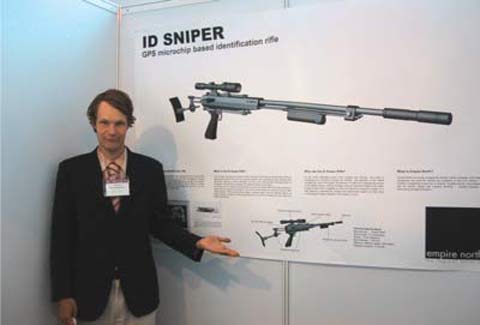
    Jakob S. Boeskov from downtown Copenhagen, Denmark – is a funny boy. Take his latest arts prankster turns weapons gangster project, now exhibiting in NY (http://events.thing.net). Jakob infiltrated an International Weapons fair at Bejing with a fake blueprint for an ID Sniper which ’shoots GPS (Global Positioning System) microchips into the bodies of innocent civilians, whose movements later could be followed by authorities via a GPS satellite system’. He documented the spooky scenes and reactions of the arms traders until he could take it no more, and if that effort impresses you at all, you should really make a little effort of your own to read his hilarious account of it all at www.jakobboeskov.com, or try his fictious weapons company www.empirenorth.dk.

    doomsday

    What’s your beef with surveillance buddy?
    It’s rude.

    Can you think of a situation where you’d like to have a GPS sniper rifle?
    Well, I already have one.

    How did the exhibition fare against your expectations?
    There was no people with people with patches over their eyes, it was not so James Bond like. It was just a bunch of people from around the world making shitloads of money from war and the fear of terrorism. Quite banal and therefore much more horrific. Boring people selling tanks is something that is truly a nightmare for me.

    What were you afraid of during your exhibition?
    To be revealed as a fraud. All the plainclothes policemen really stressed me out. But people treat you nice as long as they think you are a weapons dealer. Another concern was that they would eventually want to buy my weapon. And that happened. They basically asked how much money I needed. They really wanted this horrible piece of technology. When I went to New York I received endless emails from real weapon dealers who wanted to invest in the weapon. A huge american investment bank, Prudential, was also quite interested.

    Your choice of weapon if you had to kill someone – you know, like if you really had no choice?

    With a pen. Or a very sharp pencil.

    What surprised you about the people marketing new weapons of mass destruction?
    I didn’t meet any of them. To my knowledge, nuclear weapons are not sold at these fairs. Dupont chemical had a booth though, but i never had the time to chat with them.

    How scary is the Danish Defence industry?
    Well, they do stuff for the new Eurofighter plane. A company called Terma also did stuff for the F16. The Danish shipping company Maersk which is bigger than Coca Cola now, used to make guns for the occupying nazis. It’s really a myth that there is no weapons industry in Denmark.

    Other strange, horrific weapons you came across at the expo?
    Armed robots.

    How well do they fingerprint / interrogate ‘innocent civilians’ such as yourself, travelling to New York to exhibit your ‘project’?
    They took me straight to customs, because I had a model of the ID Sniper with me. They started to shout a bit, and said I was violating state law, but eventually they let me go. They forgot to fingerprint me.

    What do you think artists can learn from weapons manufacturers?
    To make money.

    Pure Data in the Tropics: Patrick King

    patrick king
    On each of the endless Big Fruit statues on the road to Brisvegas, there’s a tiny penguin etched on their sides. Carver unknown, but rumours include: dmotd aka d:void aka one Patrick King, long-time Linux enthusiast and audiovisual ecologist so well versed in the art of the accident, the Briz tow truck drivers all tune in on their CB radios. Patrick also enjoys walks on the beach, fragmented noise patterns and making machines that bite back. Bookmark the boy here: http://dmotd.bpweb.net/

    What’s your current live AV set-up and what do u do with it?
    I have 6 computers, all running Linux (gentoo + debian distributions).. mostly old P3’s and G3’s, old hardware is cheap. The total cpu + ram is equivalent to a new machine, but I don’t have a few grand floating about. I communicate between computers through a network – some process sound, others splice video or generate 3D + 2D graphics, and the rest are typically user-interfaces. Software wise I mostly use pure-data for audio + video, php + mysql for network interfacing and a few other programs and custom scripts – all open-source so it’s a relatively cheap setup.

    Benefits of Linux for AV?
    ‘Made by hackers, for hackers’, linux philosophically is at odds with proprietary operating systems, it’s user contributed, it’s free (as in speech and beer), comes in many forms and flavours and is fast, stable and usually won’t break without human error. Linux is an open-source operating system, meaning anyone in the know has access to guts of the software, and generally comes in bits like a meccano set – there are a lot of small programs and libraries that can be patched together to make larger programs. This is a major distinction from it’s competitors (asides from BSD), where one program has a thousand functions, of which you may only need three.

    Linux is packaged with thousands of bits of open-source software written by people worldwide.. it’s very eclectic and disorganized, so in theory there are thousands of ways that you could set up your computer for the same task. AV-wise there are standalone video editors, but also subsets of programs that may just splice video, or create a composite image etc.. it’s up to you to dictate how these subsets function. It’s very easy to have programs talk to each other, ie send audio signals between programs, send video streams over networks, or create interfaces in one program to influence another, which is how I’ve been operating my machines. Linux encourages thinking outside the square, and if you’re prepared to put the time into it you can create quite complex and personal results.

    Benefits of Pure Data for AV?
    Pure-data is a program designed and created by Miller Puckette, of max/msp fame. It’s cross-platform, open-source and is basically a redesign of max. Pure-data is a visual scripting language primarily designed for audio signal processing, there are thousands of user built extensions for PD that take it beyond audio into areas like video, 3D, physical modelling, complex algebra, hardware interfacing and networking, making it more of a general multimedia programming tool. It’s great for people that are visually minded, that want to create live multimedia works, but who lose the plot in line-by-line programming. It’s sort of like macromedia director in some ways, in that it gives you a great deal of control over many disparate elements. You could theoretically create anything that comes to mind, as long as you’ve got the processing power to compute and have the ability to describe things in symbols and numbers.

    What bores you about electronic music and multimedia these days?
    The limited palette that people use, structurally and stylistically nothing much changes between artists and we slip into a monotonous hole. For the most part electronic stuff generally builds upon its own history, and artists more or less are reliant on the talents of programmers to define their style. We have tools that could feasibly create sound and vision completely alien to anything on this planet, yet there seems little variation. I haven’t heard or seen much recently that breaks the presets and defines a whole new set of parameters. In some ways electronic experimentation ended in the fifties.. but there are numerous people who could prove me wrong.

    And video?
    Video still has the ability to excite me, it’s still a pretty fresh field, so I think there’s more leeway for experimentation.. as long as we don’t keep hitting the preset effects, there should be plenty of interesting stuff coming our direction.

    What are the learning curves like for linux though – say for the average PC user?
    Linux is by no means a complete out of the box studio. It’s got a long way to go before it has the maturity and interoperability of mac/win. It’s an excellent playground for inquisitive and intuitive people.. making the transition is relatively simple as long as you’re prepared for a thousand little changes that could potentially make you go insane.. so if you make your dollars on a computer, I’d strongly advise keeping your commercial O/S!! Linux is still a hobbyists O/S, but is becoming much more functional to use day-to-day. To check it out grab a copy of knoppix or dynebolic, which you just boot into from a cdrom, no installation necessary. A lot of the linux software is cross-platform, so there’s a good chance you can run open-source software on your windows or osx box.

    Best URLS for the LINUX curious?
    http://linux-sound.org
    http://www.linuxartist.org/
    Bootable cd’s: knoppix: www.knoppix.com, dynebolic: www.dynebolic.org
    Standard: mandrake: www.mandrakelinux.com, fedora: fedora.redhat.com, debian: www.debian.org, gentoo: www.gentoo.org
    Questions/docs/info: www.gnu.org, www.linuxquestions.org, www.tldp.org
    Pure-data: pure-data.iem.at