Chips, Flu, Hungry Cycling Wolves

Flippin Chips
CHIPFLIP is a new blog by Swedish 8-bit wunder-kid, Goto80 ( also “Extraboy, Susanne, 4D-Man, Skrubier, or other even sillier names”), where he aims to collect and discuss things regarding chip music and 8-bit art for an MA degree. “It’s about low tech visual and sonic creativity, not nostalgia.” In other words, lotsa links and projects to explore, downloads to be had, things to read. Which you’d expect from one of the boys behind the 365 songs project.

Sample post?
“8-bit noise music is not very common, which means that good 8-bit noise music doesn’t really have best of compilations (yet!). Maybe .. the certain particularities with a genre that make it so good, are quite tricky to reproduce with an old soundchip. Here are a few examples of 8-bit noise music I appreciate, and if you have more suggestions feel free to leave a harsh / random comment with maximum content. I must have left out a lot of gems, right?” (( post goes on to list extensive links ))

The sidebar sections are especially interesting, featuring extended sections on – plagiarism where artists have heavily sampled videogame use without acknowledging ( or paying ) the original artists, – timeline of chipmusic from 1951 ( in Sydney!) to today, – a how to section for emulating commodore 64’s with today’s machines, – and an exploration of chipmusic as medium, form and culture.

More Feathers in Your Life
Stunning sculptural feathery works, from the Frozen Mammoth.

Travel Bug vs Swine Flu?
The 1918 Pandemic flu, now that was big, carving a fair chunk out of the global population, right at the tail of world war one as well. AIDS? Also declared a pandemic. As of 2007, lived with by 33 million people worldwide and having killed 2.1 million. Swine flu? So far around 1000 people have been identified as infected, a much smaller number killed by it. Worryingly, it especially threatens the artistic population – as people cling to their bunkers with stocks of baked beans, travel prices inevitably come down, inevitably luring starving artists to other pastures, great for cross cultural dialogue an fertilisation, but maybe removing artists from the gene pool in a cruel twist on the viral media they hope to create. In other words : lots of my friends seem to be travelling to lots of far-flung places at the moment.

Hungry Like A Domesticated Wolf
Or How to Get Rid of Stuff : A guide to downsizing your belongings by Bruce Sterling. I first read this in 2008, but I found it in the back of my internet lounge again recently, and it jumped out more on a second browsing. Lots of fun in there, and extensions of these ideas :

– As long as I’ve got broadband, I’m perfectly at ease with the fact that my position on the planet’s surface is arbitrary.
– You need to re-think your relationship to material possessions in terms of things that occupy your time. The things that are physically closest to you. Time and space.
– The things that you use every day should be the best-designed things you can get.
– Sell – even give away– anything you never use.

Which maybe vindicates a recent decision to spend a fair bit of money getting my bicycle fixed, and upgraded in various ways at the same time. In other news, The Human Powered Cycle crew who did the job are starting up a cafe on 562 High st, Thornbury beside their shop, hopefully featuring muscly thighed boys and girls pedalling under desks to provide banana smoothies, grind coffee beans and the like.

Netlabel of the week? Acroplane, with free downloads including Mad EP’s ‘Twenty Four Breakbeats’, a composition project that started off to compose a breakbeat in every major and minor key. ( via Lucy Benson, who has a new blog )

by Sean Healy, May 15, 2009 0 comments
Biomimicry + Cradle To Cradle

Have been helping with a design course recently, and amongst other insights, it’s been interesting to see where ecology and design processes have been intersecting of late.

Biomimicry
Beyond just using natural materials to solve a design problem, advocates of biomimicry endeavour to learn how natural solutions and adaptations work, and think about how these processes could be applied to various design challenges. Some examples of this in action can be found at The Biomimicry Institute, who say “after 3.8 billion years of research and development, failures are fossils, and what surrounds us is the secret to survival.”

Kingfisher Efficiency
The Shinkansen Bullet Train of the West Japan Railway Company is the fastest train in the world, traveling 200 miles per hour. The problem? Noise. Air pressure changes produced large thunder claps every time the train emerged from a tunnel, causing residents one-quarter a mile away to complain. Modeling the front-end of the train after the beak of kingfishers, which dive from the air into bodies of water with very little splash to catch fish, resulted not only in a quieter train, but 15% less electricity use even while the train travels 10% faster.

Lotus Plant Cleaners

Lotus leaves are water repellent because the myriad crevices of its microscopically rough leaf surface trap a maze of air upon which water droplets float, so that the slightest breeze or tilt in the leaf causes balls of water to roll cleanly off, taking attached dirt particles with them. And so, microscopically rough surface additives have been introduced into a new generation of paint, glass, and fabric finishes, greatly reducing the need for chemical or laborious cleaning.

Humpback Whale Wind Power
The humpback whale’s surprising dexterity is due mainly to its flippers, which have large, irregular looking bumps called tubercules across their leading edges, which allows humpbacks to keep their “grip” on the water at sharper angles and turn tighter corners, even at low speeds. Wind tunnel tests have demonstrated the aerodynamic improvements tubercules make, and a company called WhalePower is applying these lessons to the design of wind turbines to increase their efficiency, while this natural technology also has enormous potential to improve the safety and performance of airplanes, fans, and more.

Inspiration of course also lies on the microscopic and chemical level, with many newly engineered materials mimicking the structure of natural materials. One holy grail in the field seems to be the relative strength of a spider web – apparently if a human sized spider was to make a web ( yet one which could fold up into the size of a tea chest – this would be strong enough to catch a jumbo jet at landing speed.

Cradle to Cradle
Biomimicry folk are also keen observers of the lack of waste in natural systems – in a working ecology, all components break-down and form something useful for others. Zooming on this, chemist Michael Braungart and architect William McDonough set about trying to change the way we produce and build. The film Waste=Food documents their inspiring efforts so far ( the hour long video is a heartening watch ). Core idea? “If waste would become food for the biosphere or the technosphere (all the technical products we make), produc­tion and consumption could become beneficial for the planet.” Inspiring to see the extent to which those such as Nike, Ford and other giant textile companies are keen to integrate these ideas where possible.

And a final eco-design shout-out to sci-fi author Bruce Sterling, whose Viridian Manifesto argues eco-design needs to be glamorous to succeed in winning people over. In relation to the cradle to cradle idea, and the consideration of the whole life cycle of a product, he is also famous for suggesting the idea of ‘SPIMES’ ( objects that can be tracked over space / time, a lot like RFID tags.. ), and what these kinds of tech advancements might mean for sustainable processes.

by Sean Healy, May 14, 2009 0 comments

Ableton Live 8 Review

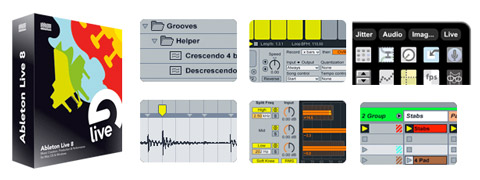
ableton live 8
Amazingly, the world’s population has grown by 500 million people since I reviewed Ableton Live 2 in 2002. And while each year brings a new version, it’s surely getting harder for Ableton(.com) to convince all these people that Live comes from the future, like it seemed to back at the start of the 21st century. Nowadays people just expect to be able to ‘extract grooves’, ‘deep freeze tracks’, ‘add pseudo warp markers’, and other sci-fi sounding techniques – all of which should work in real-time thanks. So whats’s a software company to do? Sometimes you just need to consolidate, and 2009 seems to be one of those years, Live 8 delivering a range of incremental adjustments, a couple of new effects here, a couple of new workflow enhancements there. The calm before the storm perhaps, when the release of ‘Max for Live’ takes us back to the dizzying multi-dimensional future ( Max for Live = full Max/MSP/Jitter functionality inside Ableton Live – including video synthesis and animation via Jitter objects ). Where were we?

Ableton Live 8
So what stands out as new?

I like the simple addition of Looper, a new audio effect modelled on people you’ve seen in a pub pressing their foot on a pedal, while they’ve layered beatboxing, violins, weird noises, singing and the like into a buzzing swarm of sound ( and if you’re needing a foot pedal for this, try a $10 DIY one).

There is a new warping engine which now allows a more intuitive manipulation of time markers, and adds a new complex warp mode, plus you can slice audio files to MIDI tracks based on transients. Also baked? A new groove functionality which allows subtle or extreme control timing controls on a per clip basis, including the sci-fi option of being able to extract grooves ( which get stored in a ‘groove pool’ for application onto other songs later ).

Being able to create crossfades between adjacent clips in arrangement view? That’s a win. Or a little victory at least.

Session view tracks can be easily grouped together, to allow easier control of many at once.

The interface comes with a zoom option – allowing nice customisation to suit the current screen being worked on, and preferred number of tracks visible.

Operator has a new waveform editor – draw your own waveforms, and there’s a new Vocoder.

Supports ogg vorbis and flac file formats now* ( for those seeking better sounding, less license restrictive formats than mp3 )(*at least it’s the first I’ve noticed that support)

The browser tab previews samples nicely now – showing a waveform for them, allowing them to be scrubbed, and giving the option of them playing back at native tempo, or matching the current tempo of the session being played.

Instruments and FX can now be copied and pasted with standard clipboard commands. ( That won’t excite the 500 million digital natives too much )

And supposedly all computing happens in the cloud these days, so it shouldn’t be no surprise that Live 8 comes with an option to upload your current set and media files to your area at the ableton mainframe, with options for sharing this publically or storing for private use.

What You’ll Need :
Cash – Ableton Live 8 (Download) EUR 349/USD 449
Australian Pricing : Ableton Live 8 RRP $999.99 Ableton Live 8 Suite RRP $1399.99
Enquires: ableton@musiclink.com.au Australian dealer listings

MachinesMac: 1.25 GHz G4/G5 or faster (Intel Mac recommended), 1 GB RAM (2 GB recommended), Mac OS X 10.4.11 (10.5 or later recommended), DVD-ROM drive. Or Windows: 1.5 GHz Pentium 4 or Celeron compatible CPU or faster (multicore CPU recommended), 1 GB RAM (2 GB recommended), Windows XP or Windows Vista, Windows compatible sound card (ASIO driver support recommended), DVD-ROM drive, QuickTime recommended

Verdict
Another fine release from Team Ableton. While there’ve been some grumblings online about the mac version of Live 8, it has worked flawlessly for me ( albeit without pushing it in multi-dimensional hell for leather ways ), and others have reported it feeling much snappier. With the upcoming Ableton + Akai hardware controller, and the release of Max for Live, the refinements continued with Live 8 further solidify their key position in real-time performance software.

( And going back in time : reviews of Ableton Live 7 / 6 / 4 / 2 )

by Sean Healy, May 1, 2009 0 comments

Mad Max: The Dub Remix

mad max remix
Live overdubbed cinema depends to some extent on the films being used, and their ripeness for satire. Hard to go wrong then, with the cartoon-like post-apocalyptic worlds of the Mad Max trilogy, currently being pulled part at the Melbourne Comedy Festival, hot on the heels of it’s Sydney roasting.

The Dub Team
Writers and directors : Zoe Coombs Marr, Eddie Sharp.
Live Foley Sound Effects : Lil O’Neil and Blaine Cooper
Whenever Max spoke onscreen : Eytan Messiah
Whenever a female spoke on screen ( eg Tina Turner ) : Zoe Coombs Marr
Whenever anyone else spoke onscreen : Eddie Sharp ( including many accent gear-changes )

Previous Credits : The Willy Wonka Chocolate Factory Remix

And So..
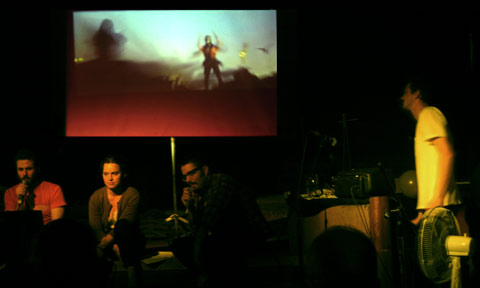
Wander into Bar Open, Brunswick st Fitzroy before April 26, drift upstairs into that weird carpetted split-room that usually hosts clusters of experimental musicians, to discover a vaguely cinematic setting. Up-high, a screen to display an edited highlights package of the Mad Max trilogy, which will showcase over the hour, various re-composited scenes, super-imposed characters, various pop cultural inserts and a grab bag of editing tricks ( eg a wounded Mel Gibson crawling along the road, re-edited to suggest a dance sequence ). While nowhere near Soda Jerk in scale ( see their gargantuan remix efforts ), there’s still a considerable amount of work involved here, in retwisting the various Mad Max threads to suit the remaker’s new premise : Maxas a5 year old, dreams of being a dancer, and one day being accepted into Tina Turner’s Bartertown Dance Academy ( aka the thunderdome gladiator to the death set of the trilogy’s final chapter ).

Underneath the screen @ Bar Open, sit 3 microphone holding characters, faces lit by the tv monitor they take their cues from. And to their side, a pair of foley artists stand amidst a junkyard of soundmaking debris ( a lettuce to punch for fight scenes, a toy car with toy siren, various instruments, bells, gongs, a vacuum cleaner tube to emulate a V8 muffler, paper to rustle etc etc ). The edits flow thick and fast, leaping from film to film, all sense of the original film’s chronology dismissed in the servicing of the new narrative. And to their credit, the journey of Max to the dance academy mostly flows well, despite the consistent leaping between different eras of Max’s life ( y’know – before and after some unthinkable big catastrophe like an economic meltdown / global market collapse ).

The new lines being delivered live, to suit the on-screen edits, are for the most part hilarious and the obvious enjoyment in the faces of the microphone wielding folk on stage, adds nicely to the show. The glee with which the foley artists mangle their vegetables and ‘molest their balloons’ doesn’t hurt either. And the new script they’ve crafted is quite playful, characters shifting through quite a range of accents, scenarios and surreal possibilities ( time travelling cops, playing with the age of Max, and gay bdsm and feral raver parodies which’d seem almost inevitable ), and pockets of improvisation ( including many references to Mel Gibson’s recent divorce announcements ). And yet, the cult status and over the top of absurdity of the films themselves, clearly evident in the assorted cinematography presented, leave the remix feeling ‘not quite there’. An awesome first draft maybe, and very enjoyable, but needing to sharpen it’s claws somewhat before properly savaging that worthy flesh.

Update : Mad Max, the 2005 breakbeat remix, via toby *spark in the comments.

by Sean Healy, April 24, 2009 1 Comment

The Red Rattler Sets Sail

red rattler
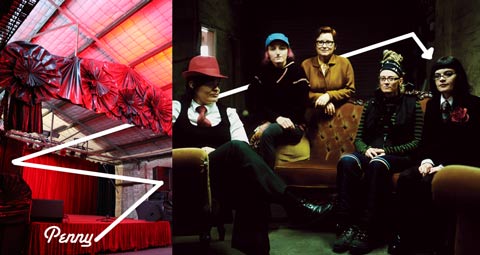
Sydney’s development laws and rental costs make any new arts space something worth celebrating. The scope of the artist and activist run Red Rattler, makes it doubly so, now offering in a converted Marrickville warehouse, a ‘creative playground for performers, musicians, artists, designers, multi-media makers, experimentalists, film-makers, theorists, activists, and collective organisers’. Penelope Benton is understandably excited:

What was the catalyst or the final straw which inspired the ambitious Red Rattler plan into motion?
The shut down of LanFranchis and the close of Space3 were the big ones, on top of a big list of artist run initiatives (Squatspace, Phatspace, Gallery Wren, Imperial Slacks, The Wedding Circle, Mekanarky Studios, Knot Gallery and just this year Gallery 44, and Medium,Rare) that’ve been forced to close in the last decade due to developers, landlord trouble, rental increases, neighbour complaints and other systematic shut downs including government and council regulations that make building compliance inaccessible and impossible for non-profit artist run spaces.

The constant police appearances, shut downs and fine threats were exhausting. Our events didn’t fit into pubs and clubs, we couldn’t afford other spaces, and the atmosphere was all wrong. So a group of us (five women: Meredith Williams, Patsy Black, Teresa Avila, NDY and myself) got together and started talking about ideas for a permanent space, a legal independent creative playground. We knew that the kind of budget and workload required to set up a legal space under today’s legislation would be huge and investing that into a rental was risky, so we emptied our pockets, shelved our personal dreams, harnessed the security that comes from working full time for 10-15 years, and collectively bought a warehouse in industrial Marrickville.

Is there something of a resurgence in artist run spaces in Sydney now?
Spaces open, run for a while, then get shut down and people spend some time feeling loss and remorse then start getting active and open up new spaces, its a cycle. In Marrickville, there is a buzz of new spaces brewing incorporating artists studios and one-off events. There are five or six ARIs currently looking into establishing themselves as legal places of public entertainment, rather than exclusive galleries, there are a few galleries already, but it is a bit difficult to get people to come to the inner west for art on the wall, don’t know why, but they do come out here for performance nights, film screenings, workshops, and sound or music events.

What have been some of the biggest challenges in setting up the space?
In NSW you need a POPE (place of public entertainment) license to host an event in a space. This legislation, full of exorbitant fire safety compliance, toilet quantities, and disability access requirements is the killer. Dissecting the BCA (Building Code of Australia) is a nightmare, funding it is horrifying and currently there is no support network for helping ARIs through this process. This is by far, the biggest challenge we faced. After months of research, a zillion meetings with Council, external consultants, and certifiers, our set up costs doubled.

We project managed the process ourselves and completed much of the work ourselves (electrical, carpentry, tiling, plasterboarding, general building works) with an incredible amount of help and support from friends and family. It was hard and overwhelming, but we did get through, our DA was approved in November, our approved construction certificate in Dec and received our Occupancy Certificate in March this year, so we’re now legal, yay, we’re very excited.

Our latest challenge is wearing the ongoing strain of extra set up costs and not being able to run properly yet – we applied for a liquor license under the new state laws that came into effect in July last year and were advised this would be a thirty-day process, however after almost ninety days now, we’re still waiting.

What’s the Red Rattler plan for “running the space largely on renewable water and energy sources”?
The Red Rattler has a five-year eco-sustainability plan – we’ve installed water wall tanks for rain water catchment and have low-flush toilets throughout the venue. We’ve fitted low-energy lighting and power systems including LED stage lighting rig and low-wattage light fittings throughout the bar, toilets, theatre space and rooftop garden. We’ve installed whirly birds in the roof and smoke exhaust vents that double as air vents in the ceiling, which we opted for instead of air-conditioning. We hope to install solar panels to our roof down the track to ensure maximum use of green power, with a vision to feed power back to the grid. Plus our bar stock will include local, organic, and preservative-free products. We’re taking a 50c eco-tax off door tix, or for free gigs we ask punters to donate 50c as they come in to contribute to this sustainability plan.

As a member of a Artist Run space, what do you think of the proposal to spend $1billion dollars to upgrade the Opera house?
Injecting even a bit of this sort of budget into a support organization for ARIs and non-profit performance spaces would completely revamp this city. Firstly the POPE legislation needs to be revised for like spaces. Then we need a service to guide artists and small businesses through DA and BCA processes, and a funding program for fire safety and toilet upgrades. Even if funding came with a condition that once you did start to make profit, from running a bar lets say, you paid back into the fund to support new non-profit creative spaces. A sustainable grant program. Sounds great!

Upcoming events you’re looking forward to at the Red Rattler?
PERV – Queerotic Film Festival Apr 23, The Box Brownie Flash (celebrating AV in performance art ) Apr 24 and much, much more~!
( see redrattler.org for full list )

Syd-Arts Related URLs provide by Penny :
http://www.myspace.com/tortugastudios
http://www.myspace.com/dirtyshirlows
http://www.billandgeorge.org
http://quarterbred.blogspot.com/
http://www.cadfactory.com.au/
http://www.officialsydney.com
http://www.workshopshowroom.org
http://quarterbred.blogspot.com/
http://www.figureight.org
http://www.blackandbluegallery.com
http://www.rizzeria.com/

by Sean Healy, April 22, 2009 1 Comment