Documentaries I Have Yet To Love

For those bunkering down to a winter of movie watching, a shared list from my pixel horizons.

On Paper Wings
When I think of World War II and Japan, the first thing that comes to mind is the hibakusha, a Japanese name for the surviving victims of the atomic bombs dropped on Hiroshima and Nagasaki, that literally translates to “explosion-affected people.” Long ago a documentary exposed me to horrifyingly surreal half-melted bodies of some of these people – some living survivors, and others the victims of radiation birth defects. This was the tail end of The Manhattan Project, a 3 year, 100,000 person United States project to develop a bomb.

On Paper Wings offers a little known flipside to that history. During WWII, the Japanese military developed a new weapon intended to strike directly at the American continent – the balloon bomb. High school girls across Japan were conscripted into factories where they built thousands of balloons made of paper. These balloons were then attached to bombs and launched into the jet stream to drift toward North America. On May 5th, 1945, a pastor, his pregnant wife, and five children departed on a picnic in Southern Oregon. When they found an un-detonated balloon bomb, the device exploded, killing the pastor’s wife and all five children. They became the only people killed on the continental U.S. as the result of enemy action during WWII.

Forty years later, a Japanese American man who had spent his wartime years in an internment camp found out about these deaths. He knew several women in Japan who as young girls had been forced to work on the balloon bombs, and the news of these deaths shocked and saddened them. These women decided to fold a thousand origami paper cranes to offer to the families of those killed in Oregon, and the groups eventually all met face to face. The friendships formed since have helped citizens on both sides of the Pacific cope with the tragedies they experienced during WWII.

On Paper Wings is the story of four Japanese women who worked on balloon bombs, the families of those killed in Oregon, and the man whose actions brought them all together forty years after WWII, and the balloon bomb project.

Général Idi Amin Dada: Autoportrait
Idi Amin, was a Ugandan military dictator and the President of Uganda from 1971 to 1979, with an estimates varying that 100,000 to 500,000 were killed during his rule. A confronting character for any film director to have to contend with, and with the constraints with which Idi Amin eventually placed on the film, French director Barbet Schroeder decided to call this a self-portrait by Amin. Upon release of the film, Amin sent a letter to Schroeder requesting additional cuts to the film. Schroeder refused, and Amin responded by rounding up 200 French citizens and confining them to a hotel surrounded by the Ugandan army. He also supplied them with Schroeder’s home telephone number and explained their release was conditional on the cuts. Within the 2 and a half minutes of cuts Schroeder inevitably made, he placed title cards crediting the gaps to Amin. These edits were restored after Amin’s fall from power.

The documentary promises : Amin trying to demonstrate his psychic control of crocodiles, Amin supervising a war-game simulation of an invasion of Israel, Amin dressing down his ministers at a cabinet meeting (two weeks after this meeting, the foreign minister, whom Amin criticizes here, is murdered).

Chris Marker – Vive la baleine AKA Three Cheers for the Whale (1972)
Most famous for La Jettee, his 1960’s black and white sci-fi short film made almost exclusively from photographs and narration, Chris Marker is also a formidable documentary maker, a film essayist of sorts. This short 17 minute film explores the whaling industry over the years, featuring historic photographs and paintings of whales and the whaling trade as well as real-life footage of whaling and harpooning. Marker sides with the hunted mammals in this film, and hunts himself, what it means about us that we have pursued such a past-time.

by Sean Healy, June 11, 2009 0 comments
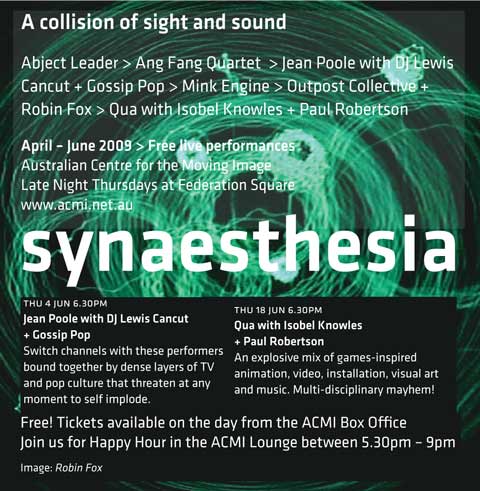
ACMI gig with Lewis Cancut, Thu Jun 4

synnerz

Many months of sampling and rehearsals with DJ Lewis Cancut culminate in a few days time, bringing together OJ Simpson, Prisoner, Molly Meldrum, Marshall McLuhan, Princess Diana, Jon Safran and assorted media luminaries into a 45 minute mix about television. It’s part of an ACMI series called Synaesthesia, curated by Eugenia Lim ( ACMI / Share Outpost ), which has already had great sessions by Robin Fox ( rocking the oscilliscope like no other ) and Abject Leader ( Brisbane’s infamous celluloid fetishists ), and with one further show still to come withQua (Jun 18, 6.30pm ) accompanied by visual work from Isobel Knowles and Paul Robertson. Great to have so many ‘live cinema’ events @ ACMI.

We’re excited anyway, and looking forward to having the work on the big screen and speakers finally.
Thu Jun 4, 6.30 ( with ACMI recommending to arrive before then to ensure a seat in small theatre )

I’ll be triggering and controlling videoclips (with sound) through VDMX ( reviews ), Lewis will be on the decks, playing back sounds and scratching video withMix Emergency (review) , and both of our signals will be going through an audiovisual Mixer: Numark AVM02 ( review ). Like so :

vidi-yooooooo

Half the work has been trying to figure out a good audiovisual dynamic between the turntables and my laptop, jumping the various tech-hurdles on the way, and just trying to figure out what actually works best in a live setting. Still a work in progress, but hopefully there’ll be enough of interest on Thursday night…. Drop a comment if you manage to make it along : )

UPDATE:
And whille you’re there, check out the United Visual Artists installation opening that night as part of the Light in Winter program at Fed Square.

by Sean Healy, June 2, 2009 2 Comments

Mapping Festival, Geneva, May 09

No Swiss passport stamps for me, but Lucy Benson ( VJ Nosis / Melb – Belfast – Zurich – Berlin etc ) who has recently migrated to the Northern hemisphere, and is rad, found herself at the Mapping festival. And so, it seemed more than a good idea to let her have my technoscape column over at 3Dworld mag this week. Below is the edit to fit into print, over yonder, there are many more words, many more photos.

**
Over the last 5 years, Geneva’s Mapping Festival has earned a solid reputation for showcasing the world’s preeminent ‘Visual-Audio’ artworks and technologies, maturing into a lengthy 10 day event with a strong emphasis on live performative acts and VJ culture. Some highlights in 2009 :

Kine TXT

KineTXT is a live story-telling collaboration between *spark and another UK outfit, Novak that allows live-generated illustration, text and poetry to be composited together in realtime and manipulated via a wii remote to develop a meaningful progression of narrative. It’s a beautiful project and despite some last minute technical difficulties – including rain, the show delivers and the six busily active artists and live soundtrack make for an absorbing spectacle.

KineTXT’s live camera action turns out to be indicative of a clear trend at the festival. Performers from all parts of the world embraced the potential of a live feed, human involvement celebrated on stage rather than hidden away behind screens and consoles and bringing to mind the emergence of a certain folk-like inclination amongst the artists. It also signified a lovely return across the festival to a human perspective of time, the most real real-time there is; the time it takes a body to move, breathe, think and react.

Visual Feedback?

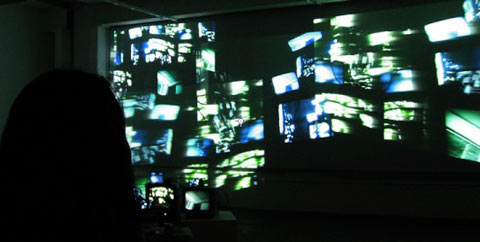
The deceptively simple work, Inside/Out, by Croatian artist Klif is made up of 3 computer controlled cameras, eight monitors and five projectors. The cameras, feeding into the monitors, pan and zoom across the installation sending glorious cascades of feedback across the large room. The open mechanics of the work provide a fascinating centre piece to the installation and lend themselves to a variety of spontaneous interventions from visitors to the exhibition.


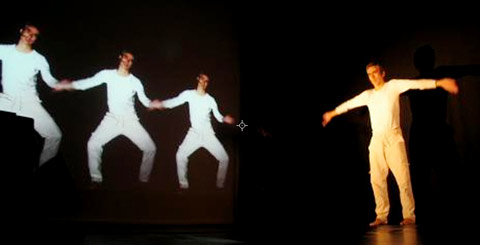
Reflexus is Spanish audiovisual processing software developed in Open Frameworks for theatre productions, and allows live camera feeds to be processed with a variety of effects, linked to an audio synth (currently the project uses Reaktor GUI components) and played back to stage. Not exactly groundbreaking, but it allows dynamic manipulation of up to 80 or so(!!) layered video feeds. Without a single dropped frame. Impressive. And the hour long showcase performance, featuring seamlessly integrated dialogue and action between ten or so versions of an actor, was mesmerising and a real highlight (despite being delivered entirely in French).

Collectif Akrylonumerik, France

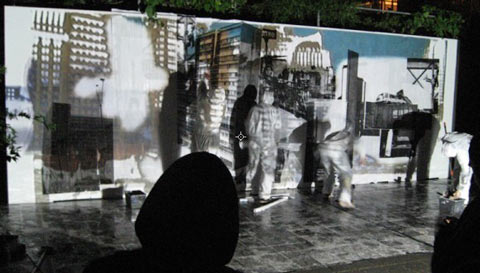
A collective of four or five street artists, dressed head to toe in white, a dj and a visualist on laptop projection. Starting with a blank white-papered wall, the artists build a foundation of graffiti and paste-ups for the projected illustration and video, creating a series of beautifully composed, continually evolving, hip-hop meets punk mise-en-scènes. The show is incredibly good at times, with an infectious street-party atmosphere and some mind-bending transformations between the physical artwork, the projections and the white-suited artists themselves. The real strength of the work however was in it’s thoughtfully constructed progression over the show’s duration.

VJ performances

The beautiful control and pacing evident in many of the performative artworks was sadly lacking here. Perhaps VJs are so used to their work being backgrounds that the tendency towards flashing, eye-grabbing graphics and technique, at the cost of meaningful imagery, is so ingrained it’s hard to break away from. One exception was Poland’s PussyKrew who built a controlled and considered show, utilising a restricted canvas area to great effect.

Overdosing
Noticed a surprising tendency for cheesy, overly-sentimental or effects-reliant material – often from an artist who a moment ago had been displaying something truly captivating. Perhaps as artists we all have our particular stylistic achilles heels – aesthetics that for some reason resonate with us, but leave everyone else scratching their head. Maybe something to be reckoned with as long as we are asking for a genuinely personal experience from these performers.

Outdoor Projections

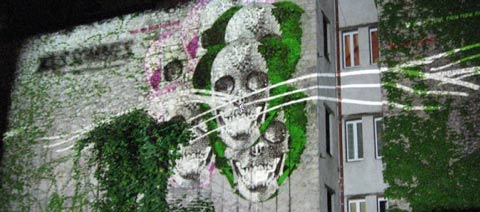
Impressive video mapping technologies? French artists Exyzst certainly delivered with their closing night performance mapped to the riverside Façade de l’Usine. The piece was sonically and visually synchronised to that extent that stops you noticing either individual medium and simply transports you temporarily.

Germany’s Videogeist also stood out, breaking the mould with some painterly generative art and an augmented version of the building that differed from the neon neo-futurist vision inextricably bound to this technology at present. Another French team, Digital Slaves, also went for a more organic aesthetic with some particularly nice moments, however were let down by the lack of synchronicity between the sound and vision – unfathomably for each of their short sets the audio abruptly cut out before the visuals.

VIDEOHUAHUA
Videoman (Fernando Llanos, Mexico) brought his own take on the festivals tagline ‘deviant electronics’ with his invention: the Videohuahua. That’s a chihuahua with a mini projector attached. Of course! Fernando and the Videohuahua (a very cute fellow named Chamacos) were an unmissable pair at the various evening events as well as the clubs and parties backstage. Little Chamacos won many fans, tottering alongside Fernando, beaming his art into the night and lighting up more than just the Geneva streets.

(( Thanks to Lucy for the report, try her full version ( twice as long))))
Stay tuned for another report, the next one from the home of mozzerella de bufala, over at the LPM festival in Italy. So many festivals, such little time~!

by Sean Healy, June 1, 2009 2 Comments

Stephen Hawking + The Internet Vs Science

Via the sprawling internet tentacles of@howthebodyworks ( no, really – subscribe to his delicious bookmark feed a while..), comes this great reminder of … well… actually, let’s not spoil it for you. Except to say it does involve eminent scientist Stephen Hawking, which reminded me of this MC Hawking interview from back in 2002, and that I’ve been meaning to mention I’ve been copying across ye olde octapod.org/jeanpoole articles to skynoise. Will list a few fave older pieces later, in the meantime, check the archives link on the side.

MC Hawking nabbed his 15 mb of net fame back in the day with ‘e=mc squared’, ‘fuck the creationists’, and other rap classics ( all available on mp3).

Q: What’s your next book or current research about?
A: I am currently trying to determine whether or not “Hammer Time” is relative.

Q: What do you think of the growing popularity of gangsta physics?
A: Yo, rap is all about dropping science. It was only a matter of time before rap and science converged.

Q: Got any lines / rhymes on artificial intelligence? (and when do u predict it?)
A: As far as predicting A.I. is concerned, I got no fucking idea; I’m a theoretical astrophysicist, not a fucking computer scientist. However, if that piece of shit movie Spielberg just put out is any indication, I’d say don’t hold your damn breath.

full MC Hawking interview here..

by Sean Healy, May 31, 2009 0 comments

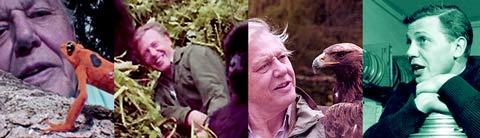
The David Attenborough Machine

david attenborough
“I would go mad if I lived in the rainforest,” he laughs. “I like what human beings do, I’m fascinated by them, and if you want to know any of those things, a big city is the place.”

Is there anybody alive who has had first hand experience of as many species as the narrator of BBC nature documentaries across the last six decades? Maybe this makes him a prime candidate for alien abduction, but even at the ripe age of 83, he continues to expand his knowledge of nature, and ours in the process. Most recent doco? ‘Life in Cold Blood’, about ‘solar-powered reptiles and amphibians’. Currently working on? A one-off documentary about evolution, other narration and radio work, serving on the boards of several wildlife organisations, making International news about population issues, and just last week, providing news commentary on the finding of the ‘missing link’. Ready for a nap yet?

Missing Links, Or Actually : Transitional Fossils

Rather than ‘missing link’, scientists prefer the term ‘transitional fossils’, to describe the fossilized remains of intermediary forms of life that illustrate an evolutionary transition. But if Charles Darwin’s theory of evolution is to be believed, argue the Creationists, why haven’t we found a fossil record of a species that is somewhere in between today’s higher primates ( humans, monkeys and apes ) and more distant relatives? Last week at the American Museum of Natural History in New York, a fossil with that potential was unveiled. The scientists responsible argue the skeleton ( nicknamed ‘Ida’) wasn’t merely a lemur, but a new species, with some closer resemblances to ourselves. Dr Jens Franzen described Ida as “like the Eighth Wonder of the World”, because of the extraordinary completeness of the skeleton. The full verdict is out just yet, but naturally, there is already a David Attenborough narrated BBC programme about it. Sayeth Dave : “the “little creature is going to show us our connection with all the rest of the mammals. The link they would have said until now is missing … it is no longer missing,” he said.

Ida Vs The Creationists
Hard to imagine writing hate-mail to the curious brained David Attenborough, he with the ever-infectious popping from behind bushes kinda joyous way of explaining some obscure facet of nature. His lack of crediting God in his documentaries however, has inspired creationists to write and tell him to ‘burn in hell’. Famously he responded on a BBC interview by saying how he always remembers a little child in East Africa with a worm burrowing through his eyeball. The worm cannot live in any other way. “I find that hard to reconcile with the notion of a divine and benevolent creator,” Attenborough said.

The Breeders
1950s, When David Attenborough started making TV? 3 billion people.
At Time of Writing? 6,836,787,487 people.
2050? An estimated 9.1 billion people

The latest of many organisations Sir David has thrown his weight behind, The Optimum Population Trust believes that Earth may not be able to support more than half its present numbers before the end of this century, and that the UK’s long-term sustainable population level may be lower than 30 million ( currently 61 ). “For the past 20 years I’ve never had any doubt that the source of the Earth’s ills is overpopulation. I can’t go on saying this sort of thing and then fail to put my head above the parapet…. If we don’t find a solution to our population problems, nature will. Other horrible factors will come along and fix it, like mass starvation.”

Last word? His astonishing list of documentaries speaks for itself.

by Sean Healy, May 28, 2009 0 comments