Tracing Footsteps On The Web

Or : a journey through time and space, via the humble hyperlink. A recent post at onlinejournalismblog.com reminded me how important links are for online interaction, and yet how often they are overlooked or under appreciated by less savvy web writers / publishers. Obviously links are economically important (more in-bound links for a site = a higher google ranking), but there’s also a significant social dimension to links. Why do the better sites take a lot of effort to ensure they reference their ideas, and provide links to everything they mention? Sure, they understand it often means the site linked to, will often link back to them – but more importantly, it helps make the web function better for everybody. As illustrated by the following single link :

“Web Comic Guru Interviewed”
What we have here is a talkshow host who thinks impersonating a hyperactive foghorn is a good interviewing style. Thankfully the guest, web comic artist Nicholas Gurewitch manages to avoid being steamrollered and retains some integrity throughout. Mostly this is of interest, if you’re familiar with his comic Perry Bible Fellowship, which has recently made the transition from adored web comic into sold-out-book-and-people-are-knocking-at-my-door-for-movie-scripts-etc. But it also serves the purpose of letting us explore the social value of links. Where did the video come from?

10zenmonkeys.com
The above video link was within a post that explored the PBF rise to fame, and discussed the reasons for Gurewitch’s recent lack of web-activity ( hey – a pilot tv show for British TV, remastering the book for re-prints, working on a feature script etc – keeps you busy! ). I’m not subscribed to the monkey site, but I found it through a subscription to :

Waxy.org/links
Waxy.org is the site of Andy Baio, a software developer, whose steady stream of eclectic ( well, eclectic within the mostly tech/online ballpark ) and succinct links and commentary quickly found its way into my RSS feeds. Where did that come from?

Kottke.org
The Kottke radar stretches out to include the design world, the arts, cinema, tv, with perioidic snapshot reminders that the world is a very strange place. Although posts are longer than waxy’s, they are similarly succinct, regularly appearing and well written, drawing the reader into merits of a particular topic. At one point, Jason Kottke’s popularity could be measured by a one weekend donation drive, where he asked his readers to donate, so that he could concentrate on blogging links full-time and gave up his designer job for a year. He raised an annual income in one weekend, but later returned to design work, claiming the paid responsibility of blogging changed it’s nature for him. Found via:

Boingboing.net
“A directory of many things”, co-curated by a busy bunch, each contributing their particular thread-flows of interest. Pointed to many mooons ago by:

alexburns.net
After a certain number of emails were ping-ponged, projects were intersected ( ask him about DIY rocket-launchers ), and because he was the Australian based editor of:

disinfo.com
Back in the pre-corporate mall days of the web, this site emerged as a repository of alternative culture / politics / weirdness in general, albeit weighed down by a conspiratorial component ( the overall mix kept it worthwhile though, and nice being kept on your toes ). Founder of the site, Richard Metzger produced a cool spin-off TV series at one point, and is currently guest blogging on boingboing ( noticeably ramping up their weirdness ratios). Found via…

marcuswestbury.net
Marcus was one my the earliest pingers of links, and although his current site is relatively fresh ( and not where I would’ve discovered disinfo.com), I’ll credit him as the first link in the chain here, given his infamy as a 20th century bean-cans-and-string-modem-type-hacker.

by Sean Healy, April 8, 2009 0 comments
Growing Food In Cities

Whether it’s the economic downturn, your choice of looming eco-pocalypses or just a desire for healthy food, there’s plenty of reasons why interest in growing your own food has recently skyrocketed.

Guerrilla Gardening
‘Anyone interested in the war against neglect and scarcity of public space as a place to grow things’ can browse through the photos and stories at guerrillagardening.org, which show a variety of reclaiming / replanting projects from all over the world by teenagers to grandmothers and all in between. And remarkably in Australia, this process has recently been documented on prime time television ( watch episodes, vote on the best guerrilla member etc ). Inevitably there are stylistic choices made to try and fit into prime-time television (( Welcome to the show where six young warriors are armed to the teeth with attitude and gardening tools …. the six Guerrillas will stop at nothing to reach a potential site – they will abseil, rope and parkour (picture the opening scene of Casino Royale) to get to the make-over site on a 20 foot high ledge… )), but still it’s quite remarkable to see channel ten producing such a show, with it’s tagline : ‘Against the law? Guerrilla Gardeners – bringing your city back to life’. Interestingly, while most online feedback was highly supportive, the negative responses tended to be people annoyed that the show seemed a ‘blatant rip-off’ of the site and group mentioned above. Aside from Tony J that is, who added his caps locked two cents, “They should be given 3 months jail each. It is ENVIRONMENTAL GRAFITTI.”

Permaculture In Cities

“When I first went to New York, I helped start a little herb-farm in the South Bronx. The land was very cheap there because there was no power, no water, no police, and there were tons of drugs. This little farm grew to supply eight percent of New York’s herbs. There are now 1,100 city farms in New York.”

– Bill Mollison, who along with David Holmgren, founded Permaculture in Australia in the 1970’s.

Permaculture is an approach to designing human settlements and perennial agricultural systems that mimic the relationships found in the natural ecologies ( thanks Wikipedia!), and started with Mollison’s realisation that no one had ever applied design to agriculture. “We’d had agriculture for 7,000 years, and we’d been losing for 7,000 years — everything was turning into desert. So I wondered, can we build systems that obey ecological principles?”

Some of these principles include looking at a whole system, observing how the parts relate, mimicking patterns in nature, layered stacking ( growing tall, medium, and low plants together to maximise the effectiveness of shade, pollination, watering and mulching), valuing diversity etc.

Transforming That Garden Plot
Sometimes a helping hand or seven can help springboard a garden into bountiful existence much quicker. A little planning and preparation and a group of people can gather together and focus on one garden at a time, taking turns to do a quick day’s work-over on someone’s backyard. This can happen between friends easily enough, but it’s also the insight being used to drive the hugely popular permablitz.net – once you’ve donated time to help other gardens get a kick-start, you qualify to have your garden selected as the one where a team of gardeners will come and re-jig it all in one day.

And an even less DIY approach, some of the permablitz crew have started veryediblegardens.com, recognising the usefulness of having the option for having people come to install a raised vegie-patch kit for you. “Package deals come to suit every price range, from DIY edging kits, through to soil-filled, fully planted packages with pest netting and an automatic timer-driven drip-irrigation system installed.”

Actually Growing That Food Stuff Yourself
Seasonal planting guides abound, these are two good ones.
Healthy soil is an important part of every good garden and making a good compost heap will help that process tremendously eg http://www.milkwood.net/content/view/53/50/

by Sean Healy, April 7, 2009 0 comments

Bees, Journalists, Honeypots

“With every revolution, from wood to coal, from coal to oil and now from oil to the renewables, profits have increased. That’s just the way the world is. I would like to see business people rewarded for doing the right thing.”

Tim Flannery, scientist, author of ‘The Future Eaters’, quoted in the Financial Times.

The Changing Shape of News
Although the Tim Flannery quote above is directed at climate change and big business, pointing out the opportunities with renewable energy, it applies neatly to the shifting news environment too. There’s currently a lot of panic about the health of newspapers, as exemplified by the recent piece by media theorist Clay Shirky, whose argument can be summed up with two lines from it :
“Society doesn’t need newspapers. What we need is journalism,” and
“Here’s how we’re going to preserve the old forms of organization in a world of cheap perfect copies!” ( the newspaper industry have seen the internet coming, but their plans were inevitably flawed as they chose not to face various technological and social realities ).

The opportunity is in how the need for journalism and news is harnessed, regardless of media format, and a good example of how blurred things are getting is ‘Newspaper Video : Will It Survive?‘, an article discussing the merits of newspapers producing video and visual material for their online sections. Elsewhere on the Endangered Charts?

What’s Happening With Those Bees?
The ones that are propping up our food chain, and were recently thought to be in danger of being wiped out in large numbers? The greatest development seems to be that there is now a name for what is happening to them, though the jury is still out on understanding why it is actually happening. Colony Collapse Disorder describes the mass die-off of beehives which has been happening lots in the last two years, particularly in North America ( 1/3 of commerical U.S. beehives suffered CCD in 2008), and there are a large range of possible culprits : pesticides, environmental changes, disease, predators, infestation, stress, and radiation from phone towers ( or any combination of the above). Modern life is rubbish apparently, as Don De Lillo covered a while back in his White Noise novel, a Professor of Hitler Studies living in a small town, observing his kids school having to temporarily close down because of allergies to one or a combination of a huge range of chemicals involved in the school building’s construction, and the town itself being menaced by an ‘Airborne Toxic Event’, a floating pollution cloud of unknown toxins and origin.

McSweeney’s Journal
And while on the literary thing, I’ve been meaning to plug these cats a while… Although their site stands up all by itself very well, thank you very much, ( see their regularly published reviews such as THE WRESTLER: A CINEMATIC ANALYSIS IN A 1989 VOLVO STATION WAGON 240 DL ), McSweeney’s Journal is a print beast which can arrive in your letterbox every few months, jamming together a motley crue of contemporary writers, the juxtaposition of each writer’s world likely to leave your head spinning fondly. They also dabble in DVD compilations of filmic esoterica ( see Wholphin, so named after a mythical dolphin-whale hybrid ). It should also be noted, that this whole enterprise was started by Dave Eggers, a decent author and screenwriter in his own right, who more recently has branched out into non-profit writing centres to help young people : see http://www.826valencia.org, which typically are set-up as super-hero accessory shops or as San Francisco’s “only independent pirate supply store” ( the latter being done to avoid some kind of zoning law problems ).

In Other News

– The Resolume folk have developed a new video codec for super-fast HD playback ( uses the GPU, only works on their software though).
– State Priorities? Victoria wanted Tiger Woods ( and got him for a golf tournament). NSW chased Brian Eno instead, to lead a new Sydney Festival ( yes, generative art on the Opera House exterior ).
– 137 Gb of BBC documentaries await you. ( Best be using a torrent application that let’s you select which files to download ) via VJ nosis.
– The Obamas are planting a vegetable garden at the White House. No word on their Hemp For Victory plantation yet though.

by Sean Healy, March 20, 2009 1 Comment

Test Driving the Numark AVM02

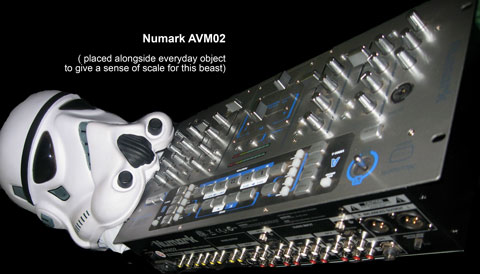
Recently carried home a Numark AVM02 Audio/Video Mixer strapped onto my bicycle rack with a $2 ocky strap. It survived.

numark avm02

Why?
There are video mixers, there are audio mixers. Combining them into one unit mostly makes sense if you want to mix both simultaneously. One smooth crossfade that leaves your other hand free for shaking a tambourine / zooming in on the sword swallowers contact microphone / scratching OJ Simpson video / making figure 8 patterns in the air with a wii controller / swirling the mike above your head / sipping your coconut juice or you know, clicking your mouse. And it’s just nice to have the option of that easy A+V sync.

Strengths
– In short, there’s not much else like it. 4 audio inputs, 4 video inputs ( of both S-video and composite), separate cross faders for audio and video, but a button click allows both to be controlled via the one cross fader for easy audiovisual mixing between 2 sources ( eg a DVD playing a clip with sound, and a laptop source, or any other combination of video and audio happening).
– Solid. Robust. It really is Schwarzeneggeresque. The cross-faders can be replaced anyway, but everything on the unit feels durable, weighty, responsive.
– 2 video outputs ( 2 S-video / 2 composite ) and 4 video preview outputs.
– Adjustible mixing slopes
– Chroma keying and Luma keying
– Comprehensive audio in/outs too : Seven stereo inputs and two microphone inputs with audio cueing section, 1/4″ and 1/8″ headphone outputs, master balanced, unbalanced, and control booth outputs.

Weaknesses ( aka AVM 03 wishlist )
– The biggest omission is no master fade-down option for the video. Let alone the option to fade down both audio and video simultaneously.
– No midi ( or OSC ). Would’ve made the unit so much more versatile.
– No blend modes (add, multiply etc ), just stock-standard 1988 video-mixer style wipes and effects.
– The size. ( (LxWxH): 482.6 x 228 x 105mm, and we’re talking 5kgs ) It’s quite huge and deskspace hungry.
– Others will bemoan the lack of HD mixing or HDMI inputs. I’d prefer the above first.

In The Wild
Immediately, you’ll notice deskspace is an issue. Is big. Where do you put it? Behind those turnables and between that laptop? Maybe sideways next to that midi controller? Spot sorted, the large number of inputs is great. Buttons allow easy sorting of which video input goes to which channel, and each audio input can be associated with either the left or right hand side of the cross-fader ( eg it allows the cross fader to mix 3 audio channels across to one channel ). The keying works well, the wipes allow some degree of compositing ( but hey, it’s 2009, what about some zoom/scale/positioning options for each layer), and the option to engage or disengage the A+V sync to one cross fader is great. And generally, all controls feel good.

Verdict
If you’re wanting to mix audio and video, and don’t mind the size, it’s a great box to have. Does all it’s bare bone functions really well, and feels reliable, trustworthy. At around $1500 Aus, it’ll only appeal to certain users, but they’ll enjoy the added audiovisual flexibility it brings.

by Sean Healy, March 17, 2009 5 Comments

Scratch Video Software : Mix Emergency 1.1

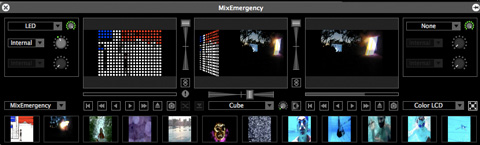
Pixel-hungry Serato turntablists have a new tool in their arsenal, Mix Emergency, available from inklen.com/mixemergency.
mix emergency

What It Is, What It Is
If my mum asked me, I’d say – DJs got tired of carrying milk crates full of records around, and started storing all their music on laptops. So instead of choosing records, now they can just pick a track on their laptop, and a special device let’s them pretend the record on the turntable has that track on it, letting them move their hands about and scratch it or jump to different places, and the device and the laptop take care of playing that music out of the speakers. Mix Emergency lets DJs use video files as well, so as well as music going to the speakers, video goes out to a projector, but the speed and timing of it is controlled by the DJ’s hands.

In other words, mix and scratch video and visualisations ( it’ll handle your quirky quartz composer patches) in real-time, if you’re already using Serato Scratch Live. Mix Emergency doesn’t handle any audio itself, but as it runs grand in conjunction with Scratch Live, that’s fine.

Under The Bonnet

– MixEmergency officially supports and recommends the following video container formats: avi, m4v, mov, mp4, mpeg, mpg and the following video codecs: H.264, Motion JPEG A, Motion JPEG B, MPEG-4.
– Supports external control by Scratch Live by Serato. Loading a video file in Scratch Live will cause the associated video to load in MixEmergency.

Verdict From An Actual DJ?
According to DJ Lewis Cancut ( myspace.com/lewiscancut // “Hip Hop / Korean Pop / Tropical”, or jump onto the Scattermish ( label ) blog / mp3 gravytrain ), Mix Emergency is “Sick”.

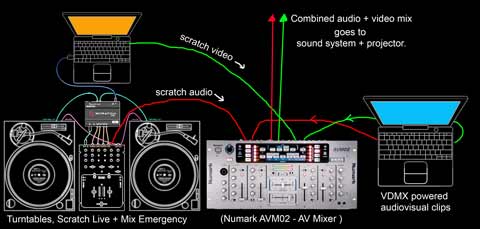
lewis cancut From my video library, Lewis made a special request for that ‘Little Superstar‘ clip doing the rounds a while back, of a tiny grinning Indian boy bodypopping like an electrified midget James Brown, freezing whenever his dad pressed stop on their portable ghetto blaster. Lewis then exported* the audio so it was a standalone track, lined this up in Scratch Live and sync-ed this to the video file in Mix Emergency, and began scratching back and forth, the hip-hop track coming out through the speakers and the video clip through video output onto a TV.

(( *UPDATE : Nick from Inkglen points out : I see that the DJ had to export the audio track from your video in order to play it with MixEmergency – you shouldn’t need to do this (unless the audio track is in a format that Scratch Live doesn’t support), as you can just drag and drop videos into Scratch Live and have MixEmergency automatically load them when you load them onto one of the Scratch Live decks. ))

Cue points are easily inserted in Scratch Live, so next Lewis was jumping back and forth to various key points on the clip ( the grin, the grin! ), and scratching along the way. Mix Emergency seemed to keep the video locked solidly to the audio and kept pumping out frame-steady pixels, no matter how motion blurry Mr. Cancut’s hands seemed to get. Double thumbs up. This is what we’ll be doing with it below :

audiovisual tofu

Good Features

– Fast, responsive, relatively stable.

– Recording and exporting of performances in a non-CPU intensive way ( ie presumably records your actions, and then later takes longer to analyse these and export your video without dropping frames. )

– Quartz compositions (.qtz) can be used, with adjustible parameters easily assigned to midi controllers.

– Decent range of transitions between channels

– Simplest, smoothest midi implementation I’ve witnessed – Option-click the on-screen control you want controlled, then move or toggle the MIDI controller. Done!

– Visual Effects parameters controllable by midi, bass or velocity control ( from rubber wristed turntable wizards )

– Good forum support and video tutorials.

– Camera input on it’s way, beta for now : inklen.com/download/8/video.DVInputStream.zip

What’s Missing?

– Overall controls of the master output – eg fade to black / white, adjust contrast, colour etc – to help the scratch DJ optimise the output for whatever projector / screen / environment they’re using. Being able to add master effects ( not just on either channel ) would be good too.

– Ability to scale/ position an image / video.

– Ability to assign keyboard shortcuts.

What You Need :

– Recommended tech specs : Mac only, and MacBook Pro or better, Video card (128 MB dedicated RAM), GB RAM, DVI or S-Video output

Mac OS X 10.4.10, Quicktime 7.3 ( + Scratch Live 1.8.22 for external control )

( MixEmergency will run on both PowerPC and Intel CPUs. However, low powered CPUs, such as those used in the PowerBook G4, are not officially supported for video mixing and scratching. Low-quality (320 by 240) videos and simple Quartz Compositions are recommended for such systems. Download and install the demo to test on your system. )

Also needed : $179 USD ( Possibly the equivalent of a small Australian home by time of publishing )

Verdict :

A great addition to the live visual performance software market, look forward to its future iterations.

by Sean Healy, March 6, 2009 Comments Off on Scratch Video Software : Mix Emergency 1.1