DSLR Helicopters!

So you’ve got a nice tripod, dolly, rail slider and even a crane for your DSLR video camera. Maybe it’s time to put that camera on a remote controlled helicopter, like Eric from helivideo.com.
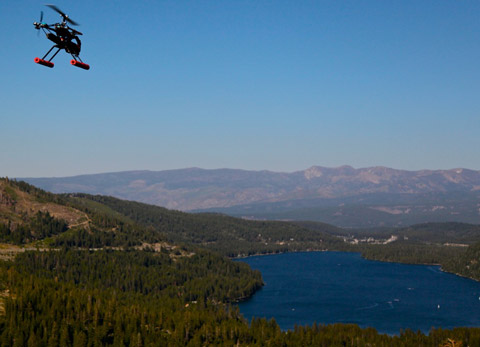
helivideo1

How did you first get into aerial photography / video making?
I already had experience in RC helicopter and airplanes from about 10 years ago and was working as a semi-pro camera man and editor. I found myself catching up on the latest helicopter technology on the internet forums and saw people putting cameras on heli’s and was in.

Do you have some kind of remote viewing of the camera’s aerial perspective?
Yes, the heli is equipped with a 900 mhz transmitter to live view the video on the ground. (The transmitter takes the video signal from the video out of the camera, transmits it to our ground station and monitor. ) This is key to frame the shot, or track the action.

What range have you got?
The range if over clear ground is just over a mile.

What does it feel like, to be ‘feel’ like flying?
Even though I am not sitting in the heli while flying, sometimes you do really get into the flight and it feels like I am looking down at the ground.

You are standing on the top of a cliff or skyscraper. How far from the edge can you fly before you start feeling nervous?
This is a great question since perception of the heli is so critical. I have flown out over 200 meter cliffs with ocean below. You get a nervous feeling as soon as the heli goes out over the cliff since you know one mistake and you will never get you equipment back. How far out I can go depends on the wind, the visual sky or background behind the heli and just how dangerous I feel that day. On a shot like that, anything over 150 to 200 meters out is extreme.
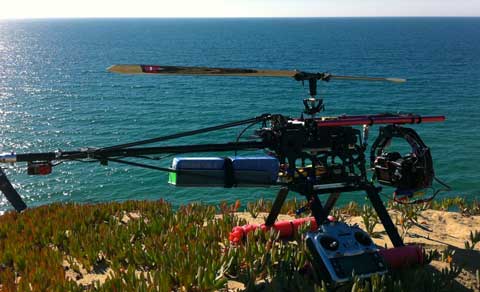
helivideo_cliff

How would you feel flying your copter around you, while in a boat mid-ocean, or hang-glider mid-air?
Flying from a boat would be great and I have been asked to do this before. It is kinda like the high cliff shot, because if any problem occurs there will not be time to safely land the heli and it will end up in the water.
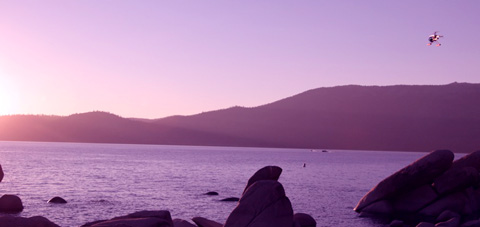
helivideo_rocks

Have you lost any cameras yet, or had any close shaves / dangerous moments?
In the last 6 months of working I have crashed the heli with my 5D attached twice. Lucky for me it was not over the cliff or the water and the camera / lens survived both accidents. Every time the heli leaves the ground it is a dangerous moment and too many close calls to mention, but that is what the clients want and I give it to them.

What have been some favourite scenes / events / locations to fly over?
Being a part of movies and tv shows are what I like best andmsome of the cool spots to fly have been downtown Toronto and also Big Sur California.

What do you like and dislike about the current range of DSLRs and their capacities?
I love the image quality that you get from these cameras and they are absolutely amazing for the price. I guess what gives me problems is how sensitive they are to vibration. Most people cannot shoot stable video while holding the camera and walking slowly. I put this camera on a whirling spinning helicopter which has to be perfect or the shot will be ruined by rolling shutter or other shaking.

What do you think about the iphone copters?
I think they’re awesome. There is so many very cool flight toys out now for $100 or less. It really allows anyone to get into flying for cheap.

Camera technology you’d be excited to see in 2011?
A 5D III and the possibility to output raw video – would be a game changer. The new 3D cameras are also very interesting and I am working on a new heli that will carry larger camera such as EX1, Panasonic 200, etc.  Thanks so much for letting me share some information with you. I hope to come fly my heli down under very soon! I can be reached at eric@helivideo.com
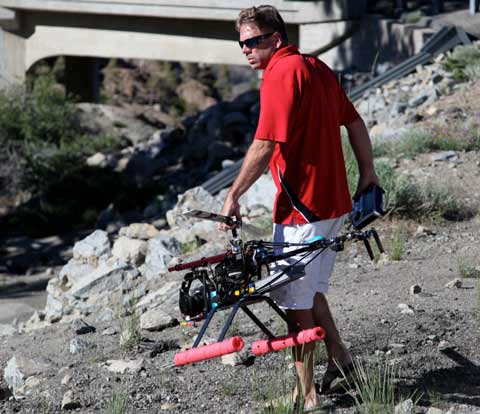
helivideo_Eric

[[ Previous DLSR related posts: stabilisation and steadicams, an introduction to DSLRsmacro photography and video, time lapsing and a Canon7D review ]]

by Sean Healy, September 28, 2010 2 Comments

Francis Bear And World War Gay

francis_bear
Wandering back down that print on demand sidestreet, Francis Bear is a fantastic new graphic novel recently published by Melbourne comic veteran, Gregory Mackay, using the print on demand facilities at the Melbourne Uni bookstore. Though it was originally commissioned by the French group ‘Hoochie Coochie / Turkey Comix‘, through the (economic) magic of machines that can print and bind professional books one at a time, this means the quirky metaphysical adventures of a suburban bear are now available to English speakers, months before the Francophile version hits their cobbled streets. Cultural advantage with a click!

As with all self-publishing though, technical hurdles are only one part of the challenge to survive, and while their are some self-publishing success stories, getting word out there can be incredibly difficult and time consuming. It’d be great to see Francis Bear become a self-publishing phenomenon ( if only so it means we get to read more of these books ), so I offer a twin pronged attempt to convince you to purchase: In one window, stare into this image, and with your credit card ready in the other window

(See also: Francis Bear reviews Scott McCloud’s Making Comics, Francis Bear reviews Larry Gonick’s Cartoon Guide To Physics, and Francis Bear takes on Sylvester Stallone.)

World War Gay

Also hailing from Melbourne’s Silent Army era (it’s comic veteran day at skynoise), Clint Cure ( Q-Ray) and Kieran Mangan are in the midst of raising funds to produce a short video series for the web. Loosely framed as a John Waters meets John Carpenter / sci-fi / action adventure about the development of an anti-gay serum, at time of writing they’ve raised $426 of their modest $1000 goal. Says Kieran: “Why does a film cost $3 million? Well, I know why, but I also know it doesn’t have to. ” And something that may increase or decrease your likelihood of offering some small support – Clint recently finished a short zombie remake : ‘Hanging at Picnic Rock’. And interestingly, this fundraising is all powered by the new Australian micro-fundraising site Fundbreak, an Australian version of kickstarter.

by Sean Healy, September 23, 2010 1 Comment

The State of VJing Today, Some Hard Stats

Via the people who want to organise the world’s information for us (google.com/insights/search), a few insights about the world of VJing and motion graphics, comparing results between 2004 and 2010.

“Insights for Search aims to provide insights into broad search patterns. Several approximations are used to compute these results. (And it has to be said – their secret sauce yields a few surprising results) The Insights for Search map is intended for general analysis of volume patterns. Borders are an approximation and may not be accurate.”

( Remember, the map is not the territory, Google said so. )

VJ as a search term? Down slightly, but still flying along. Most popular by far, by people searching from countries in South East Asia, topped by Indonesia. Top search? MTV VJ, followed by Burma VJ. Couldn’t find the part where they listed ‘cool people squinting into laptops’.

VJ Software?

Arkaos lovers are most likely to live in Portugal, then Belgium, Argentina.
Resolume: Portugal, Czech Republic, Austria.
Quartz Composer: Japan, Austria, Switzerland (*Australia 4th!)
Modul8: Esp Switzerland then Austria, Italy.
VDMX: Esp Germany then UK, US.

Of note – Portugal and Austria seem to be pixel hotspots! The Arkaos graph is on a sharp decline over time, and if the search is restricted to just 2010, the numbers tilt a little differently. And also – *why do more people in Australia search for Quartz Composer, than all of the people in the United States?

And for less off the shelf VJ related packages, in order of popularity: Isadora (by a fair margin), VVVV, processing + video, max msp + jitter, pure data + gem.

Questions People Ask VJs
“What software are you using?” +300% (Bedroom VJs are on the up )
“Can you play this song?” -57% (People are getting better at distinguishing DJs / VJs, or are just sending their requests through twitter and facebook )

Video Jockey‘ as a search term, is thankfully on a decline. ( Most popular by far, in India.)
Scratch video‘ peaked in late 2005, declined, and seems to have stabilised since then. ( Most popular in U.S. )
DVDJ‘ – by far most popular in the U.S., on a slow decline.
Video mapping‘ – on the up and up, esp in India.

And In the Wild: What’s it like for practicing VJs? Are conditions improving? A few more search terms:
“Goddammit! I’m VJing from a milk crate on the side of stage again, drowning in foldback.” -24%
“This venue has built-in projectors, as well as preview monitors and cameras for use in our in-house digital mixer.” +6%
“Your VJ rider includes meals, top shelf drinks and professional shoulder massages on the hour.” +1.7%

MIDI vs OSC: Midi canes, and is apparently searched for the most in Madagascar, 4 times the nearest search-nation, France. Something to do with evolution and volcanoes I suppose. Germany loves OSC the most, followed by the Taiwanese.

Adobe After Effects Vs Apple Motion : Unsurprisingly, AE is the gorilla here, and especially in the Philippines.
Final Cut Pro VS Adobe Premiere : Premiere well ahead, though in decline. Australians are the 2nd biggest searchers for FCP ( after the U.S.).
VJ iPhone vs VJ Android: One side gets steamrollered. Guess which has the flat graph.

VJ Styles:
Worryingly, kaleidoscope is on the increase (esp in UK) and fractal remains high. Tunnel effect sacred geometry and lens flare remain threatening. ‘Data moshing’ is not yet searched for in high enough volume to warrant google graphing.

[Update: From the heart of pixelated heart of Berlin, Lucy confirms in the comments, that indeed, Google’s aim is true – Germans love beer, hiking *and* VDMX. And confirmed again via Kyle, searching for VJ Loops -“Seems Portugal is the mecca!”]

[[ Update 2 (aka newsflash) : Apparently people who play behind laptops making real-time video – seem to really like statistics. The comments keep on coming – from India, Germany, Austria.. y’know, all the pixel powerhouses… ]]

by Sean Healy, September 22, 2010 11 Comments

A Few Splashes of Web Ink

Have gathered a few newly favourite visual bookmarks of late.

meathaus

Meathaus.com
Meathaus is a number of things – a loose collective of New York cartoonists and illustrators, a sporadic comic anthology, and a fantastic blog abundantly filled with wonky and woozy illustrations and comics. Check their about page for their amusing modus operandi.. or their wikipedia page which lists those who’ve been on-team over time, including the likes of now-famous illustrator James Jean and the engaging and disturbing comic storyteller..

Dash Shaw
If you have enough spare time to gobble down 12 free chapters of Dash Shaw’s Bodyworld, then hop to that mother-lode of weirdness and expansive skulled nuttery right here: dashshaw.com. If already gobbled, then you’d be excited to know that Dash has followed up his animation series, The Unclothed Man in the 35th Century A.D, with work on an animated feature film, Ruined Cast. It’s great to see something so far from the Disney template getting the feature green-light, and even better that work in progress is available to view: Ruined Cast.

Scott McCloud’s Blog
Aye, the author of the oft-revered ‘Understanding Comics’ ( great for thinking about art, multimedia and the web, not just comics), has a site, blog, and twitter account. Very comic-finger pulsey, for those inclined. I’ve been enjoying his blog over the last few months because it often points to innovative web designs and comics I mightn’t have otherwise discovered, such as… Vincent Giard This Montreal-based cartoonist has a huge palette of vivid illustration style, but I especially enjoy the way he uses animated GIFS within a series of comic panels to create something that lies in between comics and animation – there’s a few hours to be lost clicking through all these pages.

Thisisnthappiness.com
Another collater of unusual images, these kind of sites are swarming all over tumblr now, but this one manages to keep the images eclectic and surprising enough to stay interesting.

by Sean Healy, September 21, 2010 0 comments

3D Print on Demand

brunswick5pm

Print on demand, itself novel enough, has been shifting into the third dimension.

2D Print on Demand
Instead of having to do a minimum print run that earlier print technologies needed, it’s now possible to print single books. This can be done at various printers who can do print on demand (eg Melbourne University’s Custom Book Centre, or by uploading a PDF to a variety of sites ( eg lulu.com / or this much bigger list)), then having others print (and mail) your book whenever someone orders one. Compared to indie print publishing of recent decades, this is a pretty amazing scenario. And then there’s …

3D Printing of Actual Objects?
Leader of the online pack seems to be Shapeways(.com), who define 3D printing as

“.. any additive manufacturing process whereby one machine turns a digital file into a finished physical object by building up that object layer by layer,” noting that,”if you were to be more precise the technology would be called rapid manufacturing and 3D printing would just be one of the manufacturing processes used to create objects in this way.”

The overall process seems similar to using lulu to print a book – upload a file, and they manufacture the object whenever someone selects one to buy from the gallery. Digital 3D file formats accepted include STL, VRML2/97, COLLADA and X3D files and they recommend Accutrans or Meshlab if you are using another format and need to convert to a shapeways friendly format. At the moment the maximum size any product can be is 49x39x20cm (19x15x7inches), which also depends on the machine and material. Possible materials for your 3D object include: stainless steel, alumide ( WSF with aluminium dust ), glass, sandstone, and various photopolymers. Their servers check your 3D model for manufacturing compatibility once uploaded, and if approved, pass it along to their production facility for processing. And judging from the gallery, objects can range from a few dollars, through to the tens of thousands.

And while noting that the future has already been arriving a while now (3D print on demand isn’t new, it just boggles me), should probably give a shout out here to sci-fi author Bruce Sterling*, who has been keeping track of such objects and processes for a long time now at his wired blog. Bruce also coined the term ‘spime’ for objects that could be tracked over space and time during their lifetime, something that could help recycling complex manufactured goods for example. See his 2005 book, Shaping Things for more on that.

((Naturally, at the time of writing, Bruce’s blog blob-blurted out a pretty important new 3D printing development: “The MakerBot Cyclops 3D Scanner! The MakerBot Cyclops 3D Scanner is a cheap, structured light scanner to turn real things into digital designs. It’s a 3D scanner!”))

(( & Elsewhere, the New York Times writes about how 3-D Printing Spurs a Manufacturing Revolution : “A California start-up is even working on building houses. Its printer, which would fit on a tractor-trailer, would use patterns delivered by computer, squirt out layers of special concrete and build entire walls that could be connected to form the basis of a house.” ))

(( (And the pic? A still from a Brunswick rooftop video made a while ago ))

by Sean Healy, September 20, 2010 1 Comment