The Tango Collection, Comic Review

tango1

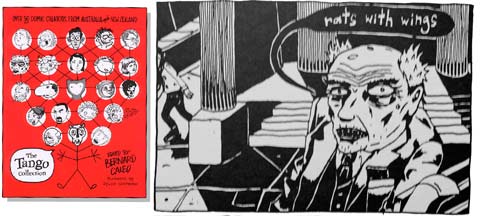
With the current rash of comics being turned into films, it’s probably a good time to remember there’s a fine array of Australian indie comic makers with a truckful of published inked pages between them. The Tango Collection, an anthology loosely themed around romance and edited by Bernard Caleo is the latest attempt to gather some of these in one place.

“If comics had a muse, she’d have crooked teeth and freckles and wear thick black-rimmed glases and old fraying cardigans, sensible shoes and embarrassing shirts her mother chose. She’d also have deep-green eyes and piercings galore, a hidden tattoo, a deliciously dirty laugh.”

Dylan Horrocks in the foreword to The Tango Collection.

And while the above description of a muse may or may not work for you, it has to be said The Tango Collection delivers when it comes to offering rawness of spirit, ideas and execution. It’s a passionate affair, featuring over 50 comic creators from Australia and New Zealand.
tango2

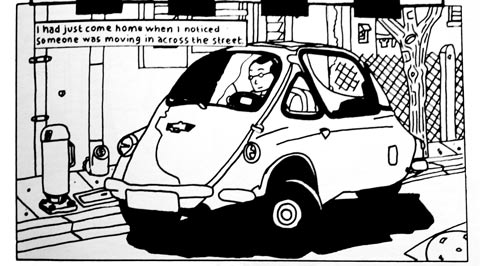
(image above by automobile fetishist, Gregory Mackay )

Highlights?
With such a diverse bunch, favourites are always going to vary, but these are mine:
Mandy Ord’s distinctive stylings always stand out, Pigeon Man…(up top, rats with wings! ) and ‘A Good Provider’ both deliver.
Gregory MacKay’s meditation on vintage aesthetics is really well timed and crafted.
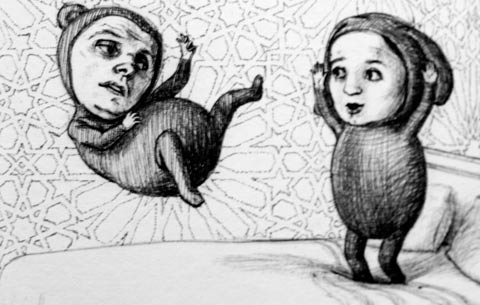
Michael Camilleri’s mini-creature humans (see below), Andrew Fulton’s parent-son wrestling, Michael Fikaris’ food thoughts and Tim Molloy’s Shining Silver Path all manage to explore visual cuteness in interesting ways.
Glenn Smith + Gina Monaco take that a step further, gushing about sausage sandwiches at Bunnings and never eating sushi without each other. ( Apparently, they’s in lurvvvve )
Tim Danko brings some typically avant layerings from NZ… pondering about Melbourne as the world’s most livable city.
and Bruce Mutard’s internal food critic is well evoked in an exploration on the difficulty of eating ethically these days.

It’s an eclectic collection, though a few too many of the comics had visual styles or techniques that felt unpolished. That’ll vary depending on personal taste, and given the range, it’s a book well worth looking at. ( Out now through allenandunwin.com )
tango3

Web profiles of Comic Artists Involved?
Kirrily Schell – kirrilyblog.blogspot.com
J. Marc Schmidt – 3rdblade.net
Glenn Smith – glennoart.com
Ian C. Thomas – labyrinth.net.au/~iant
Bernadette Trench-Thiedeman bernadettett.blogspot.com
Bobby N – bluetoaster.com
Jenny Nestor – redbubble.com/people/nestor
Mandy Ord – mandyord.blogspot.com
Gordon Reece – gordon-reece.com
Daniel Reed – crumpletonexperiments.com.au
Angela Savage – angelasavage.wordpress.com
Tim Molloy – timmolloy.deviantart.com
Toby Morris – xtotl.com
Gregory Mackay – gregorymackay.com
Dylan Horrocks – hicksvillecomics.com
Jared Lane – jaredlane.co.nz
Zeldz Magnoonis – syrupcomeks.com
Scott Matthews – mediumtedium.net
Pat Grant – patgrantart.com
Nicki Greenberg – nickigreenberg.com
Edward J. Grug III – webcomicsnation.com/grug
Owen Heitmann – owen-draws.livejournal.com
Robert De Graauw – angelfire.com/mt/seymour
Michael Fikaris – braddockways.com
Adi Firth – adisillos.blogspot.com
Adam Ford – theotheradamford.wordpress.com
Mirranda Burton – pawpedaller.com
Bernard Caleo – cardigancomics.com
Tim Danko – deadxeroxpress.com
Oslo Davis – oslodavis.com
David Blumenstein – nakedfella.com
Bowb – ragingyoghurt.org
Brendan Boyd – myspace.com/boydiemusique

And Some Australian Comic Links?
http://comicslifestyle.ning.com
http://www.tabula-rasa.info/AusComics/Links.html
http://www.ozcomics.com/
http://www.rizzeria.com/about – collectively owned stencil-press printing group in Sydney
http://comicsdownunder.blogspot.com – history of Australian comics from 1930 to today.

by Sean Healy, October 27, 2010 0 comments

We Made Our Own Disaster ( Nom Nom Chomsky )

wemadedisaster
Good times! Film-maker Robin Mahoney and bass meister Si Begg have a new full length DVD out!

The Executive Summary
We Made Our Own Disaster, A study of fascism in late 20th Century democracies : By Robin Mahoney and Si Begg, out now through Optronica (UK group founded in 2004 by artists/producers Addictive TV and curators Cinefeel ).
DVD, Dolby 5.1, 66 minutes.

Rewinding to The Noodles Foundation
If unfamiliar with the turn of the millenium era ‘Death Of Cool’ compilation series, browsing sibegg.com/noodles should give a good indication of what goes through the head of Si Begg when he’s not sculpting monster basslines and synth earworms (Actually, one step better – listen to 30 second snippets from each track on ‘The Complete Death of Cool’, which combined the best Noodling via the Leaf label ). Somehow those compilations managed to blend sonic sophistication, chunky basslines and quirky British humour into some sort of lovable mutant electronica. And at some point, they also released ‘a blitzkrieg assault of scratchpunk videos to feed your desktop’ entitled Ho-FuN – ‘The Smallest Film Festival In The World’.

Live Cinema and Dancefloor friendly DVDs?
Inevitably then, this study of fascism is more Ali G than Adam Curtis ( famed BBC documentary maker ). It’s best moments harness the curatorial judgments of the editors ( digital crate diggers, represent! ), their technical flair ( there are some captivating sonic and visual transitions) and the underlying dry British humour which milks televisual moments for every absurdity, horror, and occasionally sublime flavour. Midway through for example, a TV cabaret snippet is transformed beautifully, loop-stretched, as a zoom zeroes in, until eventually cross-fadeing into a clip of a cat spinning in zero gravity with a trainee astronaut. And some of the material is great by itself, such as a series of everyday characters staring awkwardly into the camera. There are many such golden moments, but on the flipside, the continual leaning to the dancefloor ( letting faster music and beats drive the editing, overly repetitive sample use etc ), diminishes its appeal as a DVD ( given the inevitable comparisons with cinema grade production levels and screenwriting ).

As a DVD, this is a notch above many of the video mixtapes now abundant online – you don’t get to be veterans of collage without learning a few tricks. That said, the idea of a remix compilation based around mostly archival footage and nostalgic tv commercials is a less compelling idea today than it was a dozen years ago, and the ability to lure eyeballs away from fragments online to something longer form, really depends on the quality, coherence and originality of the overall vision. There’s plenty of adventure to be had on the disc and Sibegg’s soundscaping for the most part plays a great part in binding everything together, but some of the disc’s techniques are quite dated, such as mixing of badly keyed footage, certain visual effects and a stuttery on/off approach to vocal samples that becomes annoying after a while. Why the repetitive triggering and re-triggering of samples, when there can be much more sophisticated and fluid sequencing possibilities used in the live terrain ( eg final scratch / Serato / Ableton Live sequencing video clips with midi, max for live used with jitter etc )? Maybe this is a result of the DVD being edited with traditional editing software, rather than explored with real-time processes? Who knows? Anyways, yes, more Nom Nom than Noam, but a fun and commendable effort, and another reminder that creating live cinema, or ambient cinema that can be tuned in and out of like music, is actually pretty difficult.

by Sean Healy, October 26, 2010 2 Comments

Gangpol Und Mit: Faits Divers DVD

gangpolundmit_DVD1

What’s a DVD again?

a) “Another Useless Ironic Colourful Object In The Long List of Items Produced By The Falling Western Empire”
b) Plastic taking up room on shelves you wouldn’t need if you didn’t collect plastic
c) A great way to support independent visual artists and musicians
d) A snapfrozen piece of the internet, a medley of fragments and crosswired influences
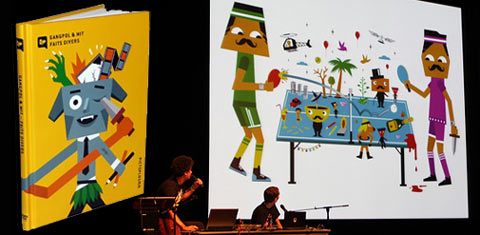
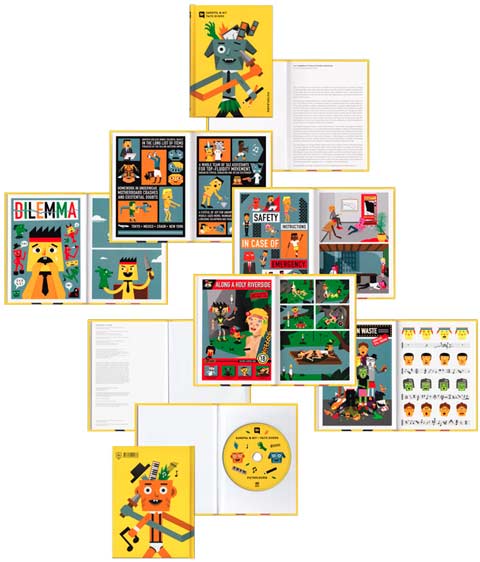
e) All of the above, ie Faits Divers by Gangpol & Mit, published by Pictoplasma publishing, beautifully packaged and designed by Wiyumi.

“Sonic and Visual in Love”
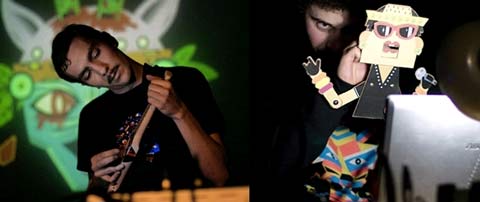
Faits Divers finds my favourite French audiovisual duo heading off into a more narrative driven direction than previous animated efforts. Sure, the sugarbuzzy pop charm is still there, and they are still farming the possibilities of blending nostalgic sounds and visions with a caricatured cutting edge tech. Where this once presented itself as mutant rhythmic AV probably best suited to a live environment, we are now treated to extended explorations in their cartoon worlds – where deviant plots unfold over time and the music doesn’t try to fit so much in at all times.

gangpolundmit_DVD3

“Many of the characters in the clips are easily read as extensions of the creators themselves, battling it out on the ping-pong table, aloof deities on a tiny cloud, lusty beings united in tantric embraces, or sailors stranded on a distant shore, on the verge of embracing cannibalism”

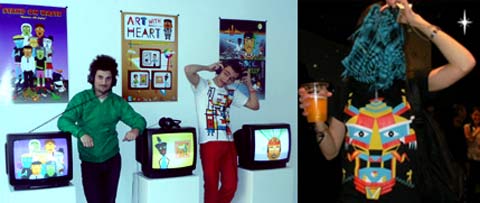
The DVD comes in 4 flavours: Clips/Stories (eg The Hatred Boat), Activities (eg Stand on Waste) and Art with Heart (Interviews with fake artists) and Archives. There is no option to play the soundtrack by itself, which is maybe deliberate, but there is available:
“A special free gift mp3 package delivering 4 new edits of its soundtrack, alternative versions especially reworked to animate your new years celebrations, wedding parties, mystic choirs, ethnic orchestras and goat skin percussions etc”.

gangpolundmit_DVD4

“In times where digital media and low-cost travel shrink the globe to the size of a pixel, we are haunted by the computer generated nightmare version of this carnival. The man-eating feast is taken place just millimetres below your computer screen – slaughter on the motherboard.”

“Gangpol & Mit’s message is subliminal: Eat technology before technology eats you!”

gangpolundmit_DVD2

Everything in quotation marks has been nabbed from the French horse’s mouth… ie the DVD liner notes*, “The Cannibalist Ethos of Techno Cannibalism,” by Lars Denicke and Peter Thaler, or the G+M website, where many treats await you.

by Sean Healy, October 15, 2010 1 Comment

Graffiti Gardening

Or how a lack of space doesn’t seem to deter some people from getting their green thumbs on.

Ha-Ha Plants
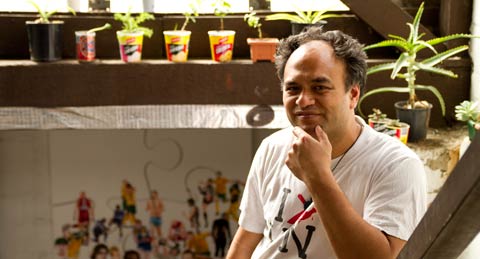
Regan Tamanui’s website proudly proclaims in a banner, that he is ‘Australia’s most prolific and notorious stencil artist’. It’s a claim few in the stencil community would dispute, and to those outside that circle of spray paint fumes and stanley knives, there’s a fair chance Regan’s work has been stumbled across in the street, usually with his Ha-Ha tag somewhere nearby. Turns out though, that Regan is also quite the guerilla gardener, adapting lots of inner city spaces for one of his latest passions: growing food. I went to visit his inner city Melbourne studio to have a look at some of this in action.

hahaplants

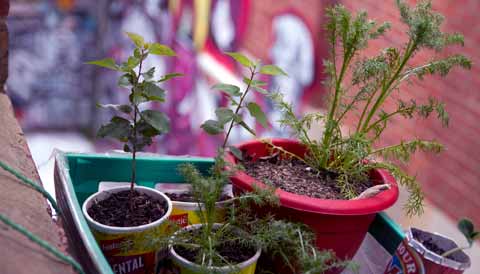
“I was previously a landscape gardener for 3 years in New Zealand, and have done a bit of it here ( in Melbourne ), I just really like being around plants and gardening, it’s good to see some nature instead of the concrete jungle,” explains Regan in his studio, surrounded by plastic stencils, stacked canvases, and pot plants, and next to a window ledge full of apple seeds he is drying out for a fruit tree project. Outside that second storey window of his studio, Regan has attached a series of milk crates with pot plants in them, growing herbs and small vegetables, some of the seedlings growing in styrofoam two minute noodle containers and beer cans.

hahaplants7

Aside from the studio, Regan also maintains mini-gardens in portions of the yards belonging to friends ( ‘they end up getting more excited about it than me in the end..’ ) and plants potatoes in vacant lots and spare space near train tracks.

hahaplants2

“It’s just so satisfying to plant a seed and see something grow out of it, and then get to eat it. At a friend’s place we’ve set up tomatoes and zucchinis growing on his rooftop, and the owner of the building wants to turn it into a full proper rooftop garden which is great. I have a friend who grows cactus gardens in a shopping trolley on her balcony in Bourke st… so you can really grow stuff anywhere.”

hahaplants4

And art? Regan’s stencils will be on gallery display Australia-wide from Oct 30th:
“The National Gallery of Australia bought a whole range of stencils in 2003, including some of mine, and they’ve organised a big touring exhibition of it called ‘Space Invaders’, which starts in Canberra, and then travelling to lots of places around the country.”

hahaplants5

[ Update – Liisa from Eatwithme.net points to this tram stop garden as a great example of urban food growing, which reminds me I also wanted to link to Permablitz, a cool group that ‘eats the suburbs, one garden at a time’. ]

by Sean Healy, October 14, 2010 2 Comments

Form + Code Review

Aye, Form + Code is the new book for Casey Reas, Chandler McWilliams + LUST, which carves it’s academic credibility by having not only one, but two, subtitles:
a) In Design, Art, And Architecture
b) A Guide to Computational Aesthetics.
Nonetheless, if you’re remotely inclined to create with computers – it’s a great and encouraging, provocative read.

Software Aided Innovation
A stoner sitting on the edge of a rooftop tells you: “Y’know what? I really looooove software.” Grinning insights follow, some of which make sense, some which don’t. Software can permeate so much of our interactions today, our existence, that it’s easy to take for granted that effectively we live with swarms of robots in our midst. Robots that automatically pay our bills, robots that share communications with friends, robots that search for us, robots that play back media for us. When it comes to robots that might aid us in the creative disciplines though ( be it art, music, design, architecture, etc ), in what ways are we limited by their design? In other words, in a question that’s at the heart of the Form + Code book, and aimed directly at creatives who use computers – to what extent do we wish to be limited by the constraints of any particular software system?

formcode1

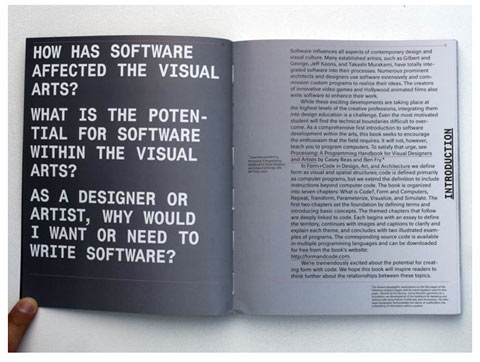
Defining Form as visual and spatial structures and Code as computer programs and non-computer instructions ( eg IKEA furniture building instructions, or instructions for knitting a scarf ), the book wanders through a history of computer aided creative work, and attempts to meaningfully categorise the different ways code can be useful. The book is definitely aimed at non-coders, an attempt to encourage more creatives to explore the options they have available for customising and creating code to make their work. For someone only recently dipping toes into the visual programming / patch based environment of Quartz Composer, the book provides a nice framework for thinking about image manipulation, and removes some of the ( … well, let’s just say it.. ) fear surrounding abstract coding.

formcode2

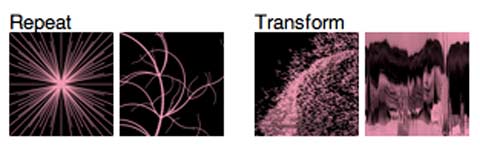
Some general core coding principles are presented simply, which is followed by examining how the computer relates to form – through defining co-ordinates, shapes, and colour, and then the extra layers of light, printing and fabrication bringing the form to life. It’s an approach which works well, demystifying the possibilities, and illustrating them well with a range of provocative contemporary and historically important examples ( in graphic design, typography, data mapping, digital fabrication, interactive media etc ).

formcod3

Naturally there’s code to play with ( via the companion site ), and the aims behind the book are reinforced when it is understood co-author Casey Reas has also co-authored (with Ben Fry) the programming language Processing ( free for mac, linux, PC), which is described as ” a software sketchbook.. an open source programming language and environment for people who want to create images, animations, and interactions”.

( Out now through Princeton Architectural Press )

by Sean Healy, October 11, 2010 0 comments