Craftwife Interview

Japanese audiovisual performance that takes in Super-Collider, NES emulators, circuit-bent Pikachus and custom iphone controlled sound synthesis programs and video sampling systems? Ah, that’d be Craftwife. They play “70-80’s style techno pop music in the special costume that may remind you (of) a German band (.. in a miniskirt).” Takeko Akamatsu took time out from touring Australia’s East Coast, to answer a few questions.
craftwife
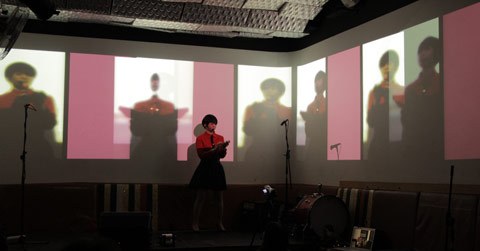
[ Above, Craftwife @ Horse Bazaar, Melbourne, Wed Jul 28, 2010. ]

How do you describe your show?
It’s an audio-visual performance and it looks like a techno pop music live. But I combine many elements in a show with many thoughts. So I’m very happy if audiences can see my performance in different, various way.

Kraftwerk liked machines playing notes, claiming it freed them up for composition… What have Craftwife been freed up to do?
Making music with computer is something special for me. I found many musicians are still following the traditional way, i.e imitating a physical phenomena with machine. I’m not interested in it, I’ve been trying to find the new way to play music with computer programming and technology. I really don’t like keep on doing a same thing, “Practice”. So that I’m happy I don’t need any sweaty practice to perform as Craftwife.

How does a circuit bent Pikachu fit into your show?
I have a project called “Craftwife + Kaseo + “. Kaseo (is the author of Pikarumin – bent Pikachu) plays powerful and loud noise music. The style of our music is very different, but we have common thoughts about the sound and music. And visually, you may find some Japanese “Kawaii” or “character” culture. Also I love the contrast of my “clean” programming, software and his messy, physical hardwares.

What has been your favourite / ( or would be your ideal?)  place to play a Craftwife gig?
Craftwife plays everywhere if audiences are waiting for us. I had played in different places such as a small cafe to a nice club or fashion museum  even at an academic conference. I cannot choose which was the best, we’re going to have a show in planetarium of my small town in this September and I’m really looking forward it. Hopefully, it must be fantastic if we can play with my favourite German band someday.

What do you enjoy about super collider?
It’s difficulty. Memo: sometimes people are used….. to be used by technologies. bababa .. too sleepy…..
craftwife_and_kristin
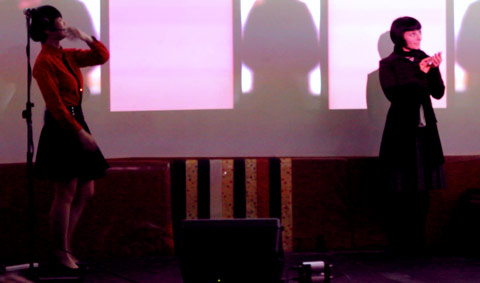
[ Above, Craftwife + Super Collider + custom software + iphone + bonus Kristin… ]

[ Side-note: First discovered Craftwife via a blog post by David Lublin, one of the VDMX head-coders. Popped off an email to see if Takeko would like to do an interview. As well as agreeing to one, Takeko mentioned she was touring Australia soon. Which later turned out to include Melbourne. On my birthday. Thereby continuing the weird sensation that VDMX pulses somewhere near the centre of a cult universe, an electromagnetic conduit for a small but growing band of dispersed pixel gypsies.]

by Sean Healy, July 29, 2010 3 Comments
How To Review the CANON 7D Camera

Part 1: The Hustle

Hassle Canon to sell a 7D at cost price in exchange for review, knowing from using the camera, and seeing online videos, that this is a most desirable camera for shooting video.

Part 2: Zoom In

Focus the review on the video qualities of the Canon 7D, knowing that the Canon 5D MK II has much better photo image quality, and that while other video cameras are on the horizon, which promise similarly large sensors but better video handling controls ( eg the SONY NEX range), the 7D holds a unique position for video capture at this point.

Part 3: Dirt, Meet Fingernails

Run around with the camera a bit, see what it can do ( it sucks light in! ), see how it feels ( sturdy, solid, well built). Think back about shooting video with it, and analyse each component.

canon7dbody
The Body
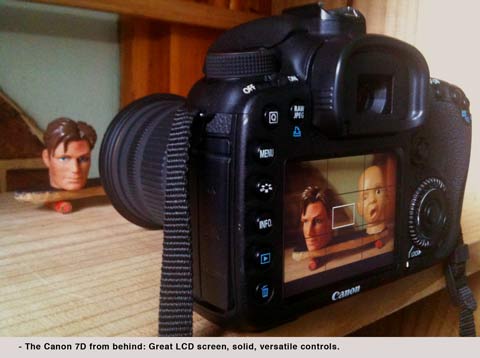
Jumping inside, the camera’s sensor is APS-C sized which means the focal range of all lenses used with it need to be multiplied by 1.6 ( eg a 50mm lens which gives a natural perspective on a full framed camera, will look like an 80mm lens on the Canon 7D – 50×1.6 = 80mm = a lense which gives a slightly zoomed in perspective.) Lenses are separate, and not something being considered here, but the camera itself feels great. Controls are precise and reliable, built to last. That said, this is not a traditional video camera, with ergonomic focus and zoom adjustments within reach. The small size ( relative to a big video camera) also means stabilisation is needed to prevent too much wobble-cam. There is a smorgasbord of companies rushing to supply supporting rigs, but the cost of these also needs to be considered up front if video is your goal.

Software
– Highly customisable interface ( hardware buttons can be re-defined / has 3 custom global settings for easy access to specific settings to suit particular shooting conditions )
– Saves files to a Compact Flash card, in the H264 codec. (Good quality, but needs transcoding into editing software)

Image Quality
Utterly gorgeous. Induces giddy laughter in low-light. It’s not without issues ( google 7D + jello-cam, rolling shutter, moire and aliasing ), but if you’ve come from any other video camera in the same price range, you’ll mostly just be slack-jaw amazed at what the camera is capable of.

canon7d_behind

Audio Quality
As lame as might be expected for what is essentially a photographic camera slowly morphing into becoming a video camera. A work around? Record using an external recorder such as the Zoom H4N, and use PluralEyes software to auto-sync up your high quality audio files with your lower quality ones, within your video editing software. Once synced, delete the bad audio, and your filmic masterpiece now has rich sound to match.

Part 4: Duel at Dawn

Compare the 7D with the 5D Mk II, the 7D’s only true competitor in the field.

5D: Full frame sensor, greater image quality, more depth of field. Better for wide shots. Use up to 25600 ISO ( ie great for low light). 3.9 FPS for photos. 1080p at 30p only. ( ie 1920 x1080 HD progressive / non-interlaced footage at 30 fps ).

7D: Smaller APS-C sensor ( means less image quality, but also means closer to 35mm movie sensor size and possibility, after adding mods, of using cinema lenses ). Better for telephoto shots. Use up to 12800 ISO. 8FPS for photos. 1080/30p (29.97), 1080/25p, 1080/24p (23.976), 720/60p (59.94) and 720/50p ( 50p + 60p footage can effectively create slow-motion footage at 25p and 30p ).

Aside from the above specs, the 7D also has a dedicated video record button, a better LCD screen for viewing in daylight, and better ergonomics for handling. Plus, this guy recommends it for video.

Part 5: Signing Out

When offering some final words of critical acclaim for this most desirable video camera, don’t forget to crowdsource, and point to the huge range of support material online developing around the 7D and it’s enthusiastic fanbase. People like to see it for themselves.
vimeo.com/groups/eos7d
vimeo.com/groups/canoneos7d

See also:
The skynoise intro to DSLR cameras and an overview of
steadicams and video stabilising systems DSLRs.

Thanks to Canon Australia, and to 3DWorld for printing the review.

by Sean Healy, July 27, 2010 2 Comments

Skateboard Vidi-Yo

Considering cinematography as a dynamic flow through time and space, it’s hardly surprising that skateboarders often demonstrate a flair with the camera. Most are familiar with the skate background of Spike Jonze, but let’s tilt the hat to a few other skate creatives.

What’s Up, Stacy Peralta?
bonesbrigade
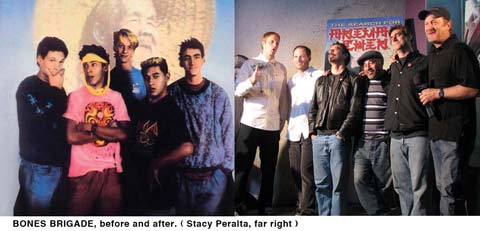
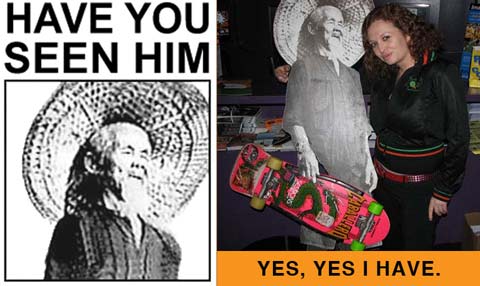
After developing a public profile in the 70s as a sponsored skater with long blonde Californian hair, Stacy later used this to form the influential skateboarding company Powell Peralta ( with George Powell). As a marketing move, they gathered some of the best skaters ( such as Tony Hawk, Steve Caballero, Lance Mountain etc, to represent the company as the Bones Brigade. Crucial to their wild success was a series of videos directed by Stacy, which fruitfully combined 80s skate gymnastics with collaged graphics, cleverly repurposed weird locations and artful editing. The Search For Animal Chin probably reigns as the most notorious of those, as the skaters wander between skate locations trying to find the kidnapped grandfather of skating, ending their search at a giant custom built ramp when they realised Animal Chin represented the true spirit of skating, and was within everyone. Further refined, Stacy’s technical skills were again well employed on his first feature, Dogtown and the Zboys ( a history of early Californian skating), then Riding Giants ( about big-wave surfing ) and Crips N Bloods ( a history of racial violence caused by segregation in Los Angeles ). From there, apparently he went onto sell hamburgers : whoppervirgins.com.

animalchinfound
Breaking News from image above: Animal Chin found by Ilana Taub.

Macho Tail Drop
Pitched as a Michel Gondry influenced Charlie and the Chocolate Factory for skaters ( If that sounds implausible, check the trailer ), MachoTailDrop zooms out from the celebrity skate circuit and tries to examine the skate stardom making machine and it’s impact on a young skater. While this terrain is covered by Stoked, The Rise and Fall of Gator ( a true and sad story of a skater succumbing to the pressures of the public limelight ), MachoTailDrop explores this from a wildly imaginative perspective. It’s a promising feature debut from co-writers and directors Corey Adams and Alex Craig, who won a $1 million prize to shoot their flick, and a teaser click will have you watching flaming riverside halfpipes, underground caverns, horses wandering inside a mansion and some quite decent skate tricks.

Paper Cut Grinds
Tilles Singer has fantastically reimagined the classic skate magazine photo sequence, by cutting out skaters in each stage of their tricks, then having them perform as stop motion animation skaters on his table top, alongside or on top of various props. It’s a gorgeous effect and well worth a few replays.

Pool Dreaming
I had a dream ages ago that involved skating a curved pool – that was full of water. It was easier to balance underwater – you could lean away from the pool wall while riding up it, and could really carve up towards the edge of the pool in a really controlled way, kind of like skating in slow motion. At some point my underwater skating brain thought it’d be good to get some air ( as in the skateboard move, not oxygen, I seemed to be able to skate fine without needing to breathe ), and I started skating towards the surface. Do you know what it feels like to grasp your right hand on the edge of a skateboard as you approach the top of a pool, then burst through the water surface, rise like 3 feet in the air, turn 180 degrees and then dive down again, splashing through the water, letting the wheels hit the pool wall just under the edge, and riding through the pool again? Let me tell you, it feels AMAZING. Watch Bob Burnquist if you need some help imagining. (Found via coolhunter.

Even More Skate Flicks
Cannonball by California is a place, via good.is. Apparently there’s a lot of newly empty pools in California these days, while people re-boot the American Dream. If the Trans-Siberian railway is more your flavour, 10,000 Kilometers is a skateboard documentary that documents the two-month-long journey of skaters who travelled from Moscow to Hong Kong by train, skateboarding the unique architecture of various cities in Russia, Siberia, Mongolia, and China along the way.

UPDATE: A timely tweet by William Gibson, points to this “Tarp Surfing” video ( which, yes, features skateboards.. )

UPDATE 2: Ok, so I’m not going to update this post with every single new weird skate video, but this was too good to pass up: Flaming skaters in Mexico, via Dangerous Minds.

by Sean Healy, July 22, 2010 2 Comments

Mr.Oizo + Jaques Tati

One makes songs about gay dentists, the other is a legendary French comedian and director no longer with us. Between them, they’ve delivered us this year, a pair of French feature films about serial killing car tyres and struggling magicians.

French Rubber
rubber
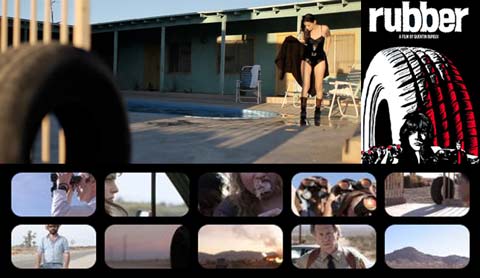
Mr.Oizo, already somewhat notorious from his audio exploits at Ed Banger records, has earlier branched out into music video and film making. Steak, a feature released only in France in 2007, had a plot based around kidnapping, plastic surgery and the fashion world, and handily, featured cameos from French artists Sebastien Tellier, Kavinsky, and SebastiAn ( who appeared as wheel-chair bound car thieves ). Apparently Mr.Oizo himself, Quentin Dupieux, is the only person who has an English subtitled version, after the French producer lost interest post-release in France.

Rubber on the other hand, is already popping up all over the web video radar, with quirky trailers available at vimeo.com, or fresh from the leathery horse’s mouth at rubberfilm.com ( and as it turns out, writing rubberfilms by mistake, delivers a premium fetish gallery. Not to be confused with Rubber, the 1936 Dutch flick, or Chris Cunningham’s flickerfest, Rubber Johnny ). It’d seem easy enough to think of this as a quirky road movie ( and yet another feature film shot on the Canon 5D), but this rubber tyre serial killer flick might just transcend the genre’s usual offerings. Also on the soundtrack alongside Mr.Oizo, will be Gaspard Augé of Justice ( another Ed Banger ). Make of it all, what you will. See Rubber at the 2010 Melbourne International Film Festival.

And In The Other French Corner..
tati

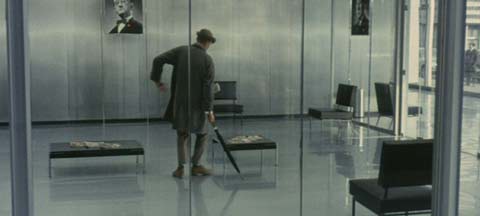
Being both a master of comic timing and carefully orchestrated cinematography, Jacques Tati‘s films inevitably unfold with visual charm, and an abundance of surprise for the eyes. Playtime, his most famous film, took 9 years to make, was shot on 70mm and involved a set on the outskirts of Paris which resembled a small city in itself. Like his other films, it too took a sword to modern society, lampooning social attitudes and obsessions with gadgetry and convenience, and being near dialogue-less, requires viewing to see just how funny it and Tati are. Interest is high then, for The Illusionist, an animation based on a script by Tati, and directed by Sylvain Chomet ( who also directed the gorgeous Triplets of Belleville animation feature). Tati intended to make the film as a live action film with his daughter, with the plot revolving around ‘a struggling illusionist who visits an isolated community and meets a young lady who is convinced that he is a real magician.’ And being a French production, naturally everything is a little more complicated.

See The Illusionist at the 2010 Melbourne International Film Festival

by Sean Healy, July 21, 2010 0 comments

World Cup Video Technology

Aside from the vuvuzela filtering and the demand for video replays of controversial decisions, there was also another newsworthy technology at the South African World Cup, 3D video.

3DTV
Wheeeeee! For those with 3DTV sets, SBS and some broadcasters from other countries beamed out select games on a 3D channel. That’s all fine and well, but the mammoth production needs of 3D meant the World Cup was both a test and a serious step up in live 3D production. Broadcast Engineering summarises the technical achievements well ( for both on-ground filming and MPEG4 compression and beaming to each country), and notes that each game uses 8 cameras ( Sony HDC-1500 ), mounted on Quasar 3D rigs from Element Technica ( for mobility, and built in motors that allow for remote focus/iris/zoom control.), and are fitted with Canon HJ22ex7.6B lenses ( 7.6mm to 336mm with 2X Extender, f1.8 ). Pro-tip: After some quick googling, better keep aside $30K for the lense, $67K for the Quasar rig and $90K for the camera when budgeting for this kit.. )

3D Cameras Under $200
Available for pre-order through Amazon : the Aiptek 3D HD (720P) camcorder for $199. $199. USB, SD card, HDMI connect to HD-3DTV – and “additional software for the camcorder should allow you to upload the stereoscopic 3D videos you made directly to YouTube 3D. And you’ll also be able to watch the recorded content on your PC with the help of anaglyph red-cyan glasses coming with the device even if you don’t have a better solution like 3D Vision, 3D TV or anything else that is better.”

3D on YouTube
Apparently this has been available for a year, the fruits of Pete Bradshaw’s spare “20%” time at Google. Stereoscopic 3D clips can be uploaded to Youtube, which will mix in real-time in your browser, and which allows a 3D pull-down menu to choose 3D options ( eg red/cyan glasses / mirror split etc ) Tag your video with yt3d:enable=true to enable the pulldown menu of 3D-viewing options. Example clips?

360 Degree Cameras
Available since January, and a weirdly named competitor to the portable Flip cameras, SONY’s ‘Bloggie’ camera comes with a 360 degree view attachment, and software which translates this into an extremely wide panoramic video.

3D or Not 3D?
As Brazil prepares for hosting the World Cup in 2014, they may do well to heed Mark Pesce’s advice: “Keep doing that and you’ll go blind“, where he notes that humanoid depth perception requires 10 different cues, and that the slightly different imagery in each eye ( parallax vision ) is just one cue. Watching 3D means we eventually ‘turn off’ these other depth cues while watching, and with lots of 3D viewing, this can cause serious problems ( known as binocular dystopia ). Watch those banana kicks!

by Sean Healy, July 8, 2010 1 Comment