Renting Cars, Bikes + Software

How’s this for a decent software pricing model : rent QLab for $3 a day? QLab is a pretty amazing looking piece of event software that allows control audio, video, and MIDI from a single workspace. It offers sample accurate synchronisation of audio and video across different machines, sync for incoming timecode, real-time video and animation, camera control and quartz composer integration for customisation. Browsing through the features, plenty of well considered detail is evident, and it looks to be a powerful and flexible solution for controlling many sources of media during a live event. You can buy the pro bundle for $599 US, but for a lot of people, the $3 a day licence would be pretty ideal for one-off events. It’s a wonder more software companies don’t get in on this sort of model. And other industries too.

Car Sharing
Taking a leaf out of Kurt Vonnegut’s book, and looking at civilisation from a distance – we do seem to be a species of oil crazed demons, intent on paving the planet over, and shuffling ourselves around in vehicles that weigh a whole tonne all by themselves. In cities with better urban planning and public transport, it’s obvious to citizens living there that not every single person needs to own a car to survive. Extending this idea another step, car sharing is about renting out cars for short periods of time and thereby reducing the amount of cars needed for a suburb. Some people need a car daily for various reasons, but for others who only need the occasional trip, the car sharing service can save a lot of money ( and other problems such as maintenance etc ). If you drive less than 15,000km a year you will probably find carsharing will save money. There’s three main car sharing groups operating in Sydney and Melbourne, each blowing their own eco-trumpet about the benefts of having access to a newer, fuel efficient car when you need it, and through sharing it with others, effectively reducing the amount of cars needed.

Flexicar, phone 1300 36 37 80 GoGet, phone 1300 769 389 Charter Drive, phone 1300 135 358

Renting Two Wheels?

melb_bikes

Like car rentals, daily bicycle hire has long been an available option for visiting tourists and wandery folk. Arguing that the short trip rental could appeal to the general public, and potentially encourage them to leave cars at home, the Victorian Government has launched a $5 million scheme which will see 600 bicycles available to pick up or drop off at 50 different bike stations across Melbourne. Subscriptions cost $50 a year, $8 a week or $2.50 a day – and the first half an hour of every trip is then free, $2 for the next half an hour and so on. A credit card is needed to participate, and helmets aren’t included, so it’ll be interesting to see whether people find bringing a helmet into the city more convenient than bringing a car. [ Yet to see a single blue bike ‘in the wild’, though plenty of them seem missing from their racks around the city… ]

by Sean Healy, July 2, 2010 0 comments

Vuvuzela Video Remixing

While South Africa is busy getting their plastic horn on – the rest of the world has responded with a flurry of filtering techniques to keep the vuvu drones from our ears. Mostly the filtering is aimed at audio, but there are some implications for video too.

Buzzkill
Audio nerds the world over must love soccer, because there’s been a huge outpouring online of ways to filter out the drone. Create Digital Music have done a pretty great round-up of these, tackling everything from EQing with onscreen TV controls ( get rid of 233, 466, 932 and 1864 HZ if you can), free VST plug-ins for mac and pc, acoustic engineers explaining the science of why vuvzelas are annoying ( I actually enjoy the medieval carnival / sacrifice kinda vibe they add ), vuvuzela orchestra ( yes, really ), vuvuzela radio ( uhuh ), and how to re-route audio signals using JACK or Soundflower into another application that has better audio filtering and VST capacities.

Audio Re-Routing
Wormhole2 – allows routing of audio between machines on a network. Now you can make use of all the processing power in your studio. For example; set aside a machine for complex instruments or effects, route audio out to it, then back into your favorite DAW. Or route audio between your PCs and Macs to get the best of both worlds. Or share audio between laptops on stage.

Soundflower is a Mac OS X (10.2 and later) system extension that allows applications to pass audio to other applications. Soundflower is easy to use, it simply presents itself as an audio device, allowing any audio application to send and receive audio with no other support needed. Soundflower is free, open-source, and runs on Mac Intel and PPC computers. IS often used for podcasting to combine tow different audi streams, or to combine skip interview voices etc.

Jack (the Jack Audio Connection Kit ) is a low-latency audio server, written originally for the GNU/Linux operating system, and now with Mac OS X support. It can connect any number of different applications to a single hardware audio device; it also allows applications to send and receive audio to and from each other. Jack is different from other audio server efforts in that it has been designed from the ground up to be suitable for professional audio work. This means that it focuses on two key areas: synchronous execution of all clients, and low latency operation.

Video Re-Routing?
But let’s say you want to send a video signal from one program into another program – how to do that? No such re-routing software currently exists, but there is at least a work around through Vade’s excellent ( and free ) Screen Capture utility. This is a Quartz Composer patch ( and therefore mac only) which allows a portion of the screen to be selected, then sent into another compatible program. This can mean web browsing / web-flash games / computer games etc can all be displayed in one corner of a screen, and then accepted within VJ software such as VDMX and used as a live signal, and filtered, mixed or processed to your heart’s content. ( Be warned : Removing plastic horns visually is likely a bit trickier… )

But Wait, There’s More..
Vade has more in the pipeline, a video re-router that will work fast, and on the graphics card rather than CPU. Tests so far allow easy re-routing between Max MSP / Jitter / Quartz and VDMX. Bookmark his site for announcements to come. And in other news the Auvi Objects have been updated for Max 5, which will please live visualists who remember it.. )

“Auvi was designed with an attitude of sympathy towards beginners. Even now, Auvi can be a lot of fun for those who are less technically advanced — for example, those who don’t want to mess about with shaders and GL. I like to think of Max as a haven for artists whose needs aren’t met by standard software. Auvi was my attempt to increase the fun-factor for these newcomers.” Kurt Ralkse

Soccer Video Remixing
Because you need something to do with all those pipes, right? Recommendo : the 1981 Escape to Victory starring Sylvester Stallone, Michael Caine + Pele in a German prisoner of war camp. Or maybe? Pele’s viagara campaign, where he offers these last smiling words to the camera:
“Talk to your doctor, I would..”
An amusingly careful phrasing, which allows Pele to retain all suggestion of athletic virility, but let anyone else know – Pele says it’s ‘ok’.

by Sean Healy, July 1, 2010 2 Comments

Steadicams + Video Stabilising Systems

Once you’ve figured out your DSLR camera, the next problem for shooting video with it, is going to be removing shakiness. Walking around with a handheld video camera generates jerky footage, especially with smaller cameras such as a DSLR. It doesn’t need to be this way.

The Cheap Option: Steadycam.org
Johnny Chung Lee has an infamous tutorial for building a steadicam with $14 of parts and needing one hour of your time – or you can order a kit for $39.95 if you wish. Bingo.

The Even Cheaper Option
A ‘string tripod’ is an old photographers trick, which simply involves finding a bolt in a hardware store that fits the underside of your camera, and attaching a 1m or 2m piece of string to it. Carry this around in your pocket, and when needed, attach bolt to camera, let string fall to ground, step on the string, and pull the camera upwards until the string is taut. Instant stabilisation.

The Bling Option: Steadicam.com
Aside from their Hollywood rigs which effectively turn camera people into stormtroopers, Steadicam also deliver smaller systems for smaller video cameras, and even a version for the iphone – the ‘Steadicam Smoothee‘ ( though you’d really have to question spending any money on that rather than getting a better camera). For smaller cameras though, there’s a whole new range of emerging players coming through.

Given the armies of DSLR wielding hipsters roaming the streets, an inevitable side industry has spawned to fit them in thin exo-skeletons for their auteur adventuring. A few of the key players include :
Redrockmicro.com – handheld, shouldermount and cinema style rigs.
Glidecam.com – These have nice ‘gimbals’, a kind of gyroscopic ball bearing system, which allows movements to be transferred to the handle, rather than the camera. Found one of these on ebay for $250.
Zacuto.com – Aside from a range of DSLR rigs, they also make add-on viewfinders, which can make the mobile filming process happen much more smoothly.
Cinevate.com – Large range of rigs

There are a quite few other manufacturers too ( eg The Blackbird Camera Stabilizer
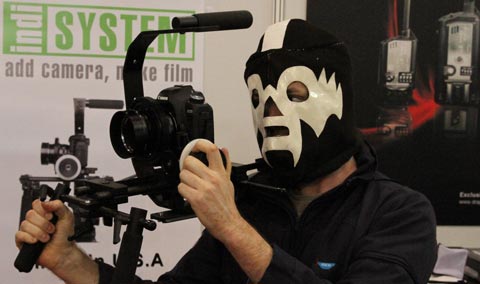
The CB 105 counter balance video camera stabilizer), but in general these kits tend to start at around $1000 for anything vaguely useful, and spiral upwards quickly. A recent addition to the list is slightly cheaper. The “Indi System”, made in U.S. and distributed in Australia by Dragon Image – is $950 for a complete rig, including focus follower, shoulder mount, adjustable handles, and rail sections for attaching externals ( lights / monitors / microphones etc ). I was able to try one out recently at the Camera Expo – felt good, solid, reliable.

wrestler_rig_IMG_0764

Still Need More Camera Movement?
A dolly is a wheeled platform that rides on a track or smooth floor – which generally means a lot of weight and volume to carry around for shooting. There are a couple of interesting alternative solutions around though. The Wally Dolly and Track System is a portable and minimal weight rails system made in Australia. Another option is fitting a rails system on top of a tripod, allowing the addition of smooth motion to framed shots – eg Glidetrack. Or a DIY Dolly? Sure. Built with skateboard wheels if you want. And when it’s time to graduate to a motorised dolly system, you’ll be ready to shoot the next ash spewing volcano

See also: steadishots.org – “Where the skills of the men and women responsible for some of the most memorable shots in television and cinema history are put on display.”
How Steadicams work – see how they eliminate shaking and rolling..

by Sean Healy, June 22, 2010 2 Comments

First World Problems

The Internet is a becoming a great place for people to whine about their first world problems ( The wi-fi at this airport lounge is so slow! My HDTV has a dead pixel! The Supermarket is out of my favourite French cheese! etc ). Turns out others are listening…

Some Context
During the last week, Australia was ranked by an Adelaide University study, as being in the top 10 countries for doing environmental harm (using indicators including species and forest loss, water pollution and carbon emissions). At the same time, the Australian Government announced it was postponing progress on it’s climate change agenda, despite being part of the world’s wealthiest 20% who are responsible for 80% of the world’s energy consumption. Does this sound like the sort of country you’d like to offer a helping hand? ( Particularly if living in one of the developing countries likely to be first effected by rising sea levels? )

The Rest Saving The West
DesignForTheFirstWorld has pro­claimed 2010 Inter­na­tional Year of the First World in Need, and has defined four main areas to address: Food Pro­duc­tion and Eat­ing Dis­or­ders, Aging Pop­u­la­tion and Low Birth rate, Immi­gra­tion and Inte­gra­tion to Soci­ety, Sus­tain­abil­ity and Over consumption.

“What does it mean to be a devel­op­ing coun­try? .. let’s stop to con­sider for a minute whether devel­oped coun­tries are some­thing we want to turn into. Are peo­ple in devel­oped coun­tries hap­pier or health­ier? Do they live a bet­ter life? Do they have a bet­ter under­stand­ing of nature and live in a bet­ter equi­lib­rium with the envi­ron­ment? Do they live in peace?”

“Our fellows in the first world often come to visit and give us their well intentioned but often very problematic “solutions”. We thought, why don’t we pay back? Dx1W is a competition for designers, artists, scientists, makers and thinkers in developing countries to provide solutions for First World problems. We’re call­ing artists, design­ers, tin­ker­ers, mak­ers, and thinkers with an idea to par­tic­i­pate. Two con­di­tions only: you were born in and live right now in a Devel­op­ing Coun­try and you are 13 years of age or older.”

The Ghana ThinkTank
The Ghana ThinkTank is solving the First World’s problems, one by one. Founded in 2006, the Ghana ThinkTank is a worldwide network of think tanks creating strategies to resolve local problems in the “developed” world. The network began with think tanks from Ghana, Cuba and El Salvador, and has since expanded to include Serbia, Mexico and Ethiopia. In their most recent project, they sent problems collected in Wales to think tanks in Ghana, Mexico, Serbia, Iran, and a group of incarcerated girls in the U.S. Prison system. These think tanks analyze the problems and propose solutions, which they put into action back in the community where the problems originated — whether those solutions seem impractical or brilliant.

By applying a typical process of community development against the grain, traditional power-roles are inverted, places are exchanged, and stereotypes clash with reality as disconnected cultures work together in detached but physical ways.
This project is an attempt to transpose parts of one culture into another, exploring the friction caused by solutions that are generated in one context and applied elsewhere, and revealing the hidden assumptions that govern cross-cultural interactions.

Garbage Dreams
Garbage Dreams is a 2009 film set in Cairo (and no, it’s not an Egyptian Slumdog Millionaire ), documenting the Zabbaleen tribe that lives off of collecting and recycling trash from Cairo. Remarkably, using primitive techniques, they manage to recycle 80% of the trash ( compared to 32% in the U.S. ). The tribe’s livelihood is under threat however, by foreign companies ( oops! Just trying to help.. ) taking over some of the recycling ( yet who recycle much less ). It’s confronting viewing, with campaign related links at garbagedreams.com.

Other Forward Thinkers : asmarterplanet.com – building a smarter planet – aiming to provide thought provoking content and a place to discuss it… a starting point for conversation about world issues. See also worldchanging.com.

by Sean Healy, June 3, 2010 4 Comments

Hot Dogma: Bennett Miller Interview on Daschund U.N.

daschund_IMG_0014web

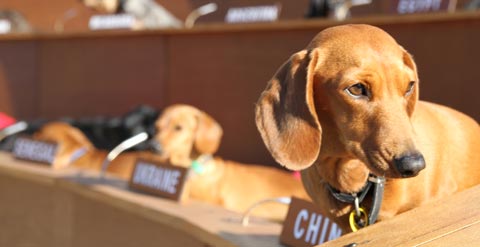
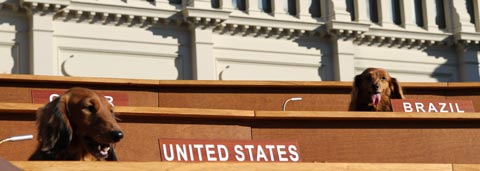
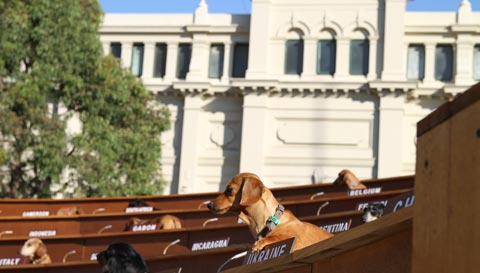
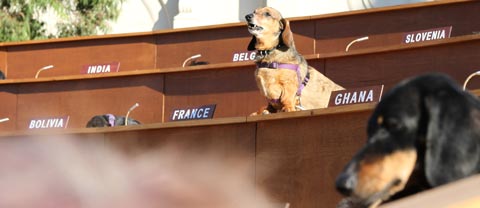
Perth artist Bennett Miller has been in the global spotlight recently for an artwork that involves 141 live sausage dogs masquerading as United Nations delegates, ‘Daschund UN‘ ( as part of the Next Wave festival). No stranger to complex logistics, previous artworks of his have included topiary mazes and retelling the story of a war in Iraq across nine mini-golf courses. He was kind enough to take time out from juggling canines to answer some questions:

Golf. Is it a gentle sport for the elderly, a grotesque misuse of land and resources for elites, or a chance for a good pun? In other words, what inspired your ‘Golf War’ series?
I regret the pun a bit- but the ‘grotesque misuse of land and resources for ( a game for ) elites’ is very close to the mark. The golf war was an ever expanding mini golf course that imitated the events and structure of an actual war in Iraq. It started as a landscape, then it was gradually turned into a game, then it was turned into an unplayable game. The architecture of the course is from the perspective of those waging the war I guess.

In the majority of instances it was shaped like a cross – like a contemporary ‘crusade’, but by the end of it this cruciform had been consumed by an islamic pattern. I liked the work at the very end, which was kind of a simple homage to the failure of the whole exercise, but before that the work was chaotic and peppered with obstacles and characters from the conflict. I made it ‘fun’ and interactive/playable to implicate the audience in the spectacle. The Dachshund UN has a lot more optimism in it than the golf war series ever did.
daschund_IMG_0027web
Was there a specific UN incident that triggered your thoughts for developing this project?
My interest in the reputation of the UN was triggered when the ‘coalition of the willing’ bypassed the UN during the Iraq War. Since then I’ve been interested in the public perception of the value of the UN- and what forces are at play in shaping this perception. I’m also very interested in the conflicts between the UN and Israel, which had a few flashpoints last year after the Goldstone Report. I developed this work in response to the festival theme ‘No Risk too Great’. The UN is a very good fit for that idea, and while my work seems like a piss-take, I’m actually a huge fan of the UN (whilst it has some massive failings- the idea of it alone is quite important).
daschund_IMG_0016web
What qualities makes the dachshund a good choice to pose as a United Nations delegate?
They are physically restricted via a breeding history that has literally ‘shaped’ them. Yet they always persevere- blissfully unaware of their stature and limitations. They often look very proud, like a statesmen or diplomat, but in faintly ridiculous dog form.

They also have a racial diversity comparable to humanity- eg ‘different but the same’, there are short, long and wire haired dachshunds, red, black, tan, dapple, chocolate and even ‘piebald’ whites. I don’t know of another dog breed with that racial breakdown, outside of all those poodle subgroups with silly names.

I love dachshunds, I don’t know whether other people see the same thing in them as I do or not, but they really make me happy and seem to represent the beauty of endeavor and personal struggle, alongside the absolute folly of it.

I wanted the audience to expect the work to be critical of the UN -but wind up affected by it in a different way. Like how ‘dog’ or ‘bitch’ is an insult but really everybody loves them. The dachshund seemed to be the right dog to mimic how the UN is both flawed and fantastic.
daschund_IMG_0011web

How did you possibly manage to get 47 dachshunds?
The Kickstart program by the awesome folk at NEXT WAVE helped get the project off the ground, and get callouts placed in the Age newspaper. I also had a lot of help from Corrienne at the Dachshund Club of Victoria. I actually needed 3 separate groups of 47 dogs- for a total of 141 – which took a full year of recruiting and meeting (pleading) with the owners. It got much easier as the momentum grew and interest in the project snowballed.

daschund_IMG_0036web
How did they seem to feel about seeing each other?
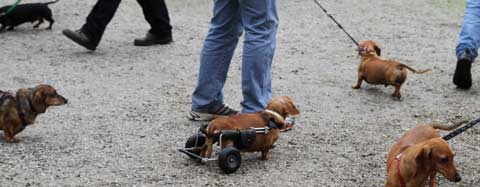
Many dachshunds only like other dachshunds, it’s not always true- but it often is. The truth is I don’t really know what they feel about it, so whilst I like to think the dachshund UN is an exciting event on the dachshund social calendar, it may not always be the case. Certainly there have been some barking incidents, but on the whole the dogs have been remarkably well behaved and fall asleep more often than they get upset.

Did the large number in a small place seem to affect them?
It can be hard to tell what they think about the experience – I wonder what the dogs make of suddenly being placed in a large sculpture full of other dachshunds, in front of a large human audience. Based on the only evidence I really have, some get a little angry and some fall asleep, the bulk of them react somewhere in between… interested in the surroundings- but only to a point.

How have the dachshund dog owners responded to the work?
I am eternally grateful to the owners for making the project possible. Some owners have responded to- and really supported- the theme of the work and some have just wanted to involve their dog for the sake of the novelty. With so many people involved I have found it hard to keep up with everyone properly- but I was pretty astounded at how generous they have all been with their time.
daschund_roller_web

What kinds of unexpected scenarios / strange logistics have you encountered with the work?
The whole project has been a bizarre undertaking. Logistically it was massive and difficult, and generated all kinds of weird databases and spreadsheets. The structure itself had some strange requirements too. As the deadlines approached it became super serious- with risk assessment forms and engineer approvals. I became completely humorless about it, which was a bit strange for what is essentially a gathering of sausage dogs.

What breed of dog do you think best represents Kevin Rudd and Tony Abbott?
I keep getting asked if I think ‘politicians’ could learn from the dachshunds but it’s hard to answer because I actually love dachshunds and the UN, and intended the work as a (balanced) celebration. If I was making a work about australian politics it would be two chihauhas in a room full of mirrors.
bennett_and_marcus
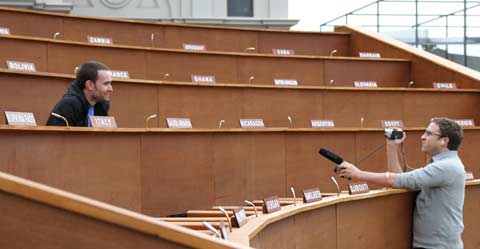
Above: Bennett being interviewed by Marcus Westbury.

[ Related: Videohuahua, an interview with Fernando Llanos about his VIDEO-PROJECTING-CHIHUAHUA! ]

by Sean Healy, June 2, 2010 4 Comments