
Oily Water, A Belated 2010 Tech Round-Up

assange_glasses

[[Below was my final technology column of the year for 3DWorld magazine in 2010. Only get 400 words or so to play with there, but added a few words and links at the bottom here, that point to some more interesting reading on the info-tech event of the year… ]]

The big technology stories of 2010 arguably revolved around oil and information – the flow of it, the spilling of it, and the abundance of hot air generated by it.

The White House called BP’s Gulf of Mexico spill in April 2010, the ‘worst environmental disaster the US has faced’, and it ended up being the ‘largest accidental marine oil spill in the history of the petroleum industry’. BP’s internal documents were later to reflect the spill was their own fault, and they only had themselves to blame for their own PR moves which included their CEO taking time out to relax at a yacht race during a key time of the repairs. Amongst the many responses to some of BP’s press gaffes, twitter user @BPGlobalPR provided the funniest and often most biting commentaries.

Later in the year, in Cancun, Mexico, we had some small progress towards our increasingly necessary transition to a low-carbon, resource-efficient economy. At the Cancun climate conference, a funding model was approved  that aimed to provide $100 billion a year of funding for developing countries by 2020 to help them green their own economies as well as adapt to the impacts of climate change. A win of sorts. Next meeting, Durban, 2011. Meanwhile:

“A trimaran sailing boat has circled the North Pole in a single summer season (Oct, 2010), a feat made possible by global warming and the melting of the Arctic ice cap.”

Information Wants To Be Free / Comic / Tragic

“They could plug into your wire whenever they wanted to. You had to live – did live, from habit that became instinct – in the assumption that every sound you made was overheard, and except in darkness, every movement scrutinized.”
– George Orwell, 1984

“Both the American people and nations that censor the internet should understand that our government is committed to helping promote internet freedom.”
– Hillary Clinton, now part of White House moves to try and prosecute Wikileaks in regards to leaked U.S diplomatic cables, some of which suggest Clinton ordered espionage on U.N. members.

“Censorship has also been privatized… litigious billionares and big companies are able to effectively prevent certain things appearing in public..”
– Julian Assange, founder of Wikileaks, which was refused service by PAYPAL, Mastercard, Amazon’s hosting late in 2010.

“We know for sure that one big media company in the US had the ‘Collateral Murder’ video for years and did not release it.”
– Julian Assange

“The aim of Wikileaks is to achieve just reform around the world and do it through the mechanism of transparency.”
– Julian Assange

“Yeah so if you ever need info about anyone at Harvard, just ask. People just submitted it. I don’t know why. They “trust me”. Dumb fucks.”
Mark Zuckerberg, during his early years of Facebook. He was the 2010 Time person of the year. The Time readers poll voted for Assange.

“Every CEO of a social network should be required to use the default privacy settings for all of their accounts on the service.”
– Anil Dash

But What Does It All Mean?
Wikileaks has of course, generated a wealth of debate about its impact and importance. Some of the more interesting pieces to be found:

First up, there’s “State and Terrorist Conspiracies” – an essay written by Julian Assange himself, which attempts to provide a philosophical foundation for Wikileaks. Remarkably, given the amount of international press, it took a blogger to point out the availability of that essay online ( thanks Aaron Bady! / zunguzungu ), and his analysis, ‘To destroy this invisible government’, adds depth to some of the more hyperbolic pro and con arguments being published.

Inevitably, much is being made about the lack of condom / rape allegations surrounding the case in Sweden.  This has extended to ‘raging debate among feminists regarding reaction to Assange’s arrest and its meaning.’ Rape deserves to be treated seriously, and celebrity profiling is easier than exploring the bigger picture, but disproportionate media coverage about these tangents of Wikileaks, given the mountains of revelations also available, in the end does the media a disservice.

Geert Lovink dropped ten theses on wikileaks back in Aug 2010.

Jaron Lanier wrote a lengthy and scathing critique at The Atlantic, ‘the hazards of nerd supremacy‘, which contains much of merit, but then maybe missed the point as well – at least according to Zeynep Tufekci, an assistant Professor of sociology at Baltimore. In her piece, also published at The Atlantic, she claims the real news story is the exposure of internet control mechanisms.

“What the Wikileaks furor shows us is that a dissent tax is emerging on the Internet. As a dissident content provider, you might have to fight your DNS provider. You might need to fund large-scale hosting resources while others can use similar capacity on commercial servers for a few hundred dollars a year. Fund-raising infrastructure that is open to pretty much everyone else, including the KKK, may not be available. This does not mean that Wikileaks cannot get hosted, as it is already well-known and big, but what about smaller, less-famous, less established, less well-off efforts? Will they even get off the ground?”

It’s all a saga that seems tailor made for sci-fi author / computer espionage / hacker Bruce Sterling, but when he finally chipped in with his typical campfire storytellers summation, his descriptions of Julian and likely trajectory of wikileaks, really polarised readers. I thought he encapsulated some ideas and contexts really well, but could see a lot of the commenters on his piece are hungrier for change than Bruce. While it’s hard to predict the spectrum of possible changes Wikileaks might trigger in the coming year(s), this list of news already published by Wikileaks (noted by one of the above commenters), suggests we should be prepared for anything.

by Sean Healy, January 25, 2011 1 Comment
Ratkings and Other Stuff I learnt in 2010

“I was six years old when my parents told me that there was a small, dark jewel inside my skull, learning to be me.”

The above quote is from someone else*, but let’s riff off that. What with all the oil leaks, data leaks, and all the hot air, there was plenty of learning to be had.
( *aka Perth coder / sci-fi author, Greg Egan. Read the full story ‘Learning to be Me’, online as part of ‘Stories on Themes in Science, Technology, and Society’, edited by Thomas Easton. )

How to Get Laid for Zero Dollars
While I didn’t learn the above from Miracle Jones, from their story of the same name, I did become aware of Rat Kings in 2010. Rat Kings get capitalisation, because really, what kind of editor is going to spend much time with ‘a number of rats.. intertwined at their tails, which become stuck together with blood, dirt, ice, excrement or simply knotted.’ Particularly when, said beasts ‘reputedly grow together while joined at the tails. The numbers of rats that are joined together can vary, but naturally rat kings formed from a larger number of rats are rarer.’

Tyrannobdella Rex
Also known as the ‘tyrant leech king’, this jungle leech was discovered in 2010 within the Peruvian jungle. Up to 7cm long, it comes with large teeth and was named one of the year’s top 10 weird new animals by National Geographic. From the same list, I’m kinda fond of the incredible looking ‘Yoda Bat’ of Papua New Guinea. The Sneezing Snub-Nosed Monkey from Myanmar ain’t bad either – although the only scientifically observed specimen had been killed by local hunters when researchers found it, and was eaten soon after. Amazing that we’re still discovering such large unique creatures in the 21st century, thought they’re probably better off staying away from us as long as they can manage.

Last Chance to See, Revisited
There was much to learn on Stephen Fry’s narrated documentary which retraced the footsteps of Douglas Adams* in trying to glimpse several of the world’s disappearing species. An entertaining, if sobering series, well worth tracking down. Incidentally, WWF’s top 10 endangered species included such significant creatures as the tiger, polar bear, bluefin tuna, mountain gorilla, giant panda and the Javan Rhinoceros – of which no more than 60 are thought to exist. No easy answers there, but it’s unfathomable to imagine a world where any of the above are no longer born.

( *See also, ‘Condoms, Microphones and the Death of Death.’)

by Sean Healy, December 20, 2010 0 comments

Artvertising and The Billboard Intercept Unit

Another Julian doing interesting things with computers? Meet Mr.Oliver and his real-time billboard replacements.

Augmented Billboards 2: The Artvertiser @ Transmediale 2010 from Julian Oliver on Vimeo.

They Live!
Indeed, as might be expected from a project that seeks to detect and replace billboards with other imagery in real-time, there is some inspiration expressed on Julian’s site for the great cult classic by John Carpenter, They Live – which features rebel sunglasses as a major plot device ( they decode the ‘real’ message of a billboard when worn ).

Developing the Artvertiser as a software platform that can detect advertisements viewed through a device, and replace them, Julian and Damian Stewart consider their work as an example of ‘Improved Reality’, claiming “The Artvertiser situates the ‘read-only’, proprietary imagery of our public spaces as a ‘read-write’ platform for the presentation of non-proprietary, critically engaging content.”

In practice so far, this seems like it works best within their own custom built device, which they’ve dubbed the Billboard Intercept Unit. Key qualities of that beast include a high-quality wide-angle lens, fast CPU and GPU, powerful wireless adaptor, long battery life and plenty of solid state storage space. Interestingly though they seek to develop versions for Linux, OS X, Google’s Android OS, the Nokia N900 (Maemo 5) and the iPhone and a single shot photo substitution version for the Symbian OS ( used by the great bulk of the world’s camera phones).

The software works by users training it to recognise individual advertisements, which can then be replaced by alternate images or videos. Then whenever that advert is encountered – “It doesn’t matter whether the advertisement is on a building, in a magazine or on the side of a vehicle” – the ad will be replaced within the viewer, by the alternate image or video. If an internet connection is available, the scene and substituted image can be immediately documented and published online, ‘providing an alternative memory of the city’.

See selectparks.net/~julian for more, including Escape from Woomera ( a 3D game set inside one of Australia’s refugee detention centres ), Packet Garden ( watch your daily net traffic generate a visual garden ), Levelhead (Augmented Reality spatial-memory game and tangible interface prototype) and Fijuu, his 3D music AV experiments.

( See also, Julian Oliver: The Art of Gardening, a piece I was asked to write for an exhibition of his, many a moon ago. )

by Sean Healy, December 20, 2010 0 comments

Wikileaks Hip Hop Interview

GNRobFoster&Assange

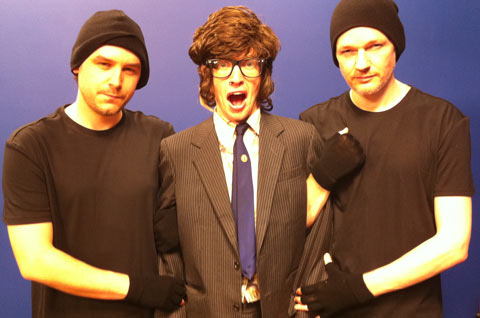
Hugh Farrant and Giordano Nanni uploaded Episode 4 of Rap News to youtube in July 2010, a funny overview of wikileaks and the issues it raised. Their witty editing earned an invitation to meet Julian Assange, resulting in his cameo appearance in Episode 5 (Oct 27), nobody yet aware of the political chaos that would unfold a month later. (Photo above on the day of their video shoot )

How difficult was it to co-ordinate shooting a video with ‘the world’s most wanted man’, Julian Assange?
He managed to fit us in to an extremely hectic schedule. We were pretty sure he’d only have a couple of hours to spare, but at the end of the day’s shoot he told us he’d be happy to come back the next day and re-shoot some of it. Messing around in front of the camera definitely helped get his mind off more serious things for a few hours. He’s a great guy with a wicked sense of humour, and the calmest demeanour of any person we’ve ever seen.

Did you glean any insights about Wikileaks from the contact?
We got to see the project as it was about to enter this current Wiki-Trickle phase. We could tell that they were building up and unleashing progressively larger and more impacting data, but we have to admit that we were blind-sided by this ‘Cable-gate’ phenomenon. I mean, this is a real game-changer. It’s gigantic, and it’s just not stopping.

rapnews

Given you’ve tallied half a million YouTube views, why refuse their offers of revenue sharing from ads?
We loathe advertising so passionately that the loss of a potential revenue stream is a small price to pay to keep the channel free of marketing. We have a donations system for people to visit, and since episode 5 dropped, plenty of people have been expressing their support with some cash. Donations keep Rap News going, and let us pay for ever more elaborate wigs and make-up.

What do you think of Auto-tune the news?
Seriously talented musicians, extremely funny, and Hugo has something of a man-crush on Michael Gregory. That guy’s got a lot of soul.

What other media inspire with it’s blend of politics and entertainment?
We both enjoyed Starship Troopers – hilarious and kick-ass sci-fi action movie, with some excellent calls about humanity’s interplanetary relations. We love South Park, and Team America is a high point of culture. Koyaanisqtasi – by Godfrey Reggio and Philip Glass – is a film which really inspires and opens one’s eyes to the world we live in. Videos of comedians Bill Hicks and George Carlin definitely taught us a few things. The greatest example of combining entertainment and politics is Jonathan Swift’s masterwork Gulliver’s Travels.

Good news – have we had any lately?
There’s never been a better time in history to be creative with access to a global audience. Wikileaks is excellent news. It was about time things got shaken up a bit. Evo Morales is excellent news for South America. Local band [Me] just signed a UK record deal. Also, Tool are visiting Melbourne in January. Very good news indeed.

Future musical projects for Hugo?
Regular gigs on the North Side. One day – some form of live Rap News format, initially within solo shows and build up from there – a full live touring Rap News musical extravaganza would be amazing. Keep your eyes out for new Branksome film clips, and the sci-fi farcical epic film clip ‘We Are The Humans’.

Future writing / journalist projects for Giordano?
Finishing touches to a book I’ve just completed, and embarking on a theatrical project – Coranderrk – in collaboration with Ilbijerri Aboriginal Theatre. And of course, future episodes of Rap News. Robert Foster’s could become an important voice. Stay tuned.

by Sean Healy, December 15, 2010 1 Comment

Swordfighting Rap News + Wikileaks

Keywords: Neal Stephenson, Julian Assange, MC Hugo

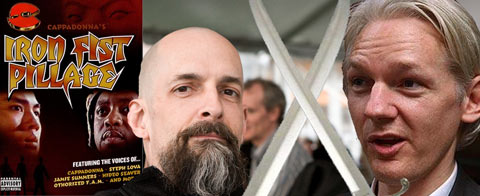
ironfistpillagewikileaks

Neal Stephenson’s Cryptonomicon ( see also: Snow Crash, The Diamond age and The Baroque Cycle ) is more than a decade old, but its themes of information security and encryption ( wrapped up in a swashbuckling adventure ) are particularly resonant this week, with the escalation of activity around wikileaks. The latest release of documents by wikileaks, dubbed ‘cablegate’, have Canadian politicans calling for the assassination of Wiki-leader Julian Assange, have Sarah Palin crying ‘treason’ (Julian isn’t actually a citizen of the United States), had U.S. politicians pressure Amazon into removing it from their hosting ( “If Amazon are so uncomfortable with the first amendment, they should get out of the business of selling books.”@wikileaks on twitter ), and they’ve provoked endless column inches in the world’s biggest newspapers and magazines dissecting the ramifications of the releases, as well as the philosophies, motivations and early writings of Assange.

Swordfighting
Anyways, back to the clashing of swords – and also in the historical fiction vein, Neal has been developing Mongoliad, an online experimental fiction project, which seems to have spawned from a bit of medieval sword fighting research slashed about with a bunch of his Seattle coder and writer and friends (including Greg Bear, another award winning sci-fi author). And so – an online serial novel, delivered to subscribers over the web and via iOS, android and kindle, with a strong emphasis on reader participation.
“Up until now novels have been defined by the technology of the printing press, and we don’t have to use that definition anymore unless it suits us. Some of the things that show up here will be chapters of the novel, some will be character portraits, some will be background articles about topics raised by the progress of the narrative, some will be maps.”

Julian Assange HipHop
Like an Aussie hiphop version of Auto-Tune the news, The Rap News uses the form of musical news broadcast to dissect and analyse current affairs. The brainchild of MC Hugo and editor / director Giordano Nanni, and made in a Melbourne bedroom studio, it’s impressively choreographed ( lots of different characters / costumes / accents / news graphics ) and manages to pack a dense analytical punch. Their video on wikileaks gained this tweet from wikileaks in response: “Hilarious Wikileaps rap gets it right. Is comedy the only honest commentary?” See for yourself.

PS. If lured in by swordfighting rap, hoping for new Wu-Tang hotel sheet shredding gossip, allow me to recommend instead, Iron Fist Pillage – a kungfu feature film with overdubbed vocals from the Wu crew ( and beats during the fight scenes).

by Sean Healy, December 2, 2010 3 Comments