Sampology Interview

Sampology’s Super Visual Smackdown! taster on Vimeo.

A+V on NYE: Dec 31 will find Brisbane’s Sampology scooting away from the sub-tropics, to scratch up a video storm down south at the Fall’s Festival in Apollo Bay. Sam was kind enough to answer a few words about the art of ‘AV-DJing‘ while he prepares.

What were your inspirations for expanding from turntablism into live audiovisuals?
I felt like a new challenge and Audio Visual DJing seemed in a lot of ways still really undefined and I could do my own thing with it. I’ve always been into what guys like Hexstatic, DJ Yoda plus a lot of other amazing artist have done with cool technology, video content, big ass screens and lots of people in front of them.

What are some of the challenges in producing and performing live audiovisual material?
That Audio and Visual have to relate together in each section as well as the whole set. There’s no point in asking a crowd to party as well as pay attention to the screen – if you aren’t doing anything engaging or creative with what you’re giving them. It’s always a difficult but extremely fun challenge in the prep work as well as the performance.

What kinds of qualities do you think live audiovisual material needs, to work well in on a cinematic dancefloor?
I try to lace a portion of the set with content that people will know, and then remix it in some way using humor/ emotion/ turntablism to try and do something creative. What I like about AV shows is that they aren’t defined to a set of rules and expectations, so I think there’s still a lot of avenues to take AV performances in.

Audiences tend to watch films a small number of times, yet are happy to hear the same songs over and over. Do you find that audiovisual songs have a shorter shelf life?
Sometimes. A lot of people request certain routines so they end up staying in the set for longer than I had actually planned! I’m going to trying and get more into using content that’s in headlines, but there’s a lot of prep work so you want to make it worthwhile if you’re going to only play the routine once.

What artists currently interest you?
There’s heaps of Caribbean influenced sounds that are exciting me, and I’m heavily into a certain movie genre at the moment but won’t let on as it will give away the theme for the 2011 Super Visual show. As for Live Audiovisuals, I saw this Japanese Opera recently, shot and performed live on this massive blue screen, it’s pretty gnarly.

What technologies are you currently excited about?
Mostly I’m happy with Serato Video-SL plus my trusty MPC. I’m more excited about pushing forward with what I’ve got, to make something as entertaining and unique for an audience as possible!

What’ve you got planned for your Super Visual Smackdown, and to what extent does narrative fit into your production?
I’ll preview the brand new ‘Super Visual’ show at the beginning of 2011. Until then I’ve got a really fun Summer themed festival AV set made for Falls & Southbound festivals as well as a couple of other special shows around oz.

by Sean Healy, November 24, 2010 0 comments
Syphon + Kinect ( Glue + Goo )

No Jetpacks announcements this week (especially from Qantas), but there’ve been a few exciting one-foot-in-the-future live video developments lately.

Syphon Teaser from vade on Vimeo.

Syphon
Syphon is “an open source Mac OS X technology that allows applications to share frames – full frame rate video or stills – with one another in realtime. Now you can leverage the expressive power of a plethora of tools to mix, mash, edit, sample, texture-map, synthesize, and present your imagery using the best tool for each part of the job. Syphon gives you flexibility to break out of single-app solutions and mix creative applications to suit your needs.”

Out of the box, this means you can send live video signals between these applications: quartz composer, max msp jitter, Freeframe GL and Unity 3D Pro ( a game engine ). Within a short while of release though, this list has been extended to include Modul8 and the MadMapper mapping software, Resolume Avenue, built-in support within the new beta of VDMX, Isadora, CoGe, Open Frameworks, Cinder and Mix Emergency ( software for scratching video with a Serato turntable set-up ).

It all happens on the graphics card, not the CPU, which means HD video can be shuffled between applications at 60 frames per second. This is a great boost for live video flexibility ( lossless live video mixing in and out of 3D game engines? No problem. ), and when it evolves to include being sent over networks, awesome collaborative possibilities await.

Kinect
Another splasher in the visual tech world has been the recent release of the Kinect camera add-on for the XBox. The device features “an RGB camera, depth sensor and multi-array microphone running proprietary software”, and enables 3D motion capture, facial recognition and voice recognition. Being such a hacker’s delight of a device, within a week of release there’s already a growing range of software written that enables it to be used outside the Xbox. Some of these include the ability to draw in 3D (and rotate the image) using gestures, visual FX applications and thanks to Syphon, there’s already a way to include Kinect 3D depth images within Quartz Composer – by first using it within OF and then sending it through Syphon to your visual app of choice.

Notable Kinect shout-outs: real-time light sabers(love the use of the little mirror to frame and juxtapose the original footage here), kinect puppet shows and instant fat-suits.

And there’s a nice extended Kinect round-up of projects over at Creative Applications.

So there you go, the future is already here – *and* it is starting to become more evenly distributed…

by Sean Healy, November 23, 2010 0 comments

Portable Pixels + Touring Video Tips

A few tips for shrinking and smoothing your touring video kit (inspired by the next fortnight of touring the East Coast for the next fortnight with the Scattermusic Sound System).

Velcro + Laptops
velcro
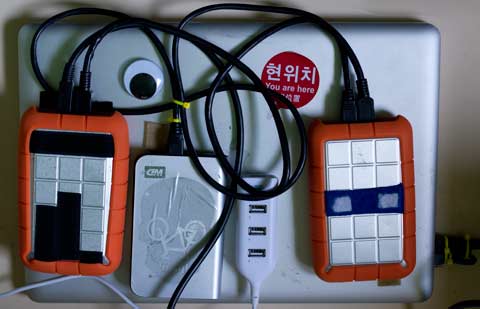
Attaching spare portable Hard-drives to your laptop lid with velcro is a super-win. Not only does it save precious performance space and avoid drives being bumped, it also extends to three, the list of questions VJs will most likely asked at venues.
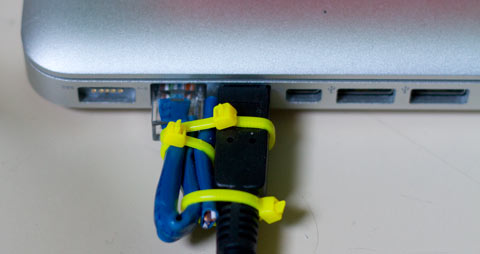
1- ‘Can you play a track by Another tip? Minimise external drives cutting out when firewire cables move or get unplugged, by using cable ties to tighten the firewire cable to an ethernet cable plugged into the port beside.
cable_tie_firewire

Hardware Mixer-Free Zones*
Hardware mixers have become a luxury (or an insurance policy against computer crashes) rather than a necessity, as most clip mixing and blending is preferably done through software and a midi controller. If tight on budget / space, mixers can be avoided. Need a live cam? Use a USB webcam to mix within your VJ software. Other USB capture devices open up worlds of lo-fi video capture, play-through and mixing. Portable midi controllers? My two favourites are the Novation Nocturn and the set of Korg nano controllers… which give the best value in terms of buttons and sliders per buck.

(*At least until *SPARK’s tiny DVI mixer is released! )

Projectors
Projectorcentral.com is a fantastic resource for comparing different projectors, and provides a great overview of what to look for in a projector.

Lumens: (brightness ) – aim for minimum 2500 for a small room, and get as many as you can.
Contrast ratio: ( eg 2000:1 ) Higher is better, richer blacks.
Zoom range: The difference between minimum and maximum sizes, which enables flexible distance from screen.
Resolution: Aim for a minimum of 720P (1280×720), which is the smallest HD size, or WXGA (1280×768). Full HD of 1920×1080 will avoid any scaling, and delivers the best image.
Aspect ratio: 16:9 native is preferable over 4:3
Inputs: VJs will want VGA inputs, and HDMI if available. Most will include RCA / composite.

eBay offers 15m VGA cables for around $30, and if you need more distance between projector and your laptop – maybe consider entering the world of baluns ( connectors / convertors that allow video signals to be sent over the much cheaper ethernet / coax cable for much longer distance without signal degradation. )

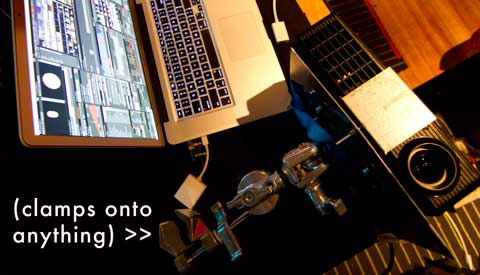
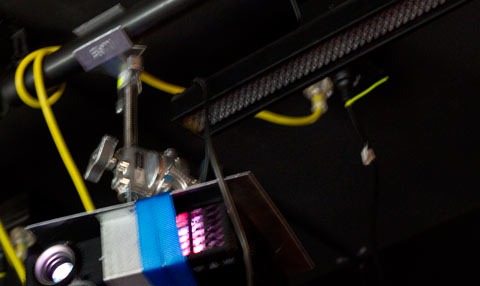
Need to build a Projector Mount that will go anywhere? ( http://vjkungfu.com/archive/build-projector-mount ) Clampalicious! Allows a projector to be easily and very securely mounted to lighting rigs, poles etc. Before and after shots below..
clamp
clampinthewild

Got any other portable touring / rig shrinking / making-video-life-easier tips? Send them along..

[[ UPDATE: Extra tips in the comments:
via the well oiled touring machine-human hybrid, Filastine: “for VJ’s that work from stage, or for solo audio/video performers like myself-project from stage into an automotive sideview mirror clamped to a mic stand, no ladders or long cables needed”
via uDart: a more compact solution to VJ Kung Fu’s mount.
“For that reason I always buy projectors hat have a 1/4-20? camera fitting. Also the ball joint can be substituted with a ‘magic arm’. That gives you countless positioning possibilities.”]]

by Sean Healy, November 17, 2010 5 Comments

Crowdsourcing with Fundbreak + Kickstarter

Alongside Paypal’s introduction of micropayments, and the app store model shifting online payment behaviours, crowdsourcing is experiencing a surge of popularity when it comes to raising funds online.

Kickstarter
This is the mother lode when it comes to leveraging social media to gather funds online. Kickstarter provides a central location where creatives can direct their friends to pledge financial support for a project (with various rewards) and Kickstarter takes care of all of the transactions. While relatively fresh, it has already financed a huge range of creative projects and is becoming increasingly visible online. They boil their success and approach down to 3 things:

– A good idea, communicated well, can spread fast and wide.
– A large group of people can be a tremendous source of money and encouragement.
– Every Kickstarter project must be fully funded before its time expires or no money changes hands.

It’s a formula that seems to work, the threat of not reaching a goal spurring fans into publicising projects wide and far. Blue Like Jazz raised $345K to cover a shortfall in producing a film of the book by Donald Miller. Glif raised $120K to produce an iphone tripod mount stand combo. Comic artist James Kochalka raised $11k to develop a computer game. An Eco-Volunteering Documentary raised $7.5K. Swimming Cities raised $6K to build a floating island of boats to take art to India. The best stoner-action film since “Pineapple Express” raised $671. Adventures in being small has managed $67 so far. Not all succeed though, but it remains a useful platform for gauging support for projects. Some failures are more special than others though, such as this attempt by Nicholad Gurewitch ( author of the fine Perry Bible Fellowship comic book ), to ‘erase the national debt of the USA’. Their goal of 15 trillion was unsuccessful.

Notably though, as Kickstarter’s transactions are handled by Amazon payments, project creators currently must have a US bank account and address, although International project support is promised for the future.

Fundbreak
Entering the void then, Australian based Fundbreak enables local creatives to join in the action. Format and approach is pretty much identical, though it currently features a smaller range of projects. One notable project seeking / deserving funding is well respected investigative journalist magazine New Matilda, which seeks $175K to stay alive and build foundations for the years to come. ($37K raised at time of writing.. ) Visit Fundbreak.com.au to see more, or start your own project fundraiser.

by Sean Healy, November 4, 2010 0 comments

Where’s the Money? ( Return of the Micropayment)


(Clip above, made by Queensland AV act Sampology, for the Parker remix of the dubstep anthem, ‘Where’s my money?’. Hard to go past a leading man like Lancelot Link, Secret Chimp. )

Micropayment options continue to expand, offering more ways to get bread on the table for artists and musicians.

The Paypal Gorilla
Micropayments are payment systems that allow for people to easily transfer very small amounts of money without a disproportionate transaction fee attached, and these have been championed as a solution for generating income for online publishers. Click a button if you like an article / song / video, and 5 cents is effortlessly donated. Spread this model over a large enough audience and it’d start to mean many could concentrate on making higher quality work for a living. There’ve been two problems with this so far though – proportionally large transaction fees, and what others have termed a ‘mental accounting barrier’. The argument there was that ‘each price, no matter how small, carries a burden of deciding if the content is worth that price; accumulated over a large amount of content, this burden would pose an extreme inconvenience to the users’. Micropayment systems have come and gone ( eg bitpass.com RIP ), but the move by the ubiquitous Paypal could change the ballpark.

Instead of a typical fee, where a $1 transaction would incur a fee of 33 cents, Paypal now offers new pricing of 5% plus 5 cents for purchases under $12 ( a $1 transaction would now only cost .10 ). The new pricing will launch later this year, but will be integrated into Facebook soon. Apparently part of the motivation was for direct in-app transactions for virtual goods within social gaming environments, where they currently process billions of dollars a year. These payments will also be available by SMS.

Already Amazon offer a Flexible Payments service, and Google offer a checkout service, both with apparently similar pricing options, but it’s popularity of Paypal as a payment system which means that this will likely have some repercussions for independent producers. Other factors that suggest the time might finally be ripe for micropayments – the increased visibility of social media services for ‘sharing’ and ‘liking’ on the web, and the App store model, which sells software at smaller prices to much larger audiences, but also gets audiences used to paying small amounts for services.

Flattr
An interesting sidenote to the above (founded by Pirate Bay members), Flattr seeks to solve the micropayment problem by using monthly fees. Choose the amount you want to pay per month, donate to whoever you like – and at the end of the month, your fee is divided between all the things you’ve flattered. 10% of incoming revenue is taken as a Flattr fee.

[ Sidenote 2: Discovered the Paypal announcement via Scott McCloud’s blog, the author of Understanding Comics, who has been a long-time micropayments advocate.]

by Sean Healy, October 28, 2010 0 comments