

Bonsai Kittens Vs Chunk 666

kitten chunk
A wrestling match of sorts this week – in the dragon’s lair. Slink yourself past the feline beasties roaming outside and witness the fitness indoors. BonsaiKitten.com, preservers of the long lost art of housepet body modification, take on crazed bicycle welders – Chunk 666.

(( PS. this was my most commented article when it was over @ the now defunct octapod.org/jeanpoole. Seemed like someone must have forwarded this URL to a teenage Christian mailing list, judging by the flock of mortified kitten-lovers it attracted.. ))

Strength
A bonsai plant achieves its miniature yet mature form through a long and delicate process of trimming during the formative years of the tree. While it is not possible to trim a kitten, oriental artists are also expert in the modification of animal forms. Both foot-binding and head-binding can miniaturize the feet and shape the head into attractive yet sturdy shapes. This technique is also the principle behind the well-known corset, and part of the Bonsai Kitten’s strength.

Chunk 666 are a bicycle club, working to hasten the heat death of the universe. They believe in the use of muscle-powered steeds which augment the physiology of their riders. Why bicycles with long extended choppers? “We ride these things because we have no choice. We ride them because life is short and should be painful as well. We ride them because we have a message to bring to the people: ‘Clear the streets! Return to your homes!’ ”

Constitution
By physically constraining the growth of a developing living thing, it can be directed to take the shape of the vessel that constrains it. A quick browse of BK shows these kitties must be made of the right stuff. Hard to compete with the chunkers though:

“After the imminent Apocalypse, gasoline and bullets will be rare. Those who already ride bicycles and shoot bb guns and slingshots today will easily dominate the huddled masses tomorrow. The laws of physics will change as well. Bicycles that are ridable now will be unridable in the future, while our apparently foolish machines lay waste to the world.”

Dexterity
At only a few weeks of age, a kitten’s bones have not yet hardened and become osseous. They are extremely soft and springy. The flexibility of the kitten’s skeleton means the bones can be gently warped at this early age, and molded into any desired shape. Bonsai Kitten place their kittens into a rigid vessel soon after birth, allowing the young cat to grow out its formative time entirely within a small glass jar.

Sez chunk: Driving a car is similar to pushing buttons on a microwave oven, and the Magic Fingers effect of a motorcycle does not prevent its rider from growing an expansive belly. Chunk nullifies this effect by crafting cycles which induce a state of intoxication in their pilots. Each decimeter of length added to a chopper fork induces the equivalent effect of one standard can of earth beer, drunk within half a minute, on its pilot. Versatile, but the kitties score here.

Intelligence
Transcend housepets with the same mundane shape as all other members of its species. Put your Bonsai Kitten smart cap on and a world of variation awaits you, limited only by your own imagination.

The chunkers provide remarkably innovative solutions to the problem of human-machine interaction. Along with stupendous bike-forks, they’ve also amassed a range of ass-killing banana seats, wheelie bars, visual and sonic distractors designed for sensual-info overload.

Wisdom
The Oriental art of miniature sculpture can produce marvellous beauty. Particularly wise, are this site’s well considered practices for dealing with the jarred kitten’s air, food and waste removal.

Non-organically-powered vehicles tend to induce boredom in the people who are steering them. Much wiser to ride with Chunk. What’s it like? One cannot truly experience the experience without sitting one’s ass on a bike, taking off, and crashing.

Charisma
The kitten essentially grows into the shape of the vessel! Once the cat is fully developed, it is removed (or the vessel broken to remove it!), producing the lovable, furry pet you’ve always wanted, but it remains in the shape you’ve always dreamed of! Talk about charismatic bonus points!

How could you not be charmed by the ‘Flaming Bikes of Death’? By choppers so long you can almost fit your bike across a whole intersection?

As MrT said: “I’m talented and flexible. I could play Hamlet, even though I look like King Kong.” With talent like BonsaiKittens & Chunk 666, the only true winner is wrestling.

by Sean Healy, August 22, 2002 1 Comment
Steel Citi_Antix

Peeps b.gettin their freek on in Newcastle again soon, with the return of the good ship Electrofringe, sailing thru from Oct 2-7 alongside the National young writers fest & the Sound Summit. Will be interviewing a few of the guest artists over the next few weeks, butt for now, tis snapshot time – sneek peeks @ soma tha sailors u might be playing with soon.

The Light Surgeons
Hailing from the UK, this crew investigates the spaces that lie somewhere in between music and
cinema, aiming at times for what they call ‘live documentary’. Theres a few stylin vidi-yos on their
site, but apparently their live combinings of turntables & digital sound games, mixed with projected
films, video maniuplation and slides, are an even more sublime eoncunter.
chek: www.thelightsurgeons.co.uk

Johnny DeKron
Straight outta the place where they used to have a big long wall in between the East and West,
J-DeK gets under the pixel bonnet frequently for better access to real-time vid-yo manipulation. And
doncha know, this Berlin boy’ll b.presenting some workshops and performances as well as his new
vidi-yo software during what is known to some as Oktoberfest in Newcastle, ja.
Bitte, bitte: www.thisserver.de/dekron

Space Invader Man
Maybe the world would be different if this boy had become infatuated with Pac�man instead, but as it
is, there are walls and surfaces in cities scattered all over the globe bearing the work of this unusually
inspired artist. The game of course, involves applying tiled pixelated space invader mosaics in weird
urban areas and extensively documenting these transitions from the screen to the street, on the
following, funny head-scratcher: www.space-invaders.com

Patch Invaders
Prepare for audio and visual abductions – by modular-code benders such as Spanky, tha effervescent
Cindii duo, and Neurospikey Alex. Their extended, open, hands-on workshop on patching software
will focus on sharing Patches, concepts & ideas, talking to fellow patchers, extending the patching
community and working on techniques of communication between different patching paradigms.
Peeps are encouraged to bring patches & computers and a gig will be involved later somehow. Hey,
u know u wanna : www.4trak.net/patch

Sound Summit Peeps
More workshops, gigs and gallavanting amongst Newcastle’s thriving business district with all yr
favourite buddies u haven#t seen in agessssssssss: neotropic (ninja tune uk), sage francis (anticon),
kevin blechdom (tigerbeat6), manitoba, mitchell akiyama, battery operated & identification ( all from
canada), dj luv (ninja tune uk), kog soundsystem (nz) and funkarmor (killer japan).

by Sean Healy, August 9, 2002 0 comments

Cloner 2.0 (software review )

Gotta love the internet. Earlier in the week, Clonaid’s South Korea office announced they’d made a Korean woman pregnant with an embryo clone. A few short emails later, they’d agreed to let me download a review copy of their revolutionary medical software Cloner 2.0 ( available for mac and PC at www.clonaid.com ).

What is Human Cloning?
Human cloning is a type of genetic engineering, but is not the same as true genetic manipulation. In human cloning, the aim is to duplicate the genes of an existing person so that an identical set is inside a human egg. The result is intended to be a cloned twin, perhaps of a dead child. Genetic engineering in its fullest form would result in the child produced having unique genes – as a result of laboratory interference, and therefore the child will not be an identikit twin.

Getting Started:
At the time of testing, Cloner v2.0 can only duplicate males. The procedure is fairly simple. Using an advanced South Korean set of algorithms and at least a 40XCD reader, this software allows the user to deposit a sperm sample on a CD, which is then inserted into the CD player for the computer. The software analyses this sample, and then, left to render overnight ( on a g3 / 333 mhz machine ), provides a customised set of genetic information related to the person sampled.

A cable internet connection is then preferred ( don’t want any errors during a transmission like this), but even using a 56k modem, I was able to match up my information with the Clonaid Online Database over a matter of hours. During this process, the software cross-matched my information with their Genomic Sequence Writer technology, and produced a template ready for ‘printing’. For a fee ( yet to be decided on ), future users will be able to have Clonaid duplicate their genes, insert these into a human egg and courier mail to their home.

Features:
Cloner v2.0 has a simple, very intuitive interface which requires little knowledge of medicine or advanced science. Given the complex tasks at hand, the software performs very well on mid-range computers, though a good CD reading speed is essential. Browsing through the menu columns revealed a wide variety of variables and plug-ins, though with nothing as simple as ‘height’ or ‘skin-colour’ available. Future releases promise easier adjustable and capacities to draw on genetic information from other species.

Cloner v2.0 & the Human Genome Project

Not to be confused with the Dog Genome Project ( http://mendel.berkeley.edu/dog.html ), the Human Genome Project is the race by biotechnology firms around the world to map out the entire set of human genes. Cloner v2.0 connects to this database, and future versions will potentially be able to draw on features from different races around the world to customise your clone.

What You’ll Need:
$US 2500
Mac: g3/333 min, g4/500 preferred, 256mb ram
PC: Pentium II 600mhz or any intel clone, 256 mb ram.
A suitable genetic profile. ( a small percentage of tests so far are incompatible for reproduction )

Pros:
– Incredible value, compared to IVF programs and black market cloning.
– Farmers of headless foetuses will love Cloner 2.0’s abilities to quickly and easily make ‘spare parts and organs’ clones.

Cons:
– Can only duplicate males so far.
– Could be used to try and develop a super-race of ‘perfect’ humans.

Further reading:
The Centre for Bioethics and Human Dignity
Human Cloning Foundation
Human Cloning, The How to Page

by Sean Healy, August 2, 2002 0 comments

LIVE 2.0 review

live 2
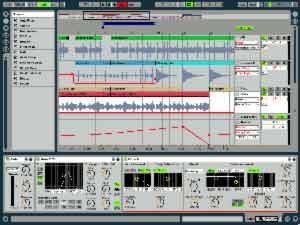
Birds as big as humans have flapped our skies. Giant wings in slow motion through a nectar haze. Sometimes we glimpse these times gone by with our modern pollution enhanced sunsets. In downtown Berlin for example, the Ableton software company would no doubt stare out their windows, lamenting the lack of winged beasties feathering the horizon. Luckily they manage to keep themselves busy, coding one of the best audio applications to emerge in recent years. Founded by Monolake, Ableton have tried to provide flexible software which accurately reflects the needs and processes of contemporary electronic music making – and with Live & now Live 2.0, they’ve hit the jackpot.

Droppin’ The Live Sequencer Bomb
Late last year Ableton updated Live to version 2.0, their crankin’ audio sequencer for Mac OS9, Mac OSX, and Windows. Live 1 & 1.5 both offered excellent capacities for live music performance, and were also recognised as fantastic studio tools because the quick and flexible ways ideas could be executed and recorded. Live 2.0 continues refining the performance and jamming features, and adds multitrack recording and editing, making Live even more suitable as a tool to use both in production and performance.

Features
Best bet’d be to browse the online manual for Live 2.0 at ableton.com to get an idea of just how flexible and powerful this baby is. Even better? Try the demo version also available at the site. At a snap, some of Live 2.0’s key features include:
– the addition of multi track recording and editing, advanced automation handling
– DJ-like cross-fading
– easy tempo ‘tapping’ during performance or recording to adjust tempo on the fly
– easy ability to assign most software parameters to midi or your computer keys
– new FX and plug-ins
– presets to save and recall effect settings
– and what Ableton term ‘elastic audio’.

Elastic Audio
Elastic Audio refers to Live 2’s unique ability to treat audio as being totally malleable and to independently control tempo and pitch. This feature allows tempo to be set at anytime during recording, performance or playback. In addition, users can drop in recordings, loops and complete songs that will play in sync direct from disk. Live 2 makes it possible to synchronize loops and recordings of any length at any point in a session or performance. Time stretching is no longer limited to loops but can now be applied to any audio material.

Data Be Smooth
From the seamless way Live accesses files on your machine without missing a beat, through to the way it handles real-time effects, loop control, tempo warping and recording of sounds to be re-used almost immediately, everything happens fluid, everything happens fast. The interface is very well thought out and very effectively allows quick access to files or the programs various ways of treating samples or your arrangements of them over time. When you use Live, it’s easy enough to understand it was developed by experienced computer music makers, but you also get the impression this has been well coded too – it works fast, and it’s yet to crash on me.

Requirements
Mac: – Any G3 or fasta, 256 MB RAM, OS 9.1 or later, also OS X.1.5 or later.

PC: 400 Mhz CPU or fasta, 128 MB RAM, Windows 98/2000/XP
Windows compatible soundcard (preferably with a DirectX or ASIO driver)

And you’ll needing around 399 Euro to grab Live 2 from www.ableton.com. Alternately you can get it from it’s Australian distributors, majormusic.com.au. (02) 9545 3540

Verdict
Completely fun to use straight out of the box ( or modem). Samples are easily looped, matched, mutated, it’s simple and quick to record directly into the Live window and start playing with this material. Easy mapping of parameters or samples to your keys, means for easily customisable and very flexible performance. Great for jamming and mutation, great for composition and recording. And it all *really* works. Fun, fun, fun.

See Also:
Ableton Live 7 Suite Review
Ableton Live 6 Review
Ableton Live 4 Review

by Sean Healy, July 26, 2002 2 Comments

Audiovisual Sync-ing With Jasch

Most Swiss people are vampires. You can see it by the teethmarks they leave in their cheese. Sinking his fangs well deep into the visualisation of music and the live performance of inter related audio and video, is the krazy kat: Jasch, who relayed these insights from his northern hemisphere rooftop.

Describe Dyad?
Dyad is my duo-collaboration with video-artist Johnny Dekam. Central theme is improvisation with visual and sonic material. We both work within the same paradigm/software: max/msp/nato. This shared syntax for sound and visuals makes communication on several levels possible. Much of the collaboration deals with finding bridges between hearing and seeing. We’ve developed a set of rules describing events and processes and the communication about them via a network link. We’ve been focusing on live-shows, where we roughly know beforehand where we want to go with the material, but improvise all of the treatments and mixing in real time. The big challenge is that there’s no guarantee to hit the right combination of materials at the right moment. But that keeps the thrill in the performances and lets us develop new things from show to show. In a way Dyad is like an improv combo, except that the instruments are silicon-based and the expressions span visual as well as acoustic phenomena.

How do you approach creating for audiovisual performance?
Along two axes: structural and emotional. The structural level deals with form and the shaping of the flow of sounds and images in real-time. The development of personal software-tools is an important part of that, another is using the appropriate hardware to interface with the processes. The emotional level is about atmosphere. All sonic material can project a context and evoke feelings. It’s essential to have at my disposal a large palette of such material and treatments and intimately know it. To me that’s the key to improvising with electronic media, basically feeling the material and be able to expressively apply it. It’s still very much like an instrument that wants to be practised and demands a considerable level of dedication. The preparation-effort oscillates between creating and refining the (soft and hard) tools and collecting and organizing new materials and processes to work with. It sounds paradoxical that the time spent programming and researching tools and materials is directly linked to the level of intuitive control. But it’s the only way to reach a state without thinking about the processes and control. The real test can only be in performance, when all elements collide and hopefully merge.

What interesting issues come up with AV performance and composition?
The crucial issue is time. Composition is thinking about structure and sound by organizing it in time, working in a detached sphere outside of time where decisions can be examined and revoked. AV-performances happen in actual, ‘forward-running’ time. The experience of composition does help in perceiving structure and temporal evolution in the moment, but doesn’t tell how to act and react to the situation. Intuition is the key, the non-linear access so to speak, to the past experiences without the need of analytical thought. Improvisation is tapping into the experience-base formed through perceiving, performing and composing. AV-performances are unique in that the shaping of visual and sonic structures happens simultaneously with a high degree of flexibility. Composition for the visual and the sonic media do have a lot in common, but there are also rules of perception based on disparate physiological phenomena: the ear, for example reacts differently to dense layering than the eye. Improvising in a open and undefined visual and sonic context demands a high degree of awareness both from audience and performer.

How do you try to transcend the limitations of laptop based performance?
By moving away from it. By finding ways to give back meaning to gesture and physical presence. Using sensors and controllers away from the typewriter-interface helps play the machine like an instrument. Projecting presence with physical action rather than thought and click.

What was your role in the development of the AV software, VDMX?
small, actually marginal, since jdk did all the coding himself. my visible contribution to VDMX2 was a small interface-hack. conceptually of course a lot of the lfo-vfo ideas and routing architecture were developed in parallel in my sound-tools and vdmx. Many ideas developed in common between me and jdk stemming from performance-experiences were filtered into and implemented in VDMX.

What software interests you at the moment & why?
Max/msp with it’s growing set of visual extensions: nato/jitter/softVNS and my own. I’m also following with interest the development of Pure Data, a cousin of max/msp on linux/windows/ and OS X.

What software would you like to develop?
More advanced and powerful 3D-sound and 3D-visual improv-tools, auto-generative and autonomous sound and visual architectures.

Current/ future projects?
Working on ‘codespace’ – a system for abstract 3D-graphics and sound in realtime. I’ve been doing shows and developing software-pieces with abstract 3D-drawing and sound control, integrating ideas from generative arts and minimalist electronic music with the realtime aspects of improvised performances. www.kat.ch/jasch/codespace.html Laying down tracks for a CD release of my material.
Future projects include a feature length DVD with dyad, development of a full surround projection system and immersive sound/visual installation and a lot of hardware development in the field of wearable interfaces for gestural expression. http://www.kat.ch/jasch

by Sean Healy, July 24, 2002 1 Comment