
Cobralingus And Text Remixing

jeff noon cobralingus

Word Up! I mean, words in the sky, words in your eye. I mean, sometimes out of print books loaned 5 years do come back. Here’s looking at you, Cobralingus by Jeff Noon.

A Toolkit For Language Bending

“Cobralingus comes completely from my love of electronic music, attempting to give language a little of the freedom that music enjoys. How can language refer to itself? Can it be bent, mutated, made liquid? Sometimes this will bring on certain poetic effects. I wouldn’t myself label it as poetry, because I think that should refer to a more heightened sense of language. I like to fire up words, energise them, drug them, destroy them, bring them back to live in some other form. Cobralingus is the end result of this process.”

Jeff Noon, author of Cobralingus, interviewed by Vladislava Gordic.

Almost like a blueprint for his well received novels in the nineties ( Vurt, Pollen, Automated Alice, Nymphomation) and beyond ( Needle in the Groove, Falling Out Of Cars ), Cobralingus is an instructional book revealing Noon’s attraction to experimental music and processes, offering a series of experiments for remixing text. The introduction brings us ‘the cobralingus engine’, for manipulating language into new shapes and meaning, and which interprets text as a signal, which can have various filters and re-routing applied to it. Noon outlines his filters ( eg decay, randomise, search and replace, sample, release virus etc ), then jumps into a series of chapters, each starting with a paragraph sample of text taken from a classic, and proceeds to transform this gradually with his filters, until it’s final iteration at the end of the chapter.

The results are varied, sprawling about in unusual page layouts, but for the most part have gained something compelling. It’s the process overall which is most intriguing though, itself part of a wider manifesto Noon has argued for elsewhere ( in this Guardian article ).

“We have to accept that English writing has been far too slow in its adoption of avant-garde techniques, in comparison with popular music, art and films. The narrative fabric of the latest cult movie is woven through with jump cuts, freeze-frames, montage, slow motion shots, tracking shots, hand-held camera techniques, and the like. House, hip-hop and garage recordings contain elements of remixing, scratching and sampling. What are the prose equivalents of the tracking shot, the hyperlink, the remix, the freeze-frame?”

Which is not to say that the Surrealists, Dadaists and the likes of James Joyce, William Burroughs / Brian Gysin haven’t already explored text mutation and cut-up techniques in the past, but perhaps suggesting that we don’t have very advanced tools or frameworks for doing so in writing as compared to other artforms. There are a few believers out there though, visible in a quick scan of the dub text universe :

cutnmix.com – a mac+pc application which ‘helps creative writers generate new ideas through the use of different methods of text randomization and manipulation. Cut’n’Mix expands the pallete of tools available to writers with functions not available in standard word processors’. ( eg randomisation, word blends, random rhythm and rhyme functions, ‘word shredding’ and ‘word gluing’.

The Text Mixing Desk – offers a range of filters to apply to a text ( eg transgenderiser, rasta rack, cut-up engine, expletive deleted ).

http://zelea.com/project/textbender/ – Textbender is a system of collaborative writing based on recombinant text. It implements a social Web medium with potential applications ranging from open art to open democracy. The underlying mechanism is evolutionary genetics.

languageisavirus.com – a few experimental writing widgets available.

Liptikl is a ‘cut up’ word arranger; a lyric generator.
writerhymes.com – “option-click on a word to find a rhyme for it”

Noonworlds :
jeffnoon.com, http://en.wikipedia.org/wiki/Jeff_Noon, http://tinyurl.com/dhtwkd : a flash version of cobralingus- which only seems to animate the text into it’s new formations – vastly less interesting than allowing the remix of inputted text.

– and there are plenty of sites for remixing text or a website into a particular dialect, be it smurf, rastafarian, hAcK3r speak etc eg http://speaklolcat.com, with special mention for the wiki project that aims to translate the entire Bible into Kitty Pidgin English ( lolcatbible.com ).

by Sean Healy, March 4, 2009 3 Comments
The Pirate Bay Spectrial

Sweden is at centre of the technology world this week, with a major court case happening in Stockholm between some of the world’s largest media companies (Warner Bros, MGM, EMI, Colombia Pictures, 20th Century Fox, Sony BMG and Universal), and the world’s largest bit torrent site, The Pirate Bay.

What’s At Issue?
According to torrentfreak.com the charges being put forward can be best summarized as “commercial copyright infringement”. Serving bit torrent files on their site since 2003, The Pirate Bay have gathered some 22 million users, however they never host any media on their servers, only torrent links to those sharing files. Fredrik Neij, Gottfrid Svartholm and Peter Sunde Carl Lundstroem, are thus pleading not guilty – but if this doesn’t work out for them, face up to two years in prison and 10 million euros worth of fines.

The Pirate Bay describe the trial as being ‘against the largest cultural distribution ever present in history’, and naturally are approaching the event with their their typical flair for public relations. Dubbing the trial a ‘Spectrial’, they’ve parked their touring Pirate Bay bus outside the court, have organised parties ( chip tune guru Goto80 who lived in Melbourne for a year is playing at one of them ), and are sending live twitter feeds from the court house ( and are successfully encouraging big use of the #spectrial tag to create attention ). According to The Swedish Pirate Party, The Pirate Bay “scares” the establishment:

“They are fighting tooth-and-nail to bring back the good old days, where there was a hard division into approved senders and passive consumer receivers, where the approved senders would compete for the wallet of the consumers. Essentially, they are trying to turn the internet into a cable TV network”.

Over @ Wired magazine, Ira Rothken, a California lawyer argued that because The Pirate Bay doesn’t host any infringing material, the case against them is going to be difficult:
“If you’re going to indict a torrent search engine, in essence, what you are doing is indicting Google. And everybody agrees with the social utility of Google,” he said.

Steal This Film 2.5
‘The League of Noble Peers’ earlier released a pair of films exploring the contemporary tensions within file sharing ( stealthisfilm.com ), and although they are currently making a third, based around the current Pirate Bay trial, they’ve just released a trial version 2.5 of their film-in-progress, to help give background for the case, which features the lead-up to the trial and re-enactments of police interviews with The Pirate Bay.

Elsewhere on the Swedish Web
http://swededfilms.com/films.html hosts a range of ‘Sweded films’, a phrase made popular during Michel Gondry’s ‘Be Kind Rewind’, referring to homemade versions of famous films ( or in the film plot – in the VHS store the remade tapes are described as having come from Sweden as an excuse for higher rental fees and longer wait times). Sample Sweded films? Karate Kid, Indiana Jones, Raiders of the Lost Ark.

The Case Finishes in Three Weeks Time
Although the prison sentence is a serious outcome the defendants face, the case is unlikely to alter file sharing habits online. As Fred von Lohmann puts it (himself an Electronic Frontier Foundation staff attorney who specializes in copyright law) :

“During Prohibition, you could bust people for running a still, but you were not going to take the alcohol away from the people,” said . “If Pirate Bay goes down, it will be replaced in popularity tomorrow by somebody else.”

by Sean Healy, February 27, 2009 0 comments

Bushfires And Water On A Drying Continent

Recent tragic events may cast a light on another, related, Australian problem : our water crisis.

First Up
An utterly tragic chapter, the bushfires speed, scale and ferocity left a trail of unfathomable horrors. Many people have endured incomprensible suffering and the burden of these fires will be felt for a long time to come. Everyone effected deserves the utmost support, and thankfully the offers of help have been pouring generously. Donate money, blood or time.

Where To From Here?
Even as fires still burn, and the threat of further scorching weather looms, many are asking what can be done to prevent this in the future? Others are asking whether we could’ve prevented these fires in the first place? Over at New Matilda, Ben Eltham, cites bushfire experts warning in advance of dangerous fuel load build-up in areas effected, and discusses the complexities of being prepared on the world’s most fire prone continent. The Royal Commission will shed further light on what could’ve been done better, but the trajectories of temperature records, and the projected conditions for the next 20 years suggest preparations for the future need to be considered now.

This is not lost on those at the frontline – the United Firefighters Union of Australia has written an open letter to Prime Minister Kevin Rudd and Victorian Premier John Brumby, on behalf of Australia’s 13,000 firefighters, arguing that ‘Australia is at risk of more tragedies such as the Victorian bushfires if the Federal Government does not reassess its approach to global warming’. Secretary Peter Marshall points out the Government’s own CSIRO report, which shows that under a high global warming scenario “catastrophic events are predicted to occur every year in Mildura and firefighters have been warned to expect up to a 230 per cent increase in extreme danger fire days in Bendigo” alone, and argues it is the current climate conditions which is allowing the fires to spread so far.
“What used to be a fire that could have been contained to a small area, we’re going to see evolve into a wildfire like we’ve seen in Victoria and that’s going to be a regular occurrence.”

( MilkWood Farm, bless their socks, have posted a range of links about using fire retardant trees to grow food around a bush property … )

The Water Context
Australia is the driest continent in the world, yet uses the highest amount of water per capita ( acf.org.au ). Most of the continent is desert or semi-arid land, and water restrictions are currently in place in many regions and cities of Australia in response to chronic shortages resulting from drought. Adelaide is building a huge ( very energy intensive ) desalination plant to meet it’s water supply demands by 2010. Perth, according to Tim Flannery ( Australian of the year in 2007 ), could become the world’s first ghost metropolis, an abandoned city with no more water to sustain its population, unless it made drastic changes. And Melbourne? With water supplies for the city currently 32% full, the recent bushfires add even more pressure, as forested water catchment areas that are regrowing from the fires will soak up much more water than previously.

Peak Water?
Peak water is reached when the rate at which water is demanded is higher than the rate at which the supply is replenished. Already cities such as Dubai have passed this point, and must import their water. Australia’s cities are at serious risk of following the same path, and intensity of the recent bushfires serve as a reminder of the dry continent’s conditions. There is a vast amount of water on the planet but sustainably managed water is becoming scarce. Although it seems counterintuitive, the world’s supply of fresh water is running out. Already one person in five has no access to safe drinking water. If present trends continue, 1.8 billion people will be living with absolute water scarcity by 2025, and two thirds of the world population could be subject to water stress.

Your Water Footprint?
People need 2.5 litres of water a day to drink, but considering other needs such as cooking, bathing and laundry, accepted water consumption per person is 150 litres a day ( Australians use 285 litres per day, Turkish 111, Africans 67 ). Over at waterfootprint.org you can calculate the water required to produce the goods and services consumed by you, entering details about diet, transport, household habits, to come up with a rough guide for your water consumption. I got a total water footprint of 935 cubic metres per year – the bulk of which was contributed to by food it seemed, which surprised me. Vegetarians have a significantly lower water footprint than meat eaters ( growing 1kg of potatoes need 100 litres of water, 1 kg of beef requires 13 000 litres), but each of our food choices carry with them a range of water demands.

Whether the Government is listening to the Firefighters union at the moment remains to be seen, but minimising climate change and worsening drought conditions are hopefully something they are thinking more seriously about ( as well as more efficient water use strategies ).

by Sean Healy, February 27, 2009 1 Comment

Pictoplasma 2 : Characters In Motion

Nobody showcases the diversity of character design better than Pictoplasma, so another DVD of 200+ minutes = double plus good.

Shuffling Pixels in Berlin
Yeah, another bunch of laptoppers in Berlin, who’d have thought? Aside from the DVDs though, Pictoplasma have maintained a character design archive since 1999, and organise annual conferences ( Berlin, NY, Argentina etc ), all dedicated to exploring contemporary character design, and ‘the importance of contemporary characters in today’s visual understanding’. Which’d maybe suggest an overdose of puffy vinyl toys, or cutesy cartoon creatures, but thankfully their approach is much wider than that.

Characters In Rhythm
pictoplasma
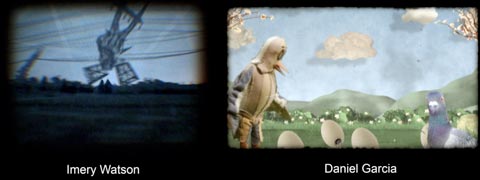
Although the disc is organised into 3 sections, for the most part the clips could’ve fit easily everyone of the sections, generally being a music video of some sort, or short film, the character(s) displayed inevitably following some kind of narrative arc, exploiting the rhythms and unreal world motions that animation allows. Plenty of highlights in this section anyway. Daniel Garcia‘s clip for TV on the Radio ( whose recent shows in oz sold out far too early ), featured gorgeous model set design, within which a meek bird-human of felt(?) feathers gets to unfold it’s personality, framed from a range of nicely composed angles, foregrounded tree branches often hiding part of the character. Imery Watson‘s ‘Sloup’ presents a train-window view of a landscape passing by, complete with the ebb and flow of electrical power lines. Her visual punchline is satisfying though, as the tall electric power towers begin to run of their own accord. Nicely executed, and similarly well framed, nicely subdued animation. Others of merit include the well celebrated ‘War Photographer’ by Joel Trussell ( keywords : viking, flash ), and the ultra-minimal and macabre graphic stylings of Motomichi Nakamura for his Knife clip : ‘We Share Our Mother’s Health’.

Characters In Motion
pictoplasma
Gangpol Und Mit get a mention here, not because this piece showcased here is necessarily their best work, but because they are a relentlessly inventive pair of audiovisualists, deserving of more credit. Not that the piece showcased here is terrible, it’s just not the best example of their demented lateral excursions into flash geometry and alternative realities. 1st Ave Machine’s jaw dropping and photo realistic mutant plant 3d animations are included as well, their sublime combination of outdoor video footage blended with organic otherworldly mechanical plants losing none of it’s power despite the clip’s saturation online.

Characters In Narration
pictoplasma
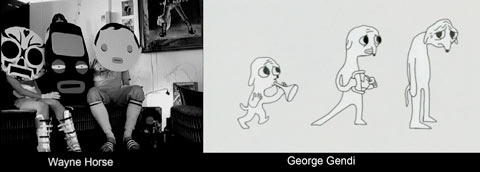
George Gendi’s ‘Middle Dog Gets Angry’ is a delightfully tender portrayal of a world where neurotic whippets and humans share the same bodies, all personality conveyed with simple emotive illustration styles. Ben Hibon’s ‘Codehunters’? Stunning work – think Manga meets Jim Jarmusch’s b+w characters in Dead Man. Guilherme Marcondes manages to bend 3d animation into a more transcendent place than most. And Wayne Horse ( would’ve been a fun name at school), gives us ‘Tell Tales’, the large cardboard heads of real people in an apartment, providing the perfect canvas for animating facial reactions in an unfolding drama.

Coming Up?
The third Pictoplasma conference in Berlin March 2009, presumably another DVD, and plenty of time exploring the gallery at their site.

(And thanks to wunderkid Jaana from betamag.ee for the disc! )

by Sean Healy, February 6, 2009 0 comments

What are you doing for the next 1000 years?

Flying, frying, trying in space.

Flying In Space
So it turns out the Gene Roddenberry and Majel Barrett Roddenberry, or rather their cremated remains, will be rocket-launched into space next year, via Celestis Inc, a company that specialises in “memorial spaceflights”. Gene, was of course, the creator of Star Trek, and his complex and beautiful relationship with Majel was explored deeply in a book written during the final years of his life by Yvonne Fern, ‘Gene Roddenberry: The Last Conversation’. In this book, Yvonne, a former nun steeped in religious knowledge but not bound by it, and Gene explored the meaning of life during his last years, intensely discussing, debating and provoking, trying to push each other through to some new understanding. It’s an enchanting and at times enlightening read, even for non-Trekkies like myself, with quite a few weird provocations floating about near the end. And now, appropriately, Gene and Majel are floating in space, forever heading further away from earth.

Meanwhile…
Back on the watery blue ball, it’d seem we are frying in space. At the time of writing Melbourne is going through a heatwave, which means a week of temperatures above 40 degrees celsius. In that same week, blue ball studiers, the US National Oceanic and Atmospheric Administration, announced the results of a study : whatever increases in CO2 that occur from 2000 to 2100 are set to “lock in” a sea level rise over the next 1,000 years. ( Going back a step : Before the industrial age CO2 in Earth’s atmosphere amounted to only 280 parts per million, and thanks to our use of fossil fuels in that last little mechanical flurry, we currently have 385 parts per million.) The scientists argued that even when we manage to stabilise the quantity of C02, whatever the rate, this will still mean that changes in surface temperature, rainfall and sea level are “largely irreversible for more than 1,000 years after CO2 emissions are completely stopped.” In other words, the longer we take to stabilise, the worse the effects that will be suffered over the next millenium.

And So…
The Long Now Foundation was established in 01996 to develop the Millennium Clock & Library Projects and promote long term thinking, and yes that’s a 5 digit number to represent the year, because they’re already thinking about the next equivalent of the millenium bug ( Remember that monster?). They do actually have a few interesting projects up their sleeves though, most notably plans to build a monument scale, multi-millenial all mechanical clock, which would move and make a noise every year, every decade, every hundred years and every thousand years. Californian computer scientist Danny Hillis was behind that idea, and to date they’ve built a prototype which is now at the Science museum in London, and are investigating a Nevada desert property as the location for the public 10,000 year clock.

Despite belief in the permanence of digital storage, it is actually very difficult and complex to securely store information digitally for use in the distant future ( as so many truckloads of obsolete disks, hard drives and computers testify ). To counter this, the Long Now are pursuing the idea of a 10,000 year library:
“In a sense every library is part of the 10,000-year Library, so Long Now is developing tools (such as the Rosetta Disk, The Long Viewer the Long Server) that may provide inspiration and utility to the whole community of librarians and archivists.”

Also inspired by the long term, they’ve started The Rosetta Project, a global collaboration of language specialists and native speakers building a publicly accessible online archive of ALL documented human languages. Their site currently hosts the largest collection of linguistic data on the Net, featuring over 2,376 different languages.

by Sean Healy, February 4, 2009 0 comments