A well favoured strategy for coping with the modern world is to remix it. For example, if sick of the viagra spam clogging your inbox, why not compose song lyrics with it and perform to rnb backing tracks while wearing a ‘strap-on dildo-AV controller’, like Brisbane artist Thea Baumann? Or check the remix strategies below –
Cold Cutz Collaborative Feature Length Film www.nowthemovie.com
“The kind of motion picture I am interested in will be like creating the modern LP record. It will be mixed into ways of thinking rather than cut linearly,” sez Francis Ford Coppola. And if non-linear cutz do it for you, then your pants may already be wet at the prospect of a Cold Cut feature on the big screen, dialogue free along the lines of Baraka or the Qaatsi films, but utilising the latest in Ninja beat-splicing and AV tricknology, and helped by a supporting crew that includes BBC documentary editors. Ze website ( www.nowthemovie.com) explains how anybody can contribute files and samples to the mix, discuss themes and editing decisions on a message board and even share in the profits of the final film.
“This will be a film in which aesthetics of vjing are used quite strongly to make it different – but we’ll have to wait and see – it’s an experiment which’ll be driven by what footage people contribute, ” enthuses Matt, who apart from this, running the label and launching a recent DVD retrospective of ninja_clips (Zen-tv) – is still finding time for another album.
“The next Cold Cut album will be released in spring 2005, and will feature ‘Cooking with Cold-Cut’, which is an av cut-up about genetically engineered food – we’ll probably release it next time Monsanto fuck something up…”
DIY MIDI Controllers http://www.audiomulch.com/midipic/
Aside from authoring the well-respected audiomulch software, Ross Bencina has been busy performing with VR gloves as part of his laptop performance trio, Simulus. Kind chap that he is, he has also published online the fruits of his research into building custom MIDI devices for controlling software. Sample Snip:
“By combining a PIC microcontroller or Basic Stamp II with a few passive components it is not difficult to construct your own knob box, trigger box, or other MIDI input device. A knowledge of electronics may be required for interfacing to some sensors. Both the Stamp and PIC provide an economical (under US$100) entry point into the world of alternative MIDI controllers.”
Bounty on Kofi Annan’s Head
CNN Breaking News… Osama Bin Laden has placed a BOUNTY on Kofi Annan’s head. Kofi, the former UN chief who recently admitted he and the international community could and should have done more to stop the 1994 Rwandan genocide where 800,000 Tutsis in Rwanda were slaughtered in the biggest massacre since the holocaust in world war II, as you can clearly see, is not impressed.
Next Wave Festival in Melb
Check the massive www.nextwave.org.au program for highlights such as these:
Harvey Pekar speaks – yes the cack-yourself-tastic comic artist that American Splendour was modelled around, which should be a real treat in person eh? May 24th
Ladies Skipping League Tour of Booty & The Kingpins – May 29 @ Fed Square.
Launch of the www.undergrowth.org ?? ‘digizine’ with live av & thea_trickle performances – May 26@ Festival Club
Launch of www.neopoetry.org DVD – also May 26
Salam Pax speaks – about his hugely popular Blog from Baghdad – May 25
New Pollutants, Music VS Physics, Curse of Dialect, Dsico etc – May 29-30 @ Festival Club
Critical Culture series of forums, with great speakers, 5 sessions a day – may 24-30
A zillion other launches, exhibitions & pah_tayz…
Four formidable wrestlers – and you get to vote who gets kicked out of the ring. As long as it’s a space cadet, because interviews with the other 3 are lined up to knock you down in coming weeks. Berlinski boy begins.
Neoangin
True stories to encourage visits to jimavignon.com:
Jim Avignon makes great computer-kitch-electronic-pop as ‘Neoangin’ with crazy, endearing lyrics and mashed up beats.
Everyday for 3 weeks at Germany’s “Documenta” festival, Jim Avignon painted a large picture and destroyed it in the evening by running and jumping through the canvas.
Jim Avignon once opened a shop in Berlin called “Curatorkiller” where he sells cheap art from various artists.
Jim Avignon makes his money with commercial jobs like designing cars (the new Rover) or a watch (SWATCH) and spends it on radical exhibition projects like building a giant brain in a greenhouse.
Jim Avignon painted the Frankfurt University (more than 2 miles of pictures) in 1993.
Jim Avignon makes lots of art constantly, some of which is covered in his way tasty cut n pasty ‘Attack Delay’ magazine/art-book.
Jim Avignon makes art at snowflake sculptural festival, on the side of aeroplanes, ships & Berlin buildings.
Norwegian Wood ( FFF )
Cute, dreadlocked Leona & Tommy are concerned about the continued destruction of forests and rainforests. And these Norwegian activists think different – they decided to put their money where their mouths are. And they’ve also put money where their genitals are. After setting up www.fuckforforest.com, they’ve managed to raise $17,000US which they’re donating to environment groups willing to accept their money. This is proving trickier than expected – given most environmental organisations wish to maintain appeal to a broad spectrum of the population. They’ve found groups willing however, and FFF hope to continue their momentum. Offering a range of explicit photos, videos and live chat for paid-up members – including private paid chats, they’re hoping to re-channel the geek-porn dollar, and enjoy themselves at the same time. In the pipeline? Some entrepreneurs have contacted them about ‘wanting to make a documentary movie about us going to Brazil, giving the money to an environmental project there (and fuck some jungle-girls/boys?)’. Believe. And they’re also looking for volunteers.
Hi-NRG
While www.energybulletin.net will give you a quick insight into the ways energy use is shaping the world’s current and future problems and power structures, and a great updated collection of relevant news & links, there’s another set of energy fiends also worth a look: GENI – The Global Energy Network Institute. Inspired by the likes of Buckminister Fuller ( yeah, that guy who invented the geodesic dome and harnessed other patterns in nature), their mission if you choose to be accepting and helping it, is to encourage a Global Energy Network GRID kind of like an internet for electricity which would redistribute power better and save us much energy apparently. Worth a browse at any rate, and the Australian rep is also an author of a book with interesting provocations but an unfortunate name: “Cosmic Accounting”. Interview on it’s way.
Space Is The Place
For those ready to leave this place, space is the mightiest of dangling carrots. And if you’re one of the geeks behind the world’s biggest software company ( Paul Allen ), it’s easy enough to make a pile of money so big that when you set fire to it, the rocket above it almost inevitably becomes the world’s first private entry into space, that domain just outside of the earth’s atmosphere. You’ve seen this in the news, yeah? (Or check www.space.com) For those without their own multinational software company, The Association of Autonomous Astronauts be yer best bet. A non-hierarchical network of local, community-based space exploration groups, developing their own space exploration programmes, and building their own spaceships. www.uncarved.org/aaa.html. Also recommended: Disconaut AAA who hope to explore the potential of dance cultures for autonomous space exploration, inspired by the likes of George Clinton (Mothership Connection ), Sun Ra ( Space Jazz Reverie, Love in Outer Space) and the 19th Century German philosopher and apparent dance enthusiast, Fred Nietzsche. Say tha nauts:
“The days of this society are numbered. Its reasons and its merits have been weighed in the balance and found wanting; its inhabitants are divided into two parties, one of which wants to build its own spaceships and leave this world behind.”
The Styx Valley of Tasmania boasts some of the oldest trees alive in the world, and is currently threatened by logging. That the logging is actually for making woodchips seems a brutal and clumsy use of technology. Much nimbler was the treetop camp set-up by the Wilderness Society and Greenpeace, complete with satellite phone and internet connection to let the world know what’s going down. Treesitter Vica Bayley describes what it was like.
Why’d you go to the Styx valley and sit up in a tree?
To create a focus on the Styx Valley and attract the attention styx.jpgof News and current affairs media around Australia and the world. The Styx is a perfect example of the out of control logging for woodchips that happens statewide in Tasmania. It has immense potential for tourism and overwhelming Australia-wide support for its protection. The tree sit, which we called ‘Global Rescue Station’, was developed by The Wilderness Society and Greenpeace.
How long were you in the treesit for, and what aspects of it were the hardest to endure?
We maintained the Global Rescue Station for over five months. The most difficult thing to endure was the continuing destruction and desecration of other parts of the Styx Valley and Tasmania. By this I mean the logging of ancient forest, burning of the remains, additional roading into untouched areas and poisoning of native wildlife. We had to live with the knowledge that industrial scale logging was continuing in other areas despite our stand.
What tech_gear did you have up there, and what were you doing with it?
Solar panels, closed cell battery, sat phone, digital video and stills cameras, laptop computer, radios and generator. These were all used to post diary entries and images on a website, record life in the tree and push out information to Australia and the world about what is happening in the Tasmanias forests and raise awareness amongst the global population.
Did you have any unusual conversations / feelings being up there, communicating from afar?
The international activists (Japan, Germany, Canada, Belgium, USA) were the furthest from home but having the experience of their lives. Communication was limited vis satelite technology but thousands of visitors came to see the GRS and provided the opportunity to directly communicate and raise awareness of the issue on a one on one grass roots level. The two spheres of communication, one high tech and remote the other very personal and face to face provided a broad experience to all the activists.
What were you afraid of while up there?
By far the greatest fear was the knowledge that the forest we were in is threatened and planned to be cut down in 2004. We were prepared for the police to be asked to come in and try to move us on, clearing the way for the clearfelling of the very tree we were in. Of course, we were most hopeful of securing protection of that area of forest and indeed the Styx and Tasmanian Ancient Forests that we are campaigning for.
How well do treesitters sleep? ( & what’s the nightlife like? )
Once used to the confines of the GRS, sleeping up the tree was a spectacular experience. Early mornings when the fog blanketed the valley and 80 metre tall trees poked up through the fog was particularly special. Activists wore a harness and two attachments to the tree at all times, even when inside a sleeping bag so the harness and umbilical cord safety lines would take a bit of getting used to. Nightlife was inspiring. There was room to sleep 5 in the GRS so conversation was always vibrant, especially under a full sky of stars. Night time animals rarely visited but early morning saw scores of birds living and playing in the treetops.
Where is the middle ground for the loggers & eco-campaigners?
The middle ground is full protection of designated ancient and high conservation value forests. When you consider that the woodchip industry has had few access restrictions to these forests for over 25 years, and woodchip exports have soared to record (over 5 million tonnes) in the last decade, to even try to find a balance for this open slather industrial logging we need to protect some of the remaining areas now.
Where can people find out more about the campaign?
Visit www.wilderness.org.au and follow the prompts to Tas forests and the Styx, or visit Tasmania and see for yourself.
Now that we all live in cubicles, the machines and communication protocols connecting us assume even greater significance. If you don’t know the right way of slipping notes between cubicles – you miss out on all the parties. And so this week – a look at some of the ways electronic musicians, artists & tinkerers get their machines talking to each other.
Musical Instrument Digital Interface
MIDI is a system designed to transmit information between electronic musical instruments, allowing computers, synthesizers, sound cards and drum machines to control one another, and to exchange system information. MIDI allows one person to control many machines such as a drum machine, keyboard or computer with just the one MIDI compatible device. And with MIDI timecode, which has become the standard for digital music synchronization, many musicians can play on connected machines that will keep ‘sync’ with each other.
MIDI file formats
MIDI information can be collected and stored on a computer disk (along with timing information), where it is called a MIDI file. A quick googling for “.mid” files will soon find your HD amassing a range of pop hits, whose parameters you can then play with in an audio sequencing program. A step further down the track, MIDI-Karaoke (which uses the “.kar” file extension) files are an “unofficial” extension to the MIDI Standard, and add synchronized lyrics to standard MIDI files. Many players are available that display the lyrics synchronized with the music in “follow-the-bouncing-ball” fashion, essentially turning any PC into a Karaoke machine.
AUDIO To MIDI Conversion
Why? Well, if you are able to convert the sounds and rhythms of audio to MIDI, you could use this MIDI information to play synthesised MIDI sounds in the same way as your audio sounded, use it as a way of editing sonic ideas, or providing parameters for controlling music with. IntelliScore Polyphonic does this by analysing sounds in a microphone in real-time, and converting them to MIDI, “automatically detecting chord names, key, meter, and tempo” and creating MIDI files suitable for playback, conversion to ringtones, notation, and editing. ( www.mp3-converter.biz/intelliscore-polyphonic )
Online Jamming
Much inter-machine fun can be had with MIDI parameters from one machine controlling another – eg a drum machine controlling the tempo of video clips on another PC with a MIDI interface. Unfortunately this MIDI communication happens in a different way to the way information is passed around on the internet, or computer networks – in small ‘packets’ at a time. This means that online MIDI jamming is quite tricky, but there are a few ‘translator’ or ‘conversion’ apps around for PC ( www.musiclab.com/products/rpl_info.htm ) & for OS X ( www.grantedsw.com/imidi/index.shtml ), which will eventually allow jamming over a network ( & without a need for external MIDI devices or interfaces ). Other alternatives for online jammers include custom-made applications such www.resrocket.com and DASE by Traksewt (www.elefanttraks.com ) which even allows jamming over a 56k modem. DASE works by just sending the manipulation information not the sound files, once you’ve both got the same sets of samples on your machines to jam with.
Open Sound Control
OSC is a relatively new protocol which is generally considered superior to MIDI, and has been implemented in software like SuperCollider, Max/MSP, Pure Data, Reaktor, Csound and increasingly more applications. OSC also allows communication over ethernet networks and the internet, which makes it ideal for computer based jammers. Straight outta Berkley >> www.cnmat.berkeley.edu/OpenSoundControl
Plug N Play
And speaking of connecting machines – there’s a weekly Melb event called ‘plug n play’ where jammers can indeed plug n play audio & video –
The Kent st Hotel, 201 Smith st Collingwood every Thu. ( Email oz_hq @ micromusic.net for more info about playing). Or you can google your way to find it, and also come across something like the ‘Matrix Vibe’ – apparently the world’s first USB powered vibrator!
“The first 10 speed Micro-controller computer powered vibe on the planet! No Batteries needed! Just plug it into your laptop, home PC’s USB port with the included USB Cable and you’re on your way! AcidDVD is taking “Plug and Play” to a whole new level! Become one with your computer as you plug and play your Matrix Vibe into your USB port with the included USB cable. Reach orgasmic heights as your body pulsates through 10 different speeds and sensations, all at the touch of your finger. No batteries required.”
With over 100 VJ programs now downloadable, exploration of live and real-time video is booming. As VJ software continues to mature, its feature lists are appealing to more than just vjs. Jean Poole profiles the cream of the crop.
Despite the relative youth of the fledgling VJ software industry, VJ coders are managing to provide many innovative solutions for real-time video, exploiting glitches and utilising clever lateral processes that are leaving some of the video rendering giants flat. With ongoing research and development matched by new hardware, new operating systems, new protocols, plug-ins and community feedback from artists – VJ software is in a state of constant evolution. Most VJ software now comes with live camera input, keying, mixing & layering abilities, easy MIDI & controller integration, audio responsiveness, BPM tempo sync, as well as a variety of live FX – all of which happens in real-time, no waiting, no rendering.
For motion designers, animators, film-makers and graphic designers, this real-time ability to test or sketch out ideas can be incredibly productive and more conducive to creativity than tweaking an editing timeline. Many VJ programs also have unique and desirable FX and processes, great for creating unusual raw material for later remixing within a traditional editor. The downside is that much of this software works with 320×240 resolution video clips – far short of broadcast standards. Increasingly though, VJ applications allow recording of real-time actions, for later rendering slowly at full-resolution. For the Vjs and installation artists wishing to control digital media in a live context however, the sacrifice of resolution is well worth the gain of real-time access to complex and powerful toolkits.
Arkaos
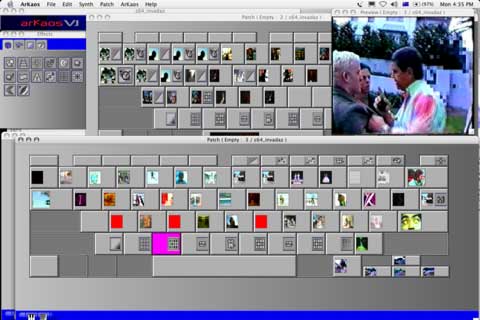
The pioneering commercial video sampler for a home computer was Arkaos, and having refined itself for many years, it boasts one of the most instrument like ‘feels’ of all vj software. Originally released to work with simple still images, Arkaos 3.02 can now handle many clips at once, has live camera input & BPM detection, features high quality photoshop style ‘transfer mode’ layering of video clips ( eg add, multiply ), has dozens of live-FX (eg movie to ascii) with FX parameters controllable by midi or mouse x/y values and includes various time-based playback variations.
“Arkaos is a versatile tool for mixing and editing alike. Being able to play visuals like music on a keyboard is amazing,” says Denny aka VJ CoresNFX, a Queenslander who now spends her time videomixing at events in the UK. This attraction to Arkaos for many VJs is because of it’s very intuitive and easy to use interface. Clips and FX are attached to an on-screen keyboard, and are then launched whenever these keys are pressed. With enough preparation and parameter tweaking, sophisticated yet simple to use preset keyboards can be developed for live use.
“The way I use arkaos when I’m VJing is to trigger my still images, clips and streamed live camera with transitions and effects. I then treat this as one real-time source for mixing against pre-edited dvd’s and vhs.”
Future plans for arkaos include a sequencing environment, more effects, further automation and playback controls. Arkaos have also announced a new Australian distributor – see http://www.elfa.com.au.
ISADORA
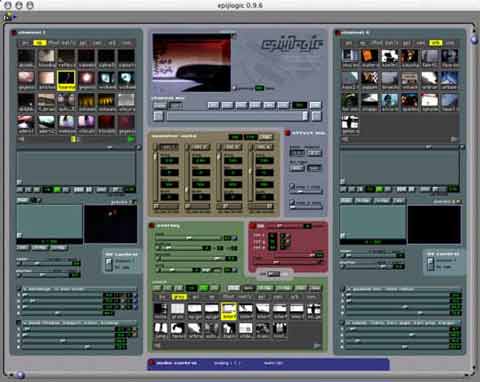
Honed from a decade of working with live video and dance performers, Isadoraepijlogic0.9.jpg is a ‘graphic programming environment’ for building your own applications to control digital media in real-time. Isadora’s learning curve is understandably steep, though less tortuous than the comparable ‘max/msp/jitter/nato’ & ‘Pure Data’ video building environments. Being able to connect different ‘building blocks’ together to customise applications, offers rich rewards for artists seeking to process video or create interactive installations. Example customisations include ‘Epij:logic’ by Austrian VJ Epij, and an installation based application by Thomas Heijman used to sequence video in response to lovers arguing across two screens.
“The core idea behind epij:logic is to make the VJing process more ‘feelable’. I don’t use any beat detections or audioanalysis, it’s all done by playing with oscillating generators and a midi controller as a quick and handy and quick interface while performing,” explains Epij. On the other hand, Heijman for his SXNDRX video project uses Isadora as a video sequencer – triggering specific movies at specific moments, jumping from one patch to the other when needed. He also makes music, and uses Isadora to midi sequence video in sync with his music.
“Certain sounds are programmed to trigger certain video fragments. I’m also developing standalone installations using Isadora in combination with sensors. Isadora features loads of modules to use, inclusing abstract calculation stuff, communication through a network, midi, external video input – but it’s not as abstract as Max/Jitter. It’s a very intuitive piece of software which doesn’t require a lot of programming knowledge from first time users, but is flexible enough to develop complex and diverse patches,” enthuses Thomas.
Isadora also features output recording to quicktime, importing of 3DMax objects, a very extensive manual and great online support. Coming soon: native YUV processing ( instead of rgb ) which brings significant speed increases, and Open Sound Control support which allows communication with a number of real-time media processing applications.
www.troikatronix.com
Cost: $US350
Platform: mac & PC (soon)
Motion Dive 4 ( mac & PC )
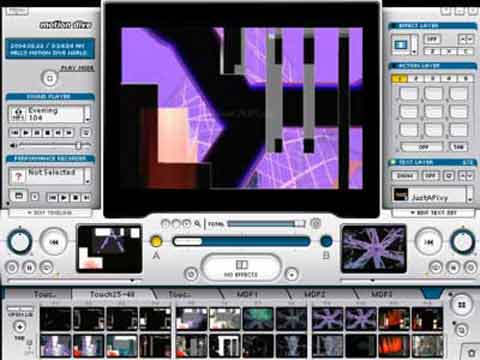
Not a culture to be left behind with tech fetishes, the gadget obsessed Japanese have an impressive array of sophisticated VJ tools available, although few with English manuals. Motion Dive is probably the most popular of these, winning over many users with its easy to use and futuristic interface, BPM tempo sync, stylised transitions, effects and mask layers. VJ Pixylight from Colorado in the States, likes Motion Dive so much he uses it on two separate computers with a video mixer between them.
“Motion Dive’s ability to record A/V clips at animation codec (nice and lossless / uncompressed) means big files, but they look great,” says VJ Pixylight, from the stateside mountains of Colorado, “MotionDive also has a great way of integrating audio and video, especially in MDTokyo, and I’d rank Motion Dive 3 as one of the best apps for graphic design, with it’s text/flash based editor (great for motion graphics). Over 30,000 copies of MD3 sold in Japan alone must merit it as something..”
Pilgrim
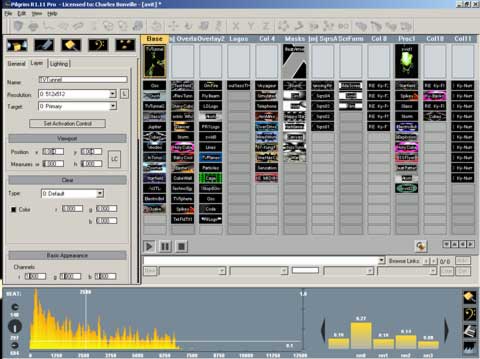
Gaming technology such as souped up graphics cards and game engines like the Unreal Tournament Pilgrim-edit_mode.jpgengine have much to offer real-time video coders. The makers of Pilgrim understand this well, taking great advantage of DirectX graphics card effects. And well sold on Pilgrim’s code and real-time 3D abilities is VJ Technolust from Oregon in the States.
“A lot of Pilgrim’s graphics processing has been moved onto the graphics card, freeing up CPU processing. The result is exceptionally smooth visuals even when layering together three or more high-resolution videos, and even when simultaneously rendering three or more 3D scenes,” explains VJ Technolust, “.. and thanks to off-loading 3D processing to the 3D DirectX video card, 3D scenes can be processed in real-time, which allows the VJ to interact with 3D scenes and models on the fly, or have them react to audio. Apparently the Pilgrim Pro version is so good with 3D objects and scenes that architectural firms are interested in using it to show their 3D models of their buildings/cars/whatever.”
VDMXX
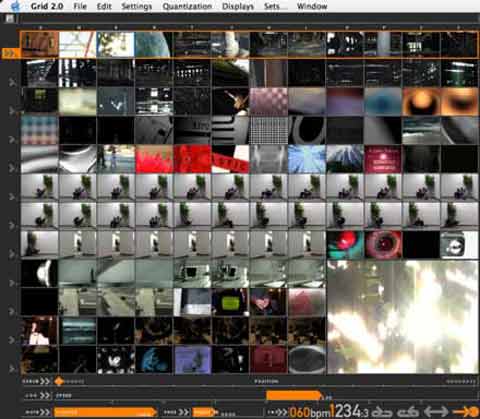
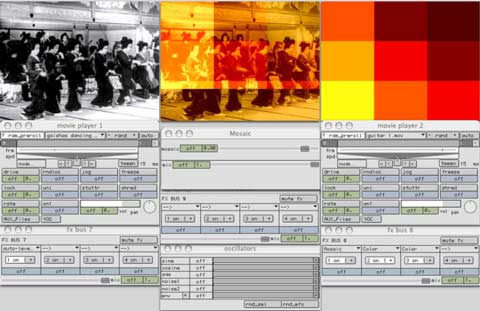
The coders at vidvox.net ‘write software so you don’t have to’ – GRID – their simple but fast and effective sample triggering software ( version 2 out now, Grid Pro out soon ), and VDMXX – a much more complex beast, meshing together time-based controls, oscillators, FX parameters and automated processes. Combining these features in VDMXX allow an impressive diversity of approaches for processing video signals, and it zips along too, considering the complexity of its tasks. Most processes can be mapped to keys or MIDI, but not individual clips unfortunately which sometimes limits it’s instrument-like usage.
“When performing I use a number of theme-based folders of short QuickTime movies. These are loaded into the VDMXX interface, combined and affected. I like to have an audio input to control effect parameters where possible, and I assign as many functions as possible to keystrokes so that I can control the program from the keyboard,” says Layla Vardo, a video artist from Melbourne, “.. I particularly like using audio to control effect parameters for VJing – it’s fun and integrates sound and vision in ways not possible with traditional hardware mixers. It’s colorizer and contrast functions also kick arse over any hardware mixer I’ve used including Panasonic mx50, Videonics MX1 and Edirol V4.”
“Unfortunately for the sake of smooth playback (even on a 1 GHZ G4 powerbook) I must use 320×240 clips. On a dual processor machine it may be possible to run full size movies and maintain smooth playback, which’d make VDMXX very useful as an alternative processing studio to Final Cut Pro – I’ve managed to achieve some great results combining and effecting images in VDMXX that I haven’t been able to replicate in Final Cut Pro.”
Visual Jockey
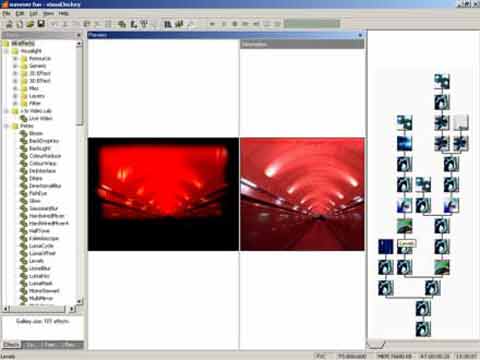
VisualJockey pitches itself as ‘real-time animation software for studio producers or VJs’, and like Isadora, offers the capacity to custom design your own effects and processes. This structural flexibility alongside advanced animation tools, audio-synchronisation, alpha-blending, live camera processing, and a wide platform of extensions and commercial plug-ins, have attracted a large community of PC users, many of whom share their custom FX with each other. Sample jockey fiend? Nick Ritar, one half of Melbourne video-performance duo Cicada.
“Visual Jockey is just about the only software I’ve used that allows me walk up with a visual idea and create it without having to compromise the initial concept. It’s like After Effects for live video. You can chain an unlimited number of effect together, it’s got a great range of mixing abilities, has complete midi control, live video input, video buffering and delays and it’s really fast,” says Nick, currently on an artist’s residency in Seoul,” With a nice machine you can put any basic effect on 1024×768 video without dropping frames, or build a whole chain of stuff for use at 640×480. And it’s ability to render out at all sorts of res is great for when your PC starts to chug.”
“VJo has two modes, editing mode and show mode. You really have to prepare a show before hand, it doesn’t have the flexibility in show mode for you to go searching for new bits of video or to build new patches. We mostly use VJo for larger shows that have a budget for us to put in the work beforehand like theatre and dance productions, the more immersive environments that we do, as well as larger touring acts.”
Other Notable VJ Apps
Union *new & serious vj contender, released since writing * – www.lividinstruments.com
Resolume – popular PC software – www.resolume.com
Flowmotion – www.robotfunk.com/flowmotion
Vjamm – one of the best real-time audio & video apps – www.ninjatune.net –
Midivid – now completely rewritten to take full advantage of today’s graphics cards, leveraging their power to perform real-time effects at high resolutions with quality not possible in CPU-based software. – http://midivid.jasondorie.com/
Vtrack, artmatic, videodelic – unusual video generators & sequencers – www.uisoftware.com
Freeframe – free real-time plug-ins for Vj tools – www.freeframe.org
Unreal tournament engine – lots of potential here – http://udn.epicgames.com/Engine/WebHome
**
Aside from updates to all the above software, what else to add in 2008? Modul8 – Swiss precision real-time video mixer and compositor, mac only. Processing – open source programming language and environment for people who want to program images, animation, and interactions. VVVV – visual programming interface for real time video synthesis. It is designed to facilitate the handling of large media environments with physical interfaces, real-time motion graphics, audio and video that can interact with many users simultaneously. Quartz Composer – node based visual programming language in os x ( tiger or leopard ).
Anything else, throw it in the comments, and it’ll get added in..