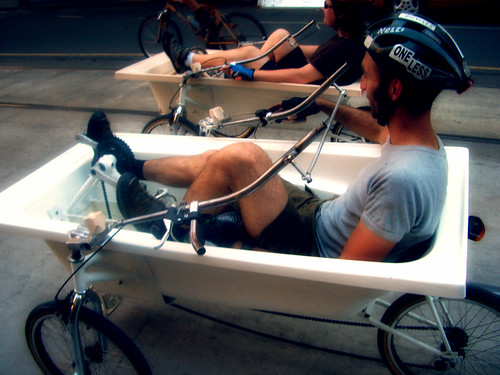
Amazing Transport Device

bath2

Aye, even Einstein recognised ze beauty, ze efficiency of ze humble spoked two wheeler, ze human powered transporter, ze deadly treadly, ze bicycle. City riding can be tricky though, a fact countered each month by the International carnival of bikes that is Critical Mass ( see www.criticalmass.org.au for a list of Aussie meeting points, byo musical instruments ). Another champion of the cycling underdog in the city is the bunnyhopper behind Melbourne’s urbanbicyclist.org, a site full of street-savvy bike riding tips.

What inspired your Urban Bicyclist Project?
All the amazing people who use their bikes every day for transport and living. Every day, at all hours, in all parts of the city there’s a breed or cyclist separate to the more official professional bicycle world – a world that tells us to ride on bike paths, wear our helmets, buy more stuff, dress funny and don’t worry because it’s all being taken care of. Go into a bike shop and the only cyclists you see are lycra clad professionals or bike path bound weekenders. When it comes to support or acknowledgement for “urban” cyclists who ride for transport, not just fitness, sport or recreation, there’s little information support or advice.

The city rider guide started with a few small tips on avoiding car doors. There was a real need for some sort of official campaign to tell car drivers to watch out. In Europe you’re taught to open your car door with your opposite arm which forces you to turn and look. In San Francisco, and New Zealand the Department of Transportation produces stickers which go on rear vision mirrors as reminders. But in Melbourne we just got campaigns targeted at ensuring cyclists wore their helmets and bright clothes.

But a campaign targeted at drivers was beyond the capabilities of the urbanbicyclist project to address. We thought it was smarter to empower cyclists with the skills and information to better handle themselves. It’s also much easier to reach the right kind of cyclists by leaving notes on bikes parked on the street. The tips and tricks grew into riding at night, riding in the wet and other traffic tips, and the guide became fridge worthy (or back of the toilet door material).

Critical Mass also inspired the urbanbicyclist project, as one of the very few things that street cyclists have as a playground for their ideas. Bicycling organisations have been conservatised by their size and wanting to please everyone all the time.

What kind of effect do you think the monthly Critical Mass bike rides have?

Critical Mass rides have a reinforcing, re-energising effect on its riders and are a breeding ground for urban activists. I can personally name dozens of people who are active in the transport planning community, an interest initially sparked by their involvement in Critical mass. There’s also an emerging breed of engineers, planners and other professionals entering federal, state and local government working towards reducing the role of the car in our society. On a broader level, car drivers also notice Critical mass and even the mainstream media has registered the Critical mass rides that have travelled onto Melbourne’s privately owned CityLink tollway.

Memorable Critical Mass moments?
So many – from the epic bridge and tunnel rides, to the sublime winter rides weaving through the back streets of Carlton.

3 things car drivers should be aware of?
Walking, cycling, public transport.

We’ve inherited cities based on car-transport, how can we improve that?
That’s not necessarily true, we’ve lived in cities for thousands of years, we’ve had cars for a hundred. Cities are a reflection of the society that inhabits them. Streets are amazing places, public spaces are the lowest common denominator, the mixing place where people interact with each other. If we start to remove car traffic from our streets, they instantly come to life, the built form of our city responds to our changing behaviour as much as it influences it.

Inspiring examples of urbanised transport solutions / projects in cities around the world?
The most creative solutions to problems, in my humble opinion, come about when people work together. When the bicycle planners are activists who now work for city hall, where the mayor catches public transport to work or where the police know that riding bicycles makes sense. Breaking down barriers that we unnecessarily build around ourselves is the key to improving our cities which are essentially the spaces we live in.

Tips 4 new cyclists in the city?
Explore the city! There’s always 3 ways to get everywhere, sneaky back street shortcuts are so plentiful. Get a map of the city and investigate alternative routes. Don’t let the wet weather hold you back – a normal visor on your helmet can help to keep rain off your face and clear glasses can keep rain out of your eyes, mud guards can help keed road grime off yourself, and a bit of planning with a change of clothes (or just a change of socks) can make a big difference on the way out. Get a copy of the ‘city rider guide’.

Last time you had car envy?
Cars are beautiful because there is an entire culture founded on making them look good, cars are comfy because they couches in them and I like sitting on couches. But as soon as you take a step back and think outside the car, it really puts things into perspective and brings you back to earth.

What’s the largest animal you’d be able to bunny-hop over?
Bunny hopping is so damn useful, and there are kids in the city who can jump a metre or more over steps and onto ledges. I can do cats and dogs, but try and ride around animals that may be too big.

by Sean Healy, June 20, 2004 0 comments
MIAF 2004 & Eugene Foo

As predicted last week, eeet isss happpening aaa-gain… and the 2004 Melbourne International Animation Festival (June 22 – 27 @ACMI, see www.miaf.net ) is the biggest selection of animations you’ll see all year. Eyeball feast on 100 films from 25 countries, an Estonian surrealist animation focus, a Priit Parn retrospective ( google the genius), a Phil Mulloy Special, a spotlight on animated documentaries, twice the usual number of digital animations and loads of Australian works including ‘Harvey Krumpet’ and the quite delightful ‘Grey Ave’ by Eugene Foo, who speaks now:

What inspired you to transform Melbourne like that?
The idea of these bizarre creatures really began with just several doodles I did over at a friend’s place. The initial sketches were by far a lot more weird and demented – some of which consisted human body parts and features, making them look very disturbing. These random and spontaneous sketches I had done are what I believe to be a combination of fantasy art and surrealism (specifically a sub-group of surrealism called ‘automatism’ – drawing thoughts from the subconcious psyche). I have been doing this for a very long time, but never really saw the potential of it being an animated film, and I certainly didn’t expect it to come in full bloom when I was in Melbourne. Being a foreigner in Melbourne, even the most mundane of urban objects seemed to have a different effect on me compared to when I am back home in Malaysia. Everything seems so ‘alien’ – just the same way these surreal creatures are alien to the real world.

How much did sound influence your visualisation / animation?
Music, I would say is the prime essence of the animated film. In fact, it was the very element that helped me string my ideas together. I used to walk to college in Melbourne listening to Madonna’s song, ‘Frozen’ from her album ‘Ray of Light’. I had this strong affinity to the tempo and beat she had in that piece – very dark and enigmatic. While doing this everytime I went to college, I had my sketches incubating in my head, sort of like waiting for an idea to hatch. I don’t know how, but one day, I just saw the sketches in my head coming to life and moving with the tempo of the music – that was when the core foundation of the idea was born.

What’d you enjoy about the tools & processes you used for ‘Grey Ave’ ?
I used a lot of Adobe Photoshop and Adobe AfterEffects in my film. These softwares were able to cut my time down to almost half compared to if I had done things manually. The texturing and colouration of objects for instance, was done in Photoshop entirely. AfterEffects was used to animate almost all of the creatures and even the walking charcacter. The softwares gave me the results I needed extremely fast and often times even more than satisfactory. Everytime I completed a shot, I get very excited and was eager to go on to the next – wanting to see how each one would look like when I brought bringing mere sketches from a static storyboard to life.

Explain ‘rotoscoping’ in terms of how you used it in your animation?
The only element rotoscoped in the animated film was the walking character – which in fact are footages of me that my housemate helped record. I felt the treatment of the rotoscoped sequences and the irregular shaky lines all incurred a certain mood and feeling I wanted. It made it feel more organic, and a whole lot more personal reason being that it is myself that I see in my film.

What animators are pushing animation ahead these days?
I’ve thought technique and technology was the driving force in the animation world, and feared 2D animation was slipping away with the explosion of 3D animated films like Shrek, and previous Oscar winning shorts like The ChubbChubbs and For the Birds. Nevertheless, it is masters like Koji Yamamura, Hayao Miyazaki and Australia’s very own Adam Elliot (this year’s short animated film Oscar winner) that proved my assumptions wrong. It is the substance and story that is most crucial. In fact, good storylines and substance is being emphasized even more now than ever because stunning imagery has been made so conveniently easy to achieve, the only way a film can stand out from the rest is from the story they each tell.

What projects are you working on now?
My next short animated film is a dark & twisted tale of a biologist whose wife is delivering their first child in a hospital. I also do paintings whenever I have free time from lecturing at a local university here in Malaysia.

3 Amazing animation URLs?
Flash Animation – www.transience.com.au, www.happytreefriends.com
Indie Animation Archive – www.zed.cbc.ca

by Sean Healy, June 12, 2004 0 comments

My Doomsday Weapon

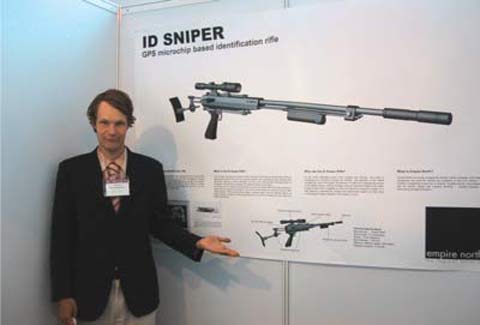
Jakob S. Boeskov from downtown Copenhagen, Denmark – is a funny boy. Take his latest arts prankster turns weapons gangster project, now exhibiting in NY (http://events.thing.net). Jakob infiltrated an International Weapons fair at Bejing with a fake blueprint for an ID Sniper which ‘shoots GPS (Global Positioning System) microchips into the bodies of innocent civilians, whose movements later could be followed by authorities via a GPS satellite system’. He documented the spooky scenes and reactions of the arms traders until he could take it no more, and if that effort impresses you at all, you should really make a little effort of your own to read his hilarious account of it all at www.jakobboeskov.com, or try his fictitious weapons company www.empirenorth.dk.

[[UPDATE: Sep, 2013: Lib’s plan to microchip suspects by sniper rifle : a Liberals candidate in Western Sydney, has been exposed as a strong advocate of sniper powered microchipping to ‘improve the productivity of the NSW Police Force’. (via Sydney Morning Herald)]].

doomsday

What’s your beef with surveillance buddy?
It’s rude.

Can you think of a situation where you’d like to have a GPS sniper rifle?
Well, I already have one.

How did the exhibition fare against your expectations?
There was no people with people with patches over their eyes, it was not so James Bond like. It was just a bunch of people from around the world making shitloads of money from war and the fear of terrorism. Quite banal and therefore much more horrific. Boring people selling tanks is something that is truly a nightmare for me.

What were you afraid of during your exhibition?
To be revealed as a fraud. All the plainclothes policemen really stressed me out. But people treat you nice as long as they think you are a weapons dealer. Another concern was that they would eventually want to buy my weapon. And that happened. They basically asked how much money I needed. They really wanted this horrible piece of technology. When I went to New York I received endless emails from real weapon dealers who wanted to invest in the weapon. A huge american investment bank, Prudential, was also quite interested.

Your choice of weapon if you had to kill someone – you know, like if you really had no choice?

With a pen. Or a very sharp pencil.

What surprised you about the people marketing new weapons of mass destruction?
I didn’t meet any of them. To my knowledge, nuclear weapons are not sold at these fairs. Dupont chemical had a booth though, but i never had the time to chat with them.

How scary is the Danish Defence industry?
Well, they do stuff for the new Eurofighter plane. A company called Terma also did stuff for the F16. The Danish shipping company Maersk which is bigger than Coca Cola now, used to make guns for the occupying nazis. It’s really a myth that there is no weapons industry in Denmark.

Other strange, horrific weapons you came across at the expo?
Armed robots.

How well do they fingerprint / interrogate ‘innocent civilians’ such as yourself, travelling to New York to exhibit your ‘project’?
They took me straight to customs, because I had a model of the ID Sniper with me. They started to shout a bit, and said I was violating state law, but eventually they let me go. They forgot to fingerprint me.

What do you think artists can learn from weapons manufacturers?
To make money.

by Sean Healy, May 20, 2004 0 comments

Pure Data in the Tropics: Patrick King

patrick king
On each of the endless Big Fruit statues on the road to Brisvegas, there’s a tiny penguin etched on their sides. Carver unknown, but rumours include: dmotd aka d:void aka one Patrick King, long-time Linux enthusiast and audiovisual ecologist so well versed in the art of the accident, the Briz tow truck drivers all tune in on their CB radios. Patrick also enjoys walks on the beach, fragmented noise patterns and making machines that bite back. Bookmark the boy here: http://dmotd.bpweb.net/

What’s your current live AV set-up and what do u do with it?
I have 6 computers, all running Linux (gentoo + debian distributions).. mostly old P3’s and G3’s, old hardware is cheap. The total cpu + ram is equivalent to a new machine, but I don’t have a few grand floating about. I communicate between computers through a network – some process sound, others splice video or generate 3D + 2D graphics, and the rest are typically user-interfaces. Software wise I mostly use pure-data for audio + video, php + mysql for network interfacing and a few other programs and custom scripts – all open-source so it’s a relatively cheap setup.

Benefits of Linux for AV?
‘Made by hackers, for hackers’, linux philosophically is at odds with proprietary operating systems, it’s user contributed, it’s free (as in speech and beer), comes in many forms and flavours and is fast, stable and usually won’t break without human error. Linux is an open-source operating system, meaning anyone in the know has access to guts of the software, and generally comes in bits like a meccano set – there are a lot of small programs and libraries that can be patched together to make larger programs. This is a major distinction from it’s competitors (asides from BSD), where one program has a thousand functions, of which you may only need three.

Linux is packaged with thousands of bits of open-source software written by people worldwide.. it’s very eclectic and disorganized, so in theory there are thousands of ways that you could set up your computer for the same task. AV-wise there are standalone video editors, but also subsets of programs that may just splice video, or create a composite image etc.. it’s up to you to dictate how these subsets function. It’s very easy to have programs talk to each other, ie send audio signals between programs, send video streams over networks, or create interfaces in one program to influence another, which is how I’ve been operating my machines. Linux encourages thinking outside the square, and if you’re prepared to put the time into it you can create quite complex and personal results.

Benefits of Pure Data for AV?
Pure-data is a program designed and created by Miller Puckette, of max/msp fame. It’s cross-platform, open-source and is basically a redesign of max. Pure-data is a visual scripting language primarily designed for audio signal processing, there are thousands of user built extensions for PD that take it beyond audio into areas like video, 3D, physical modelling, complex algebra, hardware interfacing and networking, making it more of a general multimedia programming tool. It’s great for people that are visually minded, that want to create live multimedia works, but who lose the plot in line-by-line programming. It’s sort of like macromedia director in some ways, in that it gives you a great deal of control over many disparate elements. You could theoretically create anything that comes to mind, as long as you’ve got the processing power to compute and have the ability to describe things in symbols and numbers.

What bores you about electronic music and multimedia these days?
The limited palette that people use, structurally and stylistically nothing much changes between artists and we slip into a monotonous hole. For the most part electronic stuff generally builds upon its own history, and artists more or less are reliant on the talents of programmers to define their style. We have tools that could feasibly create sound and vision completely alien to anything on this planet, yet there seems little variation. I haven’t heard or seen much recently that breaks the presets and defines a whole new set of parameters. In some ways electronic experimentation ended in the fifties.. but there are numerous people who could prove me wrong.

And video?
Video still has the ability to excite me, it’s still a pretty fresh field, so I think there’s more leeway for experimentation.. as long as we don’t keep hitting the preset effects, there should be plenty of interesting stuff coming our direction.

What are the learning curves like for linux though – say for the average PC user?
Linux is by no means a complete out of the box studio. It’s got a long way to go before it has the maturity and interoperability of mac/win. It’s an excellent playground for inquisitive and intuitive people.. making the transition is relatively simple as long as you’re prepared for a thousand little changes that could potentially make you go insane.. so if you make your dollars on a computer, I’d strongly advise keeping your commercial O/S!! Linux is still a hobbyists O/S, but is becoming much more functional to use day-to-day. To check it out grab a copy of knoppix or dynebolic, which you just boot into from a cdrom, no installation necessary. A lot of the linux software is cross-platform, so there’s a good chance you can run open-source software on your windows or osx box.

Best URLS for the LINUX curious?
http://linux-sound.org
http://www.linuxartist.org/
Bootable cd’s: knoppix: www.knoppix.com, dynebolic: www.dynebolic.org
Standard: mandrake: www.mandrakelinux.com, fedora: fedora.redhat.com, debian: www.debian.org, gentoo: www.gentoo.org
Questions/docs/info: www.gnu.org, www.linuxquestions.org, www.tldp.org
Pure-data: pure-data.iem.at

by Sean Healy, May 1, 2004 1 Comment

Wevie Stonder Interview

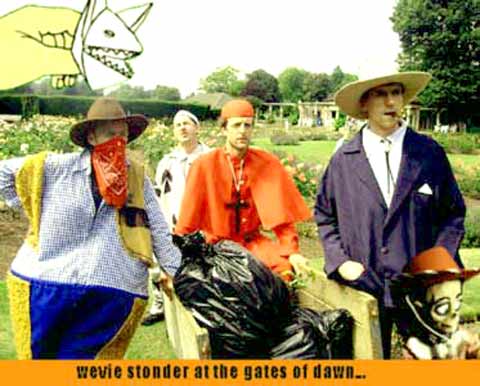
Spreadeagled in dental chairs, all throbbing teeth and spindly hearts, a world of you await their fate. Were 4 buxom dentists to rollerskate into the room, gorilla costumes bulging beneath their white suits, their name badges would probably read : “Al, Chris, Henry & Rich”, and no doubt, they’d be carrying buckets of homebrewed anaesthetic. Indeed in an oft sterile world of Lectronic music, tis a pleasure to come across such musical moonshiners as those at weviestonder.com. Putting the ape back in apocalypse, ladies & gentlemen: ‘Wevie Stonder’.
wevie stonder

if you were to play on a desert island (eg Australia ) what could we expect?
A> Sight akin to a village idiots festival of music & mime.
C> Marsupial interference.
H> The unexpected.
R> Something like when stunts go bad rocking all over the world live in Pompeii.

Do you have any quarantine issues when touring?
C> We only interfere with indigenous lifeforms in their own environment, so no.
H> The monkey and the rat seem to get us through customs every time with no problems, sometimes we have a 2m cock which tours with us and that has caused slight delays.

What’s the Wevie Stonder approach to ‘music technology’?
C> If it ain’t broke chimp it.
H > Sort of backwards on a gently curving trajectory with butt cheeks spread.
R> Best foot foward, start as you mean to go on, shoot from the hip, and leave the arguing to someone else.
A> I do it.

And how does the animal kingdom integrate into your creative processes?
C> Like a shoehorn. Without its curved assistance we’d all be in our socks staring at footwear.
H > Ask not what the animal kingdom can do for you but what you can do for it.
R> Chickens were quite keen ducks and geese a bit slow to respond.
A> It is a constant source of inspiration.

What do you know about Australian wild-life?
( sample true story: Just this year, 22 year old Luke Tresoglavic was snorkeling off a beach near Newcastle when a ‘small’ wobbegong shark bit into his left leg. Unable to remove the feisty ‘little’ bugger, Luke swam 300metres to the beach with the shark attached to his leg. Unfortunately the two sunbathers on the beach were unable to pry the shark’s mouth open, and so Luke got into his car, wedged the shark against his gearstick and drove to the local surfclub – where the shark was drowned in freshwater and removed from Luke’s leg. True story~!! )
C> I’ve seen the photos. Boy took it in his stride like a trooper.
A> Strewth.
H> You fuckers!!! we were wondering where our manager had got to.

How’d you get David Attenborough to rap about baboons for you? ( I mean it sounds so much like im 😉
C> It sounds like him but it is actually his younger brother Ronald. Got him cheap as chips.
H> We bummed him.
A> Henry
R> No comment

Obviously a movie or at least telemovie is in the works, given your emphasis on storytelling -who stars in it, and what’d be the major themes in a Wevie Stonder film?
H> A gay version of mad max starring your good self.
C> A musical serial killer Buddy Cop movie in which the killer ‘shines’ his (French Philosophy professor) victims to death with Brasso whilst singing tunes from “Fiddler On The Roof”. Hopefully we’ll get Burt Lancaster to play the lead (if he isn’t dead.? Think he might be dead… Even better, the killer is already dead before the start of the film! OK scrap the whole idea. Back to the drawing board).
R> The darts musical.
A> Starring Eric Bristow.

Dispel the myths – Wevie Stonder are actually members of Monty Python &/or the Goodies?
C> No, we are in fact Bernard Manning.
H> Them’s fightin words boy!
R> No, you got that wrong.
A> Henry was in the goons tho’.

The most common emotions felt in the Wevie Stonder backstage spa?
C> Before a gig, gladness. After a gig, baldness.
H> Nausea, colonic cramps& continuous ejaculation
R> Bother
A> Pity

Which 3 websites bring you nearest to tears?
H> www.getalifeferfucksake.pissuparopefuckstick.com
R> world beard championships, dogsincars.co.uk, and the other one
A> weviestonder.com, but not for that reason.

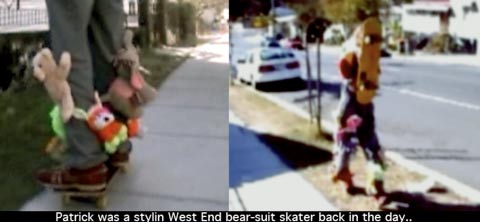
Your major skateboarding influences?
H> Your momma.
R> Something to do with a dream Russ had, better not go into it.
A> boredom

What sort of things do Wevie argue about?
C> We can argue about absolutely anything.
H> Who can drink the most, whos taken most drugs and which of the Wevie quadruplet twins really won the speed skating junior championships back in 88′
R> Diamonds and pearls.
A> Bass players & singing.

Next up – a cabaret-dub album with WEEN, or something I didn’t imagine?
C> A re-invention of the historic Swiss Cheese Industry.
H> Ask Ween.
A> Austalian tour (Go on), new album for Skam, dvd, T-shirt & shorts set, mugs & a darts musical.

What have you learned about pop music lately?
C> That it’ll probably outlive me. More’s the pity.
H> It taught us everything we know but not everything Herb Alpert knew.
R> Love it.
A> Am still learning.

by Sean Healy, April 20, 2004 0 comments