Twitter & The Whole Microblogging Thang

Or : a shift from continuously bookmarking things about twitter, to actually writing about it.

Vat Ist Twitter?
It’s a microblogging service, with the same character limit as an SMS. You can send an SMS from your phone, or a message from a desktop app, or a browser exension, and this gets added to your public timeline eg twitter.com/your_name. By subscribing to various friends, artists and organisations, a continuous feed of their daily updates can be viewed, and messages can be sent directly between users. Think of it as the status updating feed from all your Facebook friends, without any of the other bits that come with Facebook.

Or as people who have studied it at university say :
“Twitter is a social messaging service that allows users to stay connected to other users, despite geographic differences, through instant updates of the everyday minutia and activities of their friend’s daily lives.

Twitter is a tool that allows users to have some sense of where and what their friends and family in their social network are up to. It’s a manner of establishing and maintaining a connection without geographic proximity to prevent isolation in an increasingly mediated world. The immediacy of response establishes a presence that may not have been otherwise acknowledged.”

How Crap Is It?
If Facebook friend updates annoy you, steer clear of twitter. On the other hand, if you like the idea of stepping out of the FB walled garden, and having a permalink connected to each of your updates, so you can refer to them, can refer to others, so conversations can develop, and like the idea of being able to receive key updates from important people via computer or SMS, then maybe it’s worth a look.

From this simple set-up, quite a range of behaviours and possibilities are emerging. Media hounds and news junkies are finding it fantastic for discovering breaking news. Friends are using it to get quick responses on whether a certain movie or band is worth catching. Twitter users have staged a mock Martian Invasion (ala ‘War of the Worlds’, the Orson Welles radio play that caused widespread panic when it was broadcast). Groups are using to it organise gatherings. Some are posting the Ulysses novel bit by bit, others are creating ‘nanofiction’ for the 140 character limit. Send URLs of interest straight from a Firefox browser, or send messages from Second Life. Got a question you just can’t find the answer for, but suspect one of your friends knows? Post a twitter message, and answers are usually pretty quick.

Popular twitter-folk : twitter.com/MarsPhoenix ( a regular series of updates written in the voice of the robot exploring mars recently ), /snoopdogg, /Brian_Eno, /StephenColbert, /algore, /MCHammer, /WilliamShatner, /stevewozniak etc etc

Twitter Tips?

1. Gather a big list of contacts, this makes a huge difference. Twitter isn’t about reading every single message, but having a stream of messages flowing that are continuously related to current time. When you feel curious, dip in, see what people are writing / doing / recommending / asking etc etc. Grab what you need, and dip out.
Find people : http://search.twitter.com/, http://www.twingly.com/microblogsearch, http://www.celebritytweet.com, http://www.Tweetag.com/, http://twitterusergroup.com ( has groups and meetups for sydney, melbourne, canberra, brisbane, etc etc )

2. Get a desktop Twitter app. This doesn’t mean you have to leave it turned on all the time and drown in the musings of the masses, but means you are much more likely to get benefits from it, instead of going to your twitter.com/username webpage. The desktop apps also allow you to group friends together, separate more personal messages, and generally organise the information flow better in a convenient interface.

Find apps here : www.twapps.com
Arranged in categories of desktop ( mac, pc, linux ), firefox plug-ins, and other web-apps.

3. Try Some Twitter Extensions :
mrtweet.net – looks at your account, and recommends people for you to connect with.
www.tweetdeck.com – aims to evolve the existing functionality of Twitter by taking an abundance of information i.e twitter feeds, and breaking it down into more manageable bite sized pieces.
ping.fm – updates your twitter account, facebook, myspace, etc etc dozens of places in one go..
friendfeed.com

4. Play with your settings so you can send and receive messages from your phone, maybe filtered so you are only receiving the important folk you need.

5. Play with # hashtags :
Hashtags are a community-driven convention for adding additional context and metadata to your tweets. They’re like tags on Flickr, only added inline to your post. You create a hashtag simply by prefixing a word with a hash symbol: #hashtag.
eg a post with #Obama takes u to a page http://www.hashtags.org/tag/obama that shows all the recent posts with that hashtag.
twitter.com/jean_poole

by Sean Healy, February 3, 2009 0 comments
German Cannibals, Opera House protesters, Blimps, etc

Just because you’ve been wondering whatever happened to….
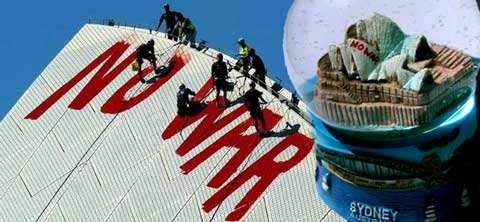
no war sydney opera house

The Guys that painted ‘No War’ 0n the Sydney Opera House?
Will Saunders and Dave Burgess made global news with their painted 2003 protest, two words on the top of Sydney’s most famous icon transforming it into a strong statement that the Australian public weren’t happy with the leader’s decision to join the invasion of Iraq. Since then? Will and Dave were convicted of the charge of malicious damage, along with a bill to clean off the paint : $151,000, which they raised over time selling snow-domes, t-shirts, stubby holders, fridge magnets and posters featuring the Opera House with ‘No War‘ painted up top. They were both also sentenced to nine months periodic detention, which they have both completed.

“We were always committed to paying any reasonable clean-up costs, or even unreasonable costs as it turned out. But the Opera House is as good as new, unlike Falluja, or Baghdad. 100,000 deaths later and with Iraq on the brink of civil war, our reasons for painting NO WAR on the Opera House look as good as ever”, says Will.

The German Cannibal
Remember Armin Meiwes? He was all over the world news back in May 2006 after being convicted of the murder of a 40 year old German designer, an event made all the stranger because of the extensive written and video evidence showing the victim’s consent, indeed the victim’s actual desire to be eaten, to offer himself up into the service of another in the profoundest of ways. The pair met on a European online cannibal forum somewhere, and discussed for months the ways it would happen, before finally following it through, complete with video recording of their last meal together. Since then, Armin has been the subject of much television documentary and film interest ( Butterfly: A Grimm Love Story, Your Heart in My Brain, Cannibal ), which he is quoted as finding ‘distasteful‘. Also true : since entering prison, Meiwes has become a vegetarian, and wants to write a book of his life story with the aim of deterring anyone who wants to follow his steps.

Geocities And Angelfire?
Back in the pre-social networking days of the twentieth century, back before ‘free social network sites’ owned by multinational media empires allowed your local anarchist punk and techno bands to conveniently publish their songs and manifesto, yes way back then, well there were a series of crappy but free webhosting services where your crazy ‘work in progress’ animated gifs could be stored above a rainbow of font colours, arranged into the special sequences that made your particular slice of the web ‘unique’. Amazingly, Geocities and Angelfire still exist, undre yahoo and lycos respectively, still serving free ( ad-hosted ) pages, and offering ad-free hosting for small change per month. Craving a domain name that better says *you*?

Webster?
You mean Emmanuel Lewis, that 1.3m high sitcom actor? Didn’t he die of a freakish breakdancing neck injury? No, that’d seem to be an urban myth, or maybe you’re mixing him up with the popular 2007 movie , ‘Kickin’ it old school’, whereby “At a talent show in 1986, young Justin Schumacher suffers a head injury and slips into a coma. Twenty years later, Justin (Jamie Kennedy) awakes with the mindset and experience of a 12-year-old. He decides to reunite the members of his former dance team and revive their short-lived careers.”

Blimps?
Sure, the Hindenburg went up in flames in 1937, along with blimp evangelist dreams of blimps taking over the worldwide. Giant gas filled objects with engines in the sky? What were they thinking? Well they still exist today, with a shifted emphasis from passenger travel to ‘certain niche applications, such as advertising, as camera platforms for sporting events, and as aerial observation and interdiction platforms, where the ability to hover in one place for an extended period outweighs the need for speed and maneuverability’. Go wikipedia! ( look up airship )

by Sean Healy, January 16, 2009 1 Comment

2009 Climate Change Resolutions

Another lap of the sun, and what’s to be done? Addressing climate change wasn’t on the Australian Prime Minister’s to do list this year, but it can still be on ours.

William Burroughs once argued that it generally takes humans a disaster in their own backyard, before they rise up to do anything about it. Or more directly : “the only thing that gets homo sapiens up off its ass is a good foot up it.” Unfortunately, we can’t wait for the full impact of climate change to hit – by the time it’d be in full swing, the processes underway would have both severe impacts upon us, and take far too long to reverse.

Severe impacts? Maybe that’s too light – rising sea levels, large-scale food shortages, plagues, massive species extinctions, unprecendented numbers of refugees, intensified ethnic and political tensions, more frequent and more severe natural disasters, and a global economic depression the likes of which no one has ever seen. In other words, it’d be kinda preferable to use our foresight muscles, and get it together sometime in advance. The bad news is that this will be very difficult. The good news, is that humanity has previously mobilised enormous responses to difficult challenges, such as the two world wars and great depression of the twentieth century.

Evidence?
But wait – is this actual happening? Well, aside from a hefty weight of ongoing scientific documents released last year, each making more urgent appeals than the last, the situation is probably best understood by realising that in August 2008, for the first time in human history, the North Pole could be circumnavigated. Additionally, the following phrases in a search engine, will prove fruitful for those unconvinced : “arctic melting rates 20 years ahead of predictions”, “arctic sea soon ice-free in summer”, “Coral reefs disappearing”, “polar bear added to endangered list”, etc etc. Sure, Al Gore told you already. But what to do about it?

Responsibility?
Many countries including Australia are refusing to address their contributions to climate change, by arguing their contribution is much smaller than that of others, and shouldn’t have to be dealt with until the larger countries contributions have been addressed. Surely a better way forward is to acknowledge and address our impact, and set an example for others? In the same way individuals shouldn’t avoid facing their own impact by insisting it doesn’t make a difference in the face of Government or big business scaled decisions. Again, it’s not an either / or situation, and the larger decisions are more likely to happen within an informed population who are practicing what they believe.

Action?
Aside from lobbying Government and big business to address their impact, you can also tackle your personal impact. It’s a short 2 Step Program.
Step One : Calculate your carbon emissions.
Step Two : Figure out ways to reduce that. That’s for everyone to do themselves, but general things to keep in mind :
transport tends to average around a quarter of our emissions ( cycle or get public transport more ),
a meat based diet is much more carbon intensive to produce than a vegetarian diet, ( Food contributes about 28% of our greenhouse gas pollution. This includes eating out and buying food. Meat and dairy products are especially problematic, because their production is particularly water-intensive. (About 200L of water is needed to produce a 150g steak),
and heating hot water makes up a surprisingly large proportion of an average persons energy consumption.

Other climate miscelleany :
Consider your direct carbon emissions, and your indirect carbon emissions

Climate Code Red, a recent Australian book tackling Climate Change and the need for serious responses.
http://www.manpollo.org/ : risk-management perspective on global warming.
breathingearth.net ( real-time simulation displays the CO2 emissions of every country in the world )
gaszappers.com ( online art games that tackle climate change, including one where the aim is to save venice)

http://www.chooseclimate.org
http://carbonrationing.org.uk – community skillsharing and events to help reduce the carbon footprint of each other’s homes :

“We believe that the impacts of climate change demand a serious programme of greenhouse gas emissions reduction, and we urge governments to adopt a universal and equitable framework to achieve this. In CRAGs, we are implementing this approach at a community level. We form local groups to support and encourage one another in reducing our carbon footprints towards a sustainable and equitable level. We measure our progress against our carbon allowances. We share knowledge and skills in lower carbon living, raise awareness, and promote practical action in the wider community.”

by Sean Healy, January 16, 2009 2 Comments

Ten End of Year Top Tens

End of year lists are generally a good reminder of three things – how bloody fast the year goes by, how much we manage to cram in, and no matter how sharp our radar, how much we manage to miss out on.

10 Stories Missing from the News in 2008
At Project Censored (via current.com) their top neglected story is the lack of media mention of the current top estimate of Iraqis killed in the Iraq war (1.2million ). Over at foreignpolicy.com/top10-2008, they name as major unreported stories – a significant increase in U.S. presence in Afghanistan during 2008, large increases in Colombian Coca production, and huge gas purchases in Africa by the Russians. For Time magazine, the Congolese civil war displacing 1 million citizens, and the outbreak of civil war in Sri Lanka are seen as needing more coverage. Time also listed their top ten green stories ( 1 = election of Obama and his focus on better energy use ), and Top 10 scientific discoveries ( 1 = The Hadron Collider – the massive particle accelerator which didn’t destroy the world, but didn’t really work either, as a helium leak caused the collider to shut down after less than two weeks. Spinning again June 2009 ). Time also noted a Chinese astronaut did a spacewalk in 2008, showing that the Chinese Space program, while still behind NASA’s achievements, is progressing at a much, much faster rate.

10 Worst (Mostly Aussie) Cock-Ups of 2008
Ben Eltham tallies up over at New Matilda, some of the year’s most notable political mistakes. No.1? Kevin Rudd’s ‘depressingly low 5 per cent target for carbon emissions reduction target’ which ‘pretty much throws in the towel when it comes to fighting climate change’. Also targetted? Lack of Australian water policy and Julia Gillard’s private schools funding bill which means that ‘billions more dollars now flow to the nation’s private schools than to public and state schools, and the Commonwealth gives more money to private schools than it does to universities’.

Top Google Searches of the Year
The annual list of Google as mirror, points out that Australian interest grew faster about about Sarah Palin than Underbelly, both of which were left in the dust by facebook and the iphone. Heath Ledger was the 5th fastest rising global search term. I wonder if all languages are counted, given China has more net-users than any other country now, and english is likely fading in proportion as a preferred language online.

Japanese Words and Archaeological Finds
Speaking of words. Pink Tentacle listed the most popular new Japanese words for 2008, and top of their tongues is ‘gerira gou’, which means ‘guerrilla rainstorm’, an expression in use for about 30 years, but really coming into it’s own with Japan’s increasingly unstable weather. Elsewhere, the Archaeological Institute of America noted that although 2008 will always be remembered for Indiana Jones and the Kingdom of the Crystal Skull, they will likely remember 2008 as the Year of the Earliest North American Coprolites (ancient human feces), or perhaps the Year of the Imperial Roman Marble Heads (two were unearthed in central Turkey). ( Full list )

Lifehacker Have Your Gadgetty Softwarish List Needs Covered
Inevitably. 20 top ten lists including obscure google search tricks, bit torrent tools + tricks, firefox 3 features, how to videos, youtube hacks, underhyped webpapps etc etc

New York Times : Best of Ideas in 2008
Spray on condoms, because one size fits all, air bags for the elderly, one-room school buses that transform long commutes into learning experiences, and eating kangaroos* to combat global warming were all celebrated as useful ideas. (*11 percent of Australia’s total greenhouse-gas emissions come from the methane produced by the rumen of cattle and sheep, whereas kangaroos don’t produce methane, because their stomachs have different microorganisms to ferment their food.) The NYTimes also point to a list of lists for best books of the year, which include the likes of : David Sedaris – You Are Engulfed in Flames, Beethoven was one-sixteenth black and Other Stories By Nadine Gordimer, graphic novels and other documents of human misadventure.

Free Music from Netlabels
http://phlow-magazine.com covers a huge range of netlabel top ten lists – and given the gigantic range of free and unknown material available, their end of year posts make a great place to start uncovering some new favourite artists. Also free, the latest EP from Melbourner Faux Pas, download from iamfauxpas.com, and a Suckaphish P. Jones mix from the road ( with bonus top ten rumblings.. ).

Ten Visual Links for a Desert Island
There’s plenty more, but if it had to be only 10, could survive with just these in my RSS reader : http://ffffound.com ( images curated by the masses ), createdigitalmotion.com ( curious brained scene scanning and speculation ), vjforums.com & http://delicious.com/tag/vj (got the VJ hive mind near covered) , mograph.net ( covers most motion graphic queries ), vidvox.net, http://vdmx.memo.tv, http://machinesdontcare.wordpress.com and http://abstrakt.vade.info ( software development and glitch FX in the house ), and say http://dekku.blogspot.com thrown in as a short film radar. ( See also antville on best music videos of 2008 )

Top Ten Things I Didn’t Miss Out On
Kid Koala ( Golden Plains, Mar 9th – Stupendous, delightful, outdoor set from the flexy wristed panda), Man On Wire ( documentary about French tightroper who snuck in and walked between the two world trade towers. Epic. ), DJ Krush ( Prince of Wales Hotel, St.Kilda – Upped the ante yet again, re-destroying and recreating so much music in one night). Best* fiction book by audio-cut-up artist? Earth Inc by Michael Bollen aka Cassette Boy (*Haven’t read it yet, review still to come, but confident it is still the best book by an audio cut-up artists this year ), Tim Sweeney’s jagged disco sludge @ La Di Da, Holy Fuck ( gorgeously chaotic @ the Meredith festival ), a whole bunch of music releases : TV On The Radio : Dear Science, the Santogold Diplo mixtape, QUA Q&A, Gang Gang Dance, Kelpe, DJ Rupture Mudd Up / Uproot, Daedalus – Love To Make Music To ( though his more condensed mixes on dublab.com are even better ) and the weirdest little splinter-genre of music I’ve come across in a while.

May your glass be half-full over the summer / winter.

by Sean Healy, December 29, 2008 0 comments

Resolume Avenue Review

Looks like it’s audiovisual kick-ass-o-clock over at resolume.com. They’ve totally revamped version 3 of their VJ software, included comprehensive audio controls, and made it available for both mac and PC.

resolume avenue

Basic Interface Concepts
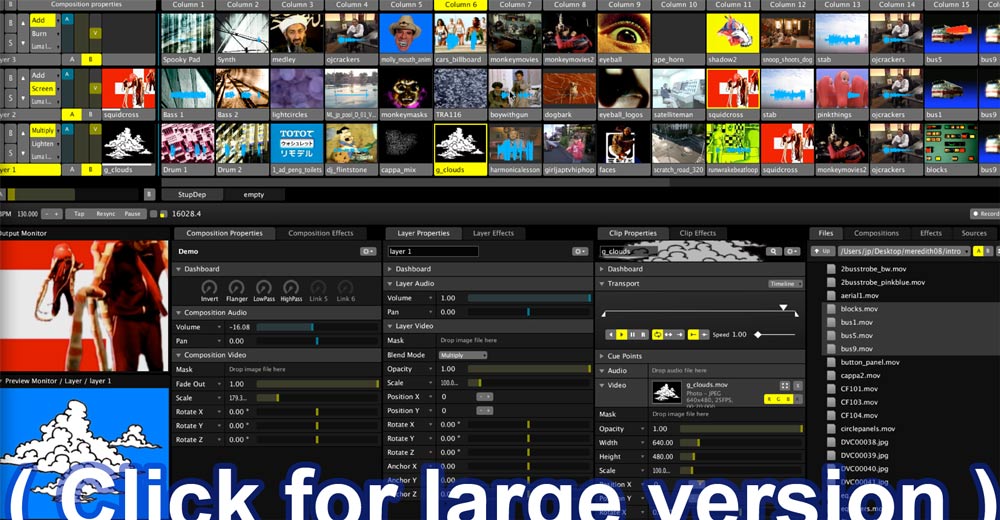
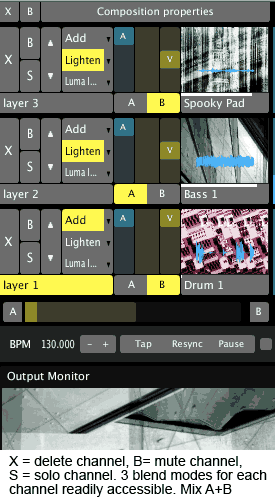
Okay. VJ software. Living mixing of clips. We get that. Lots of apps for VJing now, but how does this one work? At a quick glance, there’s a bank of clips to choose from on the top half of the screen, and a range of parameters to change them underneath. Looking closer reveals that the grid of clips is arranged in rows, and each row is a separate layer of video. Only one video from each row can play in that layer at a time. The bottom layer is rendered first, and each layer above is layered above that with a selected blending mode. Layers can be assigned to A or B, allowing cross-fading between each. Each set of rows of selected clips, can be saved as a ‘deck’ and reloaded at any time.

Underneath the rows of clips, the software’s three pronged approach unfolds :
– properties / effects for Clips – fine-tune settings for each individual clip, so it always triggers the way you want.
– properties / effects for Layers – so all clips loaded in a particular Layer can be processed the same.
– properties / effects for Composition – settings to control the final composited output of all clips and layers.

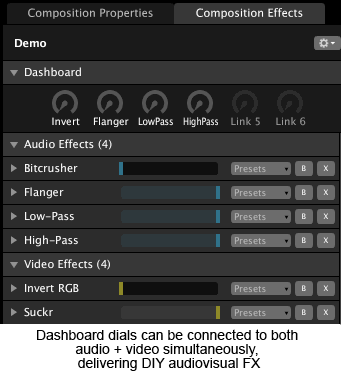
It’s a well considered approach, and becomes intuitive fairly quickly. What especially jumps out is the audio parameters integrated in each of the above areas, alongside the video parameters. Adjust some blur on layer one. Add a little distortion to the squawking bird on layer two. Adjust the brightness. Pan the audio to the left a bit. This has been especially designed for people who wish to play with audio and video simultaneously. One cool facet of this is the way that any audio and video parameters can be linked to the same on-screen controller, enabling a mouse or midi device to control both audio and video at once, and enabling highly synchronised and customised audiovisual effects.

resolume avenue beats

Also in the interface: a couple of preview monitors ( one for the final output, and while it plays, any other clip can be previewed below this by clicking the clip’s title), and a file browser on the right hand side for loading clips, loading compositions, choosing sources (camera, feedback, gradients, solid colour) and for loading visual ( FreeFrameGL ) and audio (VST) effects.

What Works Well?
resolume avenue

– Framerate. With all the rendering being done on the graphics card rather than the CPU, clips are quick to change, even when many layers are involved. Resolume Avenue is fast.
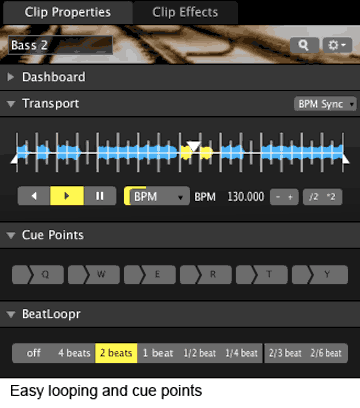
– Audio playback controls, effects and easy combining with visual parameters to make audiovisual effects. With well integrated volume, panning, VST effects, as well as beat based looping and matching, the audiovisual possibilities are huge.
– The interface. Easy to understand, and scales to suit any size screen.
– Easy mapping of keys, midi or OSC to control any of the program’s parameters.
– The solo button and mute buttons on each layer, these allow different layers of an overall audiovisual piece to be easily cut in and out ( eg stripping a multilayered piece back to just a visual drum loop, then re-engaging all content again).
– Recording! Easy, efficient recording of mixed clips, and reintegration of them back into a layer. Clips seemed to record at 15 fps, and play back fine, meaning Resolume Avenue can be used for a quick turn around production tool as well.

resolume avenue

Still to be Refined?
– Subtle interface enhancements needed here and there. ( Eg Sometimes the tiny arrows to set parameter ranges are tricky to re-click and adjust )
– Occasional sound glitches ( sound drops out, or distorts / glitches badly – improved in the latest version, and resolume recommend using separate video and audio files, then dragging them together inside their software, to avoid such glitches – which makes sense when making new sets of beats perhaps, but not when you already have large collections of cinematic snippets ).
– Some video files don’t load ( eg some older clips encoded with sorenson 3, that work fine in quicktime or vdmx ).
– More options and flexibility needed in places, which’ll probably be added over time. ( eg adjusting the cross-fade time? Having an option so that each clip triggered auto-scales to fit in it’s layer?)
– The Auto-Beat detection, while great for tightly sync-ed clips, makes simple playback of other clips tricky, with a juggle of pitch shifting and adjusting the number of beats to try and make the clip play at it’s natural speed, pitch and duration ( even when the clips’ individual settings are set to avoid beat snapping ).

Still to be Added?
Flash playback, audio FFT analysis and DMX support ( will be available as free future updates). And presumably some kind of sequencing that takes advantage of the global BPM.

Requirements?
PC – ATI Radeon 9600 or better. NVIDIA GeForce FX 5200 or better. 1GB ram.
OS X – 1.25Ghz or faster Power PC G4 or G5, Intel C oreDuo, or Intel Xeon processor. Quartz Extreme graphics card. 1Gb ram.

Price ?
300 Euros for 1 computer, 500 Euros for 2 computers, 650 Euros for 3 computers. 50% educational discount available for students, teachers and educational institutions.

Verdict:
Resolume Avenue balances quick access performance needs with depth of control, and marks a huge leap forward from earlier versions of Resolume. The audio features really set it apart, make it fun, and give it promise. Still feels a little fiddly in places, but that’s potentially something that’ll disappear after further use, and getting a good workflow process going with it. Double thumbs up!

(Late End of Year Bonus )
Free Particle System effect for download and operation within Resolume.

Drop a line if you’ve had any experiences developing audiovisual material with it, love to hear how people are finding it.

by Sean Healy, December 19, 2008 3 Comments