Dubtable Maker Interview

dubtable in the house~!
Fusing together contemporary interface design with a love of early dub pioneers such as Lee Scratch and King Tubby, James Nichols has cleverly cobbled together an interactive tactile mixing table which has been wowing crowds at events around Sydney.

Describe your ‘dubtable‘ to a bus full of ice hockey players.
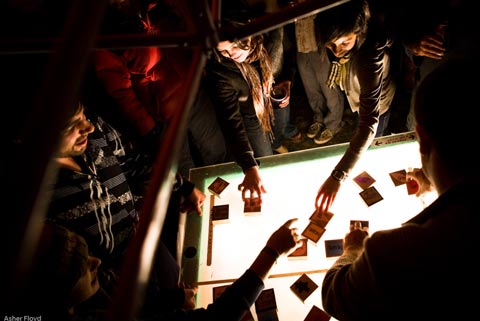
It’s like an adult version of one of those Fisher-Price musical toys that you give to young children. You know the ones with big coloured buttons that make fun sounds? It’s a large musical toy. You place blocks on a table and music happens. You move those blocks around and mix and match them and crazy sounds happen.

And to a tech-music nerd, what software and hardware do you use to put it together?
It uses a high precision camera that’s inside the table looking up at the surface, the notorious reacTIVision software to do the recognition of objects that are placed on top of the table (the “fiducials”), and an audio component written in the PureData environment that does the synthesis of sounds, reacting to the objects as recognised by reacTIVision.

How did the idea come about? What seeded it?
The inspiration half came from the reactable, which a friend showed me a few years ago and that Bjork toured with recently, and half from Lee Scratch Perry/King Tubby. Those original dub pioneers were essentially making new music through such simple manipulations of sound – by turning up the bass on a track, making hectic echos etc etc… I figured the simple interface presented by the reactable system would apply so well to making dub, and would give this technology a chance to do something a little more organic sounding. The original reactable is mainly aimed at making glitch techno.

What have been some different ways you’ve used it live, and what seems to be an optimum number of collaborators using it?
I’ve both used it as a performance tool, kind of like some live producer, and as a pure interactive experience where I’m not touching and just barking at people, telling them to experiment and have some fun.

Do you tend to encourage any audience involvement?
Yes, see above. I originally intended it as a tool for people who’ve never done music production to have a go, without having to learn the ins and outs of a large mixing desk or recording system.
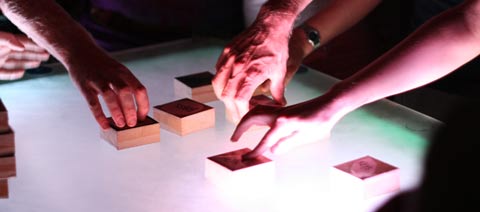
dubtable, waxing and milking..

What kind of interesting audience reactions has it had?
Some interesting ones. You really get a sense of different levels of curiousity that people have. Some people will get immersed in the table, comprehend all the possibilities, and start experimenting crazily. Others wiggle some blocks, see a few things change, get bored and move on. It’s about 50-50 I think. Maybe some people just don’t like the music…

What’ve been some surprising aspects to using it?
The whole philosophy of interface design has suddenly come to haunt me. It has made me incredibly jealous of Apple and google. How do you make something that is perfectly intuitive? See, some people just don’t get the dubtable, they can’t understand it quickly enough to be able to experimenting right away, others do. I’m constantly asking myself the question – how do I make this readily usable for *anyone*?

The dubtable has been an unexpected pleasure. The best bit has been the chance to turn things around and make the audience the performers. As a musician, I’m always asking for people to be an audience. Some times it’s tiring to always be an audience member. It has been such a great experience to see it turned around and let people perform and collaborate at a show.

Have you been using it to control both sound and video?
I haven’t done any video controlling yet. It’s quite possible, but this project is only about 8 months old, and I don’t have much time! Somewhere in the future I guess. I’d love to get it integrated with the Figureight surround video dome and make a really immersive experience. One day. If I ever get the money together.

What sorts of ideas has the dubtable given you for future development?
There’s some projects on the way. Check www.dubtable.net for more info!

by Sean Healy, September 24, 2009 0 comments
Swimmaging

Swimming in images then, or if you prefer, lieing back in an inflated tractor tire and drifting downstream with the sky set to slideshow.

Your New Swimsuit
Whether it’s a technology divide, lack of awareness or interest, half of my friends remain oblivious to the charms of having their own personally customised internet delivered to their doorstep. Or to the their RSS reader more specifically. Which bewilders the other half, who wonder how anyone manages the deluge of information without the filtering and auto-update and delivery options of RSS.
At least as people become used to the likes of constantly updating Facebook status updates of friends, or twitter feeds, it gets easier to explain RSS in those terms : RSS allows you to subscribe to the parts of the internet you like, and then instead of going to say Facebook, you can just open up your RSS page online ( eg google reader ), or better, open a dedicated RSS application ( eg netnewswire ) and see articles / images / postings from whichever of your favourite sites have updated recently. ( How to use RSS? The BBC guide to rss, or ‘rss in plain english‘ if you prefer video explanations. )

Aside from world news from your preferred sources, blog postings from your favourite authors, mp3 postings from your favourite musicians, notifications from forums you are on, ebay auctions etc etc – you can also use RSS to subscribe to a steady stream of imagery, which can be a perfect mid-work break to dive into. Most of the photo and image storage sites such as flickr have RSS feeds that allow you to subscribe to everything by a person, by a group, or even by a certain tag or keyword ( inventing unique keywords thus enables lots of people living remotely to easily contribute to the same pool of imagery and easily stay up to date with anything added to that group ). Add a subscription to your RSS reader, and then when you next browse your RSS collection, you’ll see any new image additions and can let them flow past, stopping only for what really grabs, just as you might with a barrage of Facebook status updates.

Infinite Paged Coffee Table Magazines
There are also a wide and wonderfully eccentric collection of dedicated image blogs, lovingly ( or dementedly ) curated by photographers, illustrators, artists and others with the twitchy thing behind their eyelids when the lights go off. These are a few recent additions I’ve been enjoying diving into lately.

Ephemera Assembly man
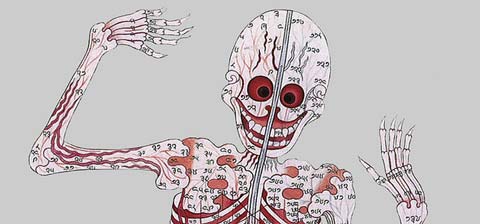
It was the collection of Tibetan anatomical paintings that hooked me on this, a series of vividly coloured alterna-clown skeletons complete with cosmic medicine colour coding. Mostly vintage imagery collected here, but it’s a fine pair of sharp-eyes to borrow if it’s yesteryear you’re after.
tibet_crop

Skull Swap
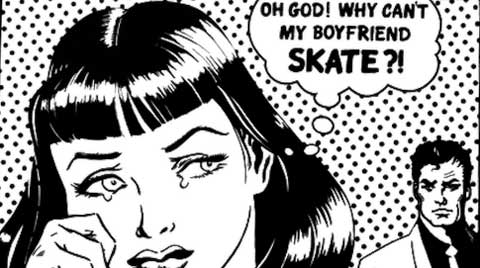
Aight – this ladies a comedian – and not just in the -look at how many netspeak hooks i can pack into 140 characters kinda way – but an actual stand up on stage full of nerves and swagger and try to make people laugh by saying things into a microphone kinda way. By the comments under each photo, and the mutant clan of jpegs themselves, I’d imagine she’s probably pretty good at that microphone thing too.
skatebf

Bodyworld
Well, mostly, this blog is subscribed to in case *anything* at all is published by the creator of the Bodyworld, a 12 chapter comic online in full, and dripping in equal parts with the apocalypse, psychedelic inter personal relationships and quite crazy layered imagery. His tangents, experiments and off-cuts that appear in the blog are well worth the price of admission.

Abandoned Places
What is it about urban decay? Maybe growing up in Newcastle has something to do with my fascination for it, and you’ve likely seen photo collections of the once thriving Detroit going around, but if in need of more, this site seems to have an army of contributors the world over, whose mission seems to be to document every broken window, every moss covered spiral staircase and every graffiti covered haunted theatre space they can find.

Awkward Families
Painfully funny. No matter how weird your upbringing, there’s something to outdo it here.

And Ye Olde Regulars
ffffound.com – an image bookmarking site, whose members keep it eyepopping.
Drawn.ca – the illustrators blog, that illustrators want their work published on.
http://riotclitshave.livejournal.com – Enchanting, bewildering, ever-fresh.
http://www.woostercollective.com – Street-art the world over.
http://www.ektopia.co.uk/ektopia – Well filtered graf + street art.
http://bibliodyssey.blogspot.com – what other eyes have seen long ago.
http://www.vvork.com – like all of the above, except these self-identify as ‘art’.

Variety in the diet is nice though, drop a line if you have any recommendations…

by Sean Healy, September 11, 2009 0 comments

Prepare For Pictopia

pictopia1
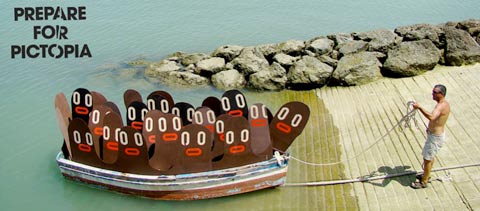
“At the turn of the century cute and cuddly robots carried none of the symptoms of technological paranoia, and bright-eyed boys and girls looked with ecstatically dilated pupils into a bright future. Only a few years later, the same characters had been tortured, twisted and mutilated. Suddenly blunt combinations of cuteness and abuse, naivety and sex, harmlessness and violence were everywhere. A little later death entered the scene and character’s eyes were crossed out. More recently there has been a spiritual shift, ghosts have started appearing and souls are being exhaled.”

Lars Denicke and Peter Thaler, editors of ‘Prepare for Pictopia‘ offering some insights from Pictoplasma’s mammoth archive of character design.

Pictoplasma?
A Berlin based group dedicated to exploring contemporary character design, which has included an ongoing archival of characters since 1999, a series of curated exhibitions, an annual animation festival and conference, and a series of DVDs and books, of which ‘Prepare for Pictopia’ is the latest (shout out to book designers Janna Davidjants + Alex Fuchs of wiyumi.com ), a chunky colour picture-dense tome of 326 almost A4 size pages.

Page Flipn
Wheeeeee! The thing is gorgeous, full of delights. Crackpot collage ( hello Franceradium ), whimsical illustration ( Andrew James Jones, come on down.. ), giant helium filled characters floating above a sea of people on a Miami beach ( Word up, FriendsWithYou), Mongolian death worms on the streets of New York ( and yes, they are in Motomichi Nakamura‘s trademark minimal palette of black, red and white ), Mark Ryden’s seductive paintings, the three dimensional double headed tigers of woodworker AJ Fosik, and so on and so on.

Australians Crashing The Party

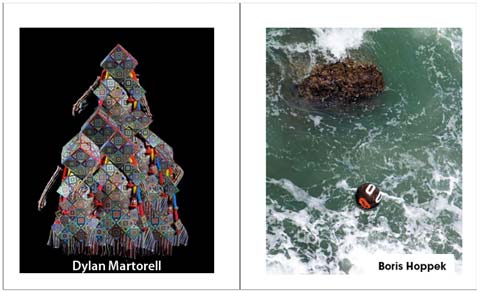
Melbourne artist Dylan Martorell : featuring both his intricate layerings and colour saturated sculpture-costumes.
Ben Frost : his multi-layered pop-art is well known, but the relative stark simplicity of his ‘Self-Regenerating Bambi’ is refreshing (a series of miniature Bambi deers are piling up under Bambi’s rear end, one in mid transit.)
Rinzen : extending their vector based schwing to sculptures and murals etc
Sam Gibbons : vivid mandalas of decomposing cartoon characters.

pictopia2
Who Else?
Nagi Noda ‘pushing pet culture deeper into artificiality’ ( remember her poodle fitness video? )
Boris Hoppek‘s bimbo / gollywog character – exploring themes of immigration, racism, violence and sexuality..
Hideaki Kawashima ethereal ‘stylised feminine beauties with wafting hair’
Olaf Bruening‘s photographs of masked and recontextualised characters in strange places..
The psychedelic crystal ink work of Charles Glaubitz.

But Wait, There’s More
“Insert your finger or tube into the finger prosthetic.”
Essays. You get a bunch of them in the book, including a typically visceral, anti-corporate anti-figurine essay / stream of consciousness covered in paint / body fluids rant from Paul McCarthy. Lev Manovich desktop-chimes in with a piece about ‘Remix after Software’, and a bunch more tackling the uncanny between animation and animism, the human machine and masks and the body. Recommendo~!

by Sean Healy, September 7, 2009 1 Comment

Len Lye’s Scratch Film + Kinetic Scupltures

lenlye2
Open, until Oct 11, the current ACMI Len Lye exhibition is one of the best reasons to wander to Melbourne.

Let There Be Light
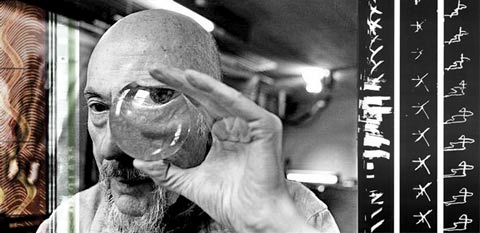
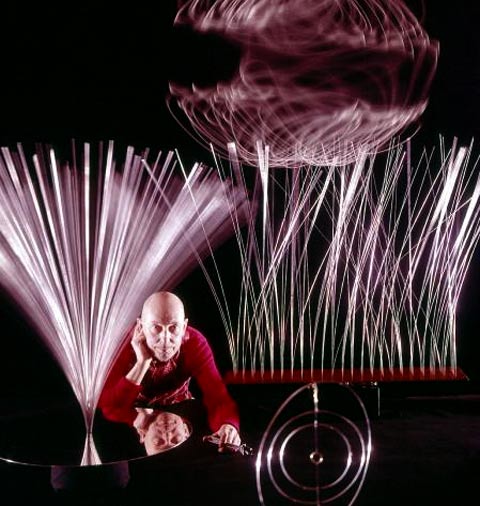
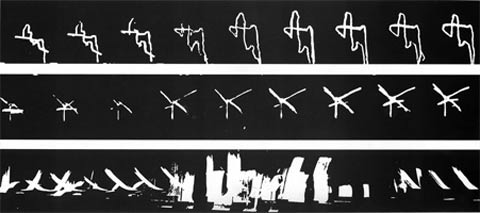
And there was light. Back in nineteen thirty-five. Which was when New Zealander Len Lye (1901 – 1980) produced the first ‘direct film’ screened to a general audience, a glowing example of a new genre of camera-less film making that saw artists directly painting onto film stock, making scratches, etchings, punching holes in it, burning it, gluing and taping objects onto it etc. His film, ‘A Colour Box’ was a wildly vibrant work, featuring bold and playful colourful shapes tightly synchronised with a Cuban jazz soundtrack, and went on to inspire other luminaries to explore the field such as Stan Brakhage and Norman McLaren (who aside from an illstrious animation career, also wrote “How to make animated movies without a camera”). From here Len Lye only pushed his handmade explorations of rhythm and motion even further, and the decades that followed are the focus of the current free exhibition at ACMI, a smorgasbord of vivid film prints, paintings, sketches and most impressively, a good collection of his gorgeous kinetic sculptures.

lenlye1
Kinetic Sculptures
“Kinetic experience lies deep in our bones, It is a more constant experience than any other.  Our hearts beat, blood runs, rib cages expand and contract, eardrums resonate, lungs vibrate, every attitude we enact we enact kinetically.”

Inspired by the idea of ‘composing motion’, Len Lye’s attempts to do so extended beyond film to a large range of mesmerising motorised steel sculptures, which ranged from small scale to landscape based, such as the 45-metre high seaside Wind Wand, and the The Water Whirler, which although designed by Lye was never realised in his lifetime, finally installed on Wellington’s waterfront in 2006. Len saw film and kinetic sculpture as aspects of the same “art of motion”, which he also wrote about in essays. Wandering into the sculptural component of the ACMI exhibition, we are treated to a variety of gentle whirs and pulses, as a combination of motors, clever positioning, gravity and the surprising elasticicity of large metal shapes helps shift the sculptures into slow hypnotic dances, the dim lighting allowing the metallic sheen to trace gorgeous patterns as the shapes ebb and flow. The sculptures alone are worth visiting, but those on top of a chance to sit and watch his vividly executed films and explore artefacts from his artistic process, makes this an exhibition worth checking out multiple times.

lenlye3
Lecture on Movement and Time in Film
Sun Sep 13 ( 2PM ) sees a special one-off related event, Gary Simmons delivering a lecture on the remarkable elasticity of cinema time: speeding up, slowing down and playing with our sensory experience of the world. Taking as his departure point Gilles Deleuze’s theories of cinema, Gary Simmons examines the capacity for screen-based media to modify space and time. This kaleidoscopic movement and possibility for multiple temporalities will be explored in a cross-section of films and artworks by the likes of Len Lye, Maya Deren, Ivan Sen, Michel Gondry, the Wachowski Brothers, Stanley Kubrick, the Dardenne Brothers and Richard Kelly. ( Free Tickets available on the day from the ACMI Box Office. )

lenlye4

Len Lye Resources
The Govett-Bewster Art Gallery ( NZ) which houses much of Len Lye’s work, Wikipedia, Youtube, Particles in Space ( Lo-res version of a particularly stupendous scratch film that seems to employ 3D camera movement around a series of tiny scratches dancing in time to tribal percussion. Handmade, yo! )

by Sean Healy, August 28, 2009 0 comments

August Video Snippets

You Suck At Photoshop
Fragments, snippets and viral videos abound online, but occasionally these are coalescing into larger forms. There’s immense opportunity for creating online video niches, and a few stand out in recent times. You Suck At Photoshop is now up to it’s second season, having tallied some 40 or so episodes now, based around the simpler premise of an embittered cubicle worker recording some screencast tutorials in his spare time. The familarity of the interface somehow reinforces the humour, part of the appeal, seeing the ingenious ways he manages to use otherwise innocent features of the software to highlight problems with his ex-partner.

Auto-Tune The News
The Gregory Brothers from NY have now pumped out 7 episodes of their musical news satire and show no signs of stopping. Formula seems to go something like : find some topical news segments, break it down into possible riffs, work a song structure around those, composite characters to appear onscreen beside the news hosts, offer alternate opinions / back-up vocals / harmonies, then shake it all up. Again what seems cool is reminder that ideas are more important than money, and today establishing a globally popular video channel is possible from anyone’s bedroom.

Collaborative Projects : Where Are They Now?
“The kind of motion picture I am interested in will be like creating the modern LP record. It will be mixed into ways of thinking rather than cut linearly” – Francis Ford Coppola, quoted at nowthemovie.com.

There have been a few notable attempts over the years to try and harness the network to create large collaborative works of video and cinema. Cold Cut spearheaded a UK attempt to facilitate a global network of film-makers contributing footage to an audiovisual collage feature film. The eventual feature film and ninjatune DVD release hasn’t eventuated though, apparently because of some promised UK funding not coming through. Also from the UK, A Swarm of Angels tried to transcend this problem by crowdsourcing the funding component as well as the creative aspects. As it currently stands, their site states they are ‘making a transformation’, and asks for patience during the site hiatus. “With members now in the four figures we are reconfiguring our web presence to simplify involvement and clarify all the project developments.”
The Age of Stupid documentary has already been completed with funds crowdsourced from many individuals and groups, but perhaps funding a large collaborative project is the easier part after all. Other group cinema projects on the boil include : Open Source Cinema hosts several collaborative documentaries, and Star Wars Uncut breaks the movie up into 473 x 15 second clips for *anyone* to remake. So far 143 have been finished. Should make for a hilariously disjointed viewing when finished.

Resolume 3.1 Now with Flash playback
A recent upgrade to Resolume adds Flash playback, which will appeal greatly to motion graphic creators and animators everywhere. Their Flash playback includes full alpha channel support so transparaceny looks great, and is Actionscript 3 compatible which allows live control over your animations with custom slides, buttons and text input from within Resolume. And they’ve conveniently added a new Flash chapter to the Resolume manual on how to get this going. There’s a bunch of other updates too including a video beat looper, a keystone plug-in for mapping onto objects, a dedicated AV slider, and a master output audio delay to compensate for the difference in time between video hitting the screen and audio hitting the speakers ( audio is generally quicker ). More at resolume.com. Elsewhere? A step sequencer for Resolume.

by Sean Healy, August 27, 2009 0 comments