DSLR 101ism

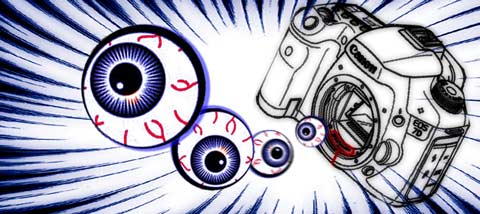
Joined the old Digital Single Lens Reflex camera club recently (hello video capable Canon 7D), which has meant learning about photography (shout out to photo guru Dan Murphy), and about technologies that bridge the old and the new. And haunting Ebay a bit more than usual.
canon7d_image
To DSLR or not to DSLR?
The benefits of digital image recording ( cost / workflow etc ) combined with the advanced light controls of a SLR camera – make DSLR cameras great for photographers, and now that they’re often capable of good quality video, DSLRs are lluring in a lot of film-makers too. It’s not all win though – videomakers expecting DSLRs to have the same ease of shooting will be disappointed. Weighing it up for those interested in video, David Torcivia has summarised the pros and cons over at Poetzerofilm.com:

Nay
Ergonomics – too light / small / awkward screen and controls
Moire and Aliasing – skipped lines in video, during process to shrink large image down to video size
Shutter Rolling – fast moving objects can be in different places in the same frame
Resolution – they don’t actually shoot as well as advertised
Compression – Canon records to lossy H264 format ( which needs processing before editing )
Audio – terrible on DSLR, need to record externally ( eg with Zoom H4n) + sync (pro-tip: Plural Eyes! )

Yay
Ergonomics – The small size can also mean shooting easily in cramped spaces, and more discreet filming.
Depth of Field – Hey look, it’s blurry in the background! Beautiful, but as the web fills with it, David helpfully notes:
“Don’t wear out the effectiveness of a shallow shot by making an entire “test” film filled with nothing but micro DoF. Shallow depth of field is just another tool in the cinematographer’s box to better tell a story. It is not a crutch or a gimmick to sell a shot or a product, an idea which cheapens the art.”
Low light – Zowie! For the price, DSLRs can shoot in hearts of darkness that video cameras cannot even see. Believe.
Price – Fantastic quality and value.
Photos – Oh yeah, do they do those too – 10 stops of dynamic range, full RAW files, 18 or 21 Megapixels – all great for timelapse .
Lenses – The variety of glass available for DSLRs vastly outweighs that possible for video cameras ( hello eBay, or hello rent-a-lense for important occasions )
Media – Tapeless workflows. Drag n drop, rather than slowly capturing footage.

Plunging In…
So in the end – disregarding all the science and numbers, you’ve found yourself swooning over luscious, colour-ripe non-grainy video shot by someone in such low light conditions that you’d packed away your video camera an hour ago. THAT’S OKAY, you’re with friends.

And if being the new owner of a DSLR finds you bewildered by the array of options available – Wikipedia’s photography page is incredibly useful for getting up to speed with photographic terms and principles, and pointing to a huge range of future learning. For starters you’ll be needing to understand :
Aperture – the lens opening, measured as the f-number ( eg f2.8 ), which controls the amount of light passing through the lense.
Shutter speed – time the imaging medium is exposed to light for each
ISO speed – The higher the ISO, the greater the sensitivity to light.

There’s plenty more, and plenty more starting points too..

Which Lenses To Get?
If you need, you can actually mount cinema lenses to a DSLR, using add-ons from hotrodcameras.com. For most people though, the existing range of photography lenses will be a vast enough jump in quality from handheld video. Things to note? Lenses with lower f-numbers are preferable ( and more expensive ). Aside from lenses specific to your camera, there are also a wide range of cheap adaptors that can be fitted to any DLSR, which will enable lenses from other manufacturers to be used ( functions like auto-focussing can be lost with some of these though ). And one more complication – the Canon 7D doesn’t have a full frame sensor, and it’s smaller proportion of a frame means you have to multiply the below numbers by 1.6. In other words, a 50mm lense on the Canon 7D is the equivalent of a 80mm lense (50 x 1.6), and the perspective it brings.

50mm – The classic lense. A lense this size renders perspective in a way similar to how a scene is perceived by the human eye.
Wide Angle Lenses ( Below 35mm ) – allow you to fit more in frame from closer range ( think fish eye), but exaggerate distance between objects and can distort.
Telephoto Zoom Lenses (Above 70mm ) – allow magnification of distant objects / skateboarders / small furry animals etc ( though tends to compress distance between objects ).

Macro lenses – Want to shoot close-ups? These are the lense for you – or – seek out extension tubes or adjustable bellows ( both which are placed between another lense and the camera, changing the dynamics so that close-up is possible ), or get an auxiliary close-up lense to attach to the front of a lense, or get a reversing ring ( an adaptor that allows the lense to be attached to the camera backwards, which creates extreme close-up vision ). http://en.wikipedia.org/wiki/Macro_photography

( See also Tamron’s guide to lenses, and Cambridge in Colour about lense focal lengths, zooms vs primes etc )

A range of trick filters which can be added onto existing lenses for various effects ( find out what diameter your lense is ( eg 72mm), to find appropriately fitting add-ons ). And then there’s the tilt-shift lenses ( see also lensbaby ), and other trick lenses… ( on it goes.. ).

Time Lapse?
The image quality is significantly higher quality for photos in DSLRs, than it is for video. Correspondingly, animating a series of high quality photos in sequence for timelapse bumps the ‘video’ quality up even higher. Strangely the Canon 7D doesn’t have an automated sequencing function built in, and needs an external ‘intervalometer’ to do this. Canon sells one for around $200. Hong Kong vendors on Ebay sell adequate imitators for $30. There’s also an iPhone app for remote triggering / viewing of photos – but it requires the camera to be attached to a computer ( not great for out and about shots.. )

Stability… Later…
Someone walking around with a handheld video camera, will produce jerky footage, no matter the camera… but especially so with a small camera like a DSLR,, and then there’s the additional desire to avoid troubles like the Jelly Vision mentioned above. The image quality is good enough though, that a whole industry has spawned in providing ways to minimise trouble. And so…

Next DSLR Update : Stabilisation, active filming + Steadicam Systems ( from pro to DIY )

by Sean Healy, May 21, 2010 7 Comments
Contraception Techniques for 3D Blindfolded Stormtroopers

The number of human nipples in the world should be of interest to everybody: 2 x 6,836, 868, 270 people at time of writing. Let’s look at where that number is going.

Into Cities Mostly
Aye, we’re an urbanising species, it’d seem. 192021.org ( 19 cities with a population of 20 million in the 21st century ) gathers a good range of population information and presents it in a useful and provocative way. A few stats jumped out :

Since the last ice age, 18,000 years ago, sea level has risen 400 feet, as a result of global warming, this trend will continue.
Almost all of the world’s largest cities, are cities that border the oceans of the world, and will be affected by the rise in sea levels.

In 1800 less than 3% of the world lived in cities. Most people lived their entire lives without seeing one.
In 1900 150 million people lived in the world’s cities.
Today more than half of the world lives in a city
By 2050 it will be more than 2/3 of us.

Bejing was first city with 1 million people ( 1800 )
New York was first city to reach 10 million ( 1950 )
Tokyo reaches 35 million.. . ( 2005 )

Australia recently acquired a population minister, Tony Burke, ( a good sign ), and had statements from the Prime Minister wishing for a ‘Big Australia’ – or effectively a population of 35 million in 2050 ( a bad sign? ). This is effectively up from 22 million now, and one of the fastest rates of growth in the world, and not backed up by any strategies to improve say – the water supply issues that plague the driest continent in the world. See also The Australian Population Organisation. Obviously the new Population Minister has his work cut out for him, hence the advice offered below:

DeathStar Avoidance
So we’re urbanising at quite a fast pace. That’s great and all, but nobody wants the ball to end up as one giant machine. An unfortunate step in that direction would be the continued expansion of the Star Wars franchise into 3D territory. The world’s garbage dumps are already filled with enough plastic ewoks and Darth Vader lunchboxes, but George Lucas is apparently considering transforming the Star Wars films into 3D, after seeing where the technology was at with Avatar. And there are emerging groups dedicated to transforming existing 2D films eg : “Dimensionalization is a method developed by In-Three of converting 2D content to stereoscopic 3D content“, but really, do we need to go there, even if Martin Scorsese is also developing a 3D film (The Invention of Hugo Cabret, about a broken robot )?

More Efficient Use of Urban Space
Instead of building new Lucas warehouses, theatres, 3D cinema complexes, why not decentralise the whole thing, and let people make it in their bedrooms, hallways and back alleys? Case in point : starwarsuncut.com, where the star wars film has been broken up into 15 second segments, each segment being remade by a case of hundreds. The first trailer is up, and the final, undoubtedly stupendous full length collage feature is almost ready to screen…

Nature’s Helping Hand
If Australia is doomed however, to massive population growth, spurred on by more sprawling Lucas warehouses and 3D complexes, and we end up in some Deathstar existence, walking around in stormtrooper-esque body armour, then it will be useful for future population ministers to be aware of a built-in escape hatch. A good way to keep us all from breeding in the future will be to keep the population of stormtroopers all curled up in separate cubicles – with the likes of Tactile Mind, a book which combines tactile nude photographs and braille descriptions. ( It is notoriously hard to see from inside stormtrooper helmets ( acquired one from Ebay a while ago )). Order now and save (us all).

by Sean Healy, May 19, 2010 0 comments

The Voodoo of Location

Today’s players : Tom Waits, Roger Ebert, Ramin Bahrani and Werner Herzog.

Bone Machine Reverb
It should come as no surprise that Tom Waits has little regard for the conventions of modern recording. His lyrics, his demeanour, his gravel throated rasps – they all exude an authenticity unsuited to being captured within sterile, pre-fabricated surrounds. Back in 1992, along with his album Bone Machine, Tom released an interview disc ( ‘The Operator’s Manual’ ), which in some detail, discussed how the album came to be. Parts were hilarious ( “With Keith Richards, we’d try to finish a bottle and a song everyday. We’d always finish the bottle.” ), but all of it was fascinating. And when it came to choosing the recording location, Tom liked to know know / feel what had been there before, liking one of the rooms because it had been a children’s nursery at some point, and he liked how that resonated with what he had in mind for the album.

The Man Without A Voice
The man without a voicebox, more like it, is Roger Ebert, who with a Pulitzer prize for criticism in 1975, 15 books on film, 23 years of film reviews on tv with Gene Siskel, and his massively popular blog – definitely has a voice. His writing is a rewarding blend of personal anecdotes and technical insight, and it’s accompanied by a whirlwindy passionate army of commenters. It was his steady stream of twitter links and provocations that first hooked me into his writing though, and lead me eventually to his longer posts about Werner Herzog and Ramin Bahrani ( two of his favourite directors ), his going to watch Rocky II at the cinema with Muhammad Ali, and somewhere along the line realising that this busy juggernaut of a critic – can’t speak ( at least not without a computer voicebox to replace his, due to post-surgical thyroid cancer complications). Or eat or drink ( he uses a feeding tube). Not that he’s letting this get him down, or slow him down.

“I mentioned that I can no longer eat or drink. A reader wrote: “That sounds so sad. Do you miss it?” Not so much really. Not anymore…. The food and drink I can do without easily. The jokes, gossip, laughs, arguments and shared memories I miss…. Maybe that’s why I enjoy this blog. You don’t realize it, but we’re at dinner right now.”
– ( A long and profound read )

Ramin Bahrani
Admittedly the only film I’ve seen of Ramin’s is Plastic Bag, a 20 minute short – exploring the life of a disposable plastic bag, and threaded with a grim, existential gravity through its narration by Werner Herzog. And the way that was put together immediately adds his 3 feature films to the wishlist : Goodbye Solo, Copy Shop and Man Push Cart, each of them having won awards in recent years. Both Bahrani + Herzog lead a recent shot-by-shot discussion of Herzog’s Aguirre: The Wrath of God at a recent public festival.

The German Voodoo Man
Herzog, he who has physically hauled a ship over a mountain ( Fitzcarraldo ), has taken a camera onboard an experimental flying vehicle ( White Diamond ), and who has moved amongst the burning Gulf War fires in Kuwait ( Lessons of Darkness ), famously speaks of a ‘voodoo of location’, which Ebert suggests is the ways in which an actual location, where actual events take place, carries a psychic, or emotional, or sensory, charge to the screen – and the more intense and physical enduring the location, the more palpable the results onscreen. Herzog’s Aguirre: The Wrath of God, is a film about a doomed historical expedition in Peru, a conquest that Herzog reshot by retracing their steps, despite the various perilous conditions.

More Voodoo : New Orleans, home of the voodoo doll, is the setting for David Simon’s currently screening television follow-up to the Wire, Treme, which focusses on musicians living in post-Katrina conditions.

by Sean Healy, April 30, 2010 1 Comment

Stadium Video And Breaking The Timeline

Extravagant lighting and video productions are increasingly expected with touring acts, but a little thoughtfulness can go a long way.

massiveattack

Massive Attack @ Myer Music Bowl, Melbourne
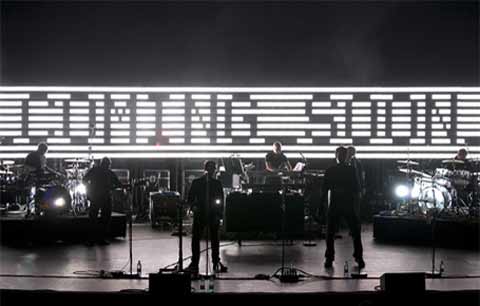
Enhancing Massive Attack’s recent sublime musical performances during their Australian Tour, was a very elegantly integrated lighting show designed by United Visual Artists. The kind of gorgeous, restrained and stylised light show you’d hope to see while visiting Blade Runner Town. The lighting set-up was deceptively simple – over the course of the evening, every one of the limited parameters available was gradually tweaked, revealing further variation where it seemed all avenues had been explored. Pulsing dots, became horizontal lines, and then combinations of dots and horizontal lines. From the palette of mostly white, red was sporadically and only very occasionally introduced, and very effectively. Occasional smoke bursts and white lights to reveal on stage depth behind the main plane of pulsing lights. And gradually, the dots are clustered closer, so we can approach something like ascii video playing through the spread out LED wall. Cycling through ascii characters, cleverly varying font sizes and cycling methods to effect the overall image. And again, occasionally using red as individual spotlights. While lighting rigs and lighting pre-visualisation and sequencing tools are getting increasingly sophisticated ( ie crazy ), this show worked because of the restraint shown, its thoughtful choreography and pacing over the evening, and because of its tight integration with the music ( they nearly became inseparable at some points ).

Chris Cunningham’s new Audiovisual Show
This is an exciting prospect. News that one of the most acclaimed music video directors of the last decade, is working on a 75 minute live audiovisual show certainly presses buttons.

“It’s a work in progress really. It’s three giant screens, lasers and a soundtrack that will be like a big mixtape. It’s the closest I can get to what I want to do: the visceral sound of a live show but with massive screens like a cinema,” he explained in the Guardian recently, arguing, “what I do is more experimental and the visuals usually come first. That’s why the live performance is exciting. It’s not film, it’s not a gig, it’s not an installation, but it has elements of all three.”

While it’s undoubtedly an impressive show ( what a great body of work to play with! ), unfortunately the comments on the Guardian article suggest that the performance seems far from live, a sidestage witness suggesting there wasn’t much meaningful being done by Cunningham on stage, others suggesting it seemed like a linear showreel. On the one hand thats fine, the show is a stepping stone, on the other – it’s a reminder that visual technologies tend to lag behind audio in terms of power ( it’s necessarily more computer intensive to manipulate 1 minute of video than audio ). And no doubt, given that the music world has decades more behind it with manipulating loops sequences and processes, it is likely also advanced more conceptually for dealing with time based media in performances. Looking at how someone like Autechre (touring Australia shortly, and themselves with a fine Cunningham video) approach time and samples, might illuminate other approaches to video than ‘jukebox compilation’.

[[ UPDATE ]] This review sounds a bit more promising. And an amusing anecdote from William Gibson about Chris potentially directing a version of Neuromancer:
“Chris is my own 100 per cent personal choice…My only choice. The only person I’ve met who I thought might have a hope in hell of doing it right. I went back to see him in London just after he’d finished the Bjork video, and I sat on a couch beside this dead sex little Bjork robot, except it was wearing Aphex Twin’s head. We talked.”

puredata
Weimar in The House
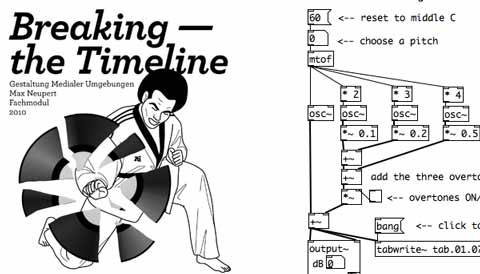
Max Neupert explores great and granular audiovisual compositions using the free software pure data, and now runs ‘Breaking The Timeline‘, a great course at the Bauhaus University of Weimar, which is dedicated to exploring ‘performative audiovisual artworks and experiments’.

“The third dimension of the moving image is time. Manipulation of the timeline means taking control over the creative potential of this dimension. Editing film or video transforms footage into a movie, thus film and video aren’t necessarily linear, but stay static in their determined timeline. Video made analog real-time effects popular but todays graphics processors in computers make it possible to fully explore the real-time potential of digital image and sound.”

Max also makes available patches which demonstrate audiovisual programming techniques in Pure Data and the Gem library.

And let’s not confuse Max with Max for Live – another exciting Audiovisual prospect – complicated max patches ( including jitter video parameters ), controllable from inside Ableton Live and it’s sophisticated sequencing possibilities.

by Sean Healy, April 29, 2010 4 Comments

The Network As Studio

Amazingly enough, there’s quite an array of tools ready to use, right there in the browser. Not just for basic file management, file sharing, communication and group collaboration, but also for recording, mixing and producing. Some are just convenient utilities, but others are powerful tools in their own right. Did a gather up of these recently for a music related course at RMIT – and so, below, your new, mostly free, portable office-studio-lounge:

File Management / Sharing / Collaboration

media-convert.com – Online file conversion of files to a huge variety of formats.
http://en.wikipedia.org/wiki/List_of_collaborative_software – Huge list of software for group collaboration
docs.google.com – Very convenient way to co-write, co-edit material, and now share files as well.
filestomp.com – Online compression of media.
dropbox.com – Nice online file sharer that creates a desktop folder you can drag and drop files into, which then syncs with your online backup and anyone elses computer you’ve authorised it to sync to.
delicious.com – Still the best social bookmarking service. RSS Subscriptions available for your bookmarks, anyone elses, or even just a keyword ( as bookmarked by everyone or just an individual ). Takes a while to realise just how great this is.
http://en.wikipedia.org/wiki/LazyWeb – For when the going gets tough / lethargic.

Actually Making Stuff From Within Your Browser
How about that! Again, just a convenience in some ways, and not meant to replace your more powerful desktop tools, but sometimes there’s more than enough power right there in your browser.

aviary.com – First shout out must go to Aviary – where from within the browser you can use a variety of their software to do – Photo-editing, adjust vector logos, play with web templates, filters, color palettes, screen captures, edit audio files and more.

looplabs.com – An online music mixing application with an impressive list of features in the sidebar.
online jamming : ninjam.com + jam2jam.com

soundcloud.com – Increasingly popular hosting service, which notably allows comments on specific parts of audio timelines, has convenient dropboxes for easy file sharing, and has many more musician-friendly features. (See intro video for more )

skype.com – Screensharing options for comparing software production notes / techniques / debugging. Voice chat, audio recording.

xtranormal.com – your text + their audio + button to publish = auto generated and published animated movie

pixton.com/uk – Templates for generating online comics.

slideshare.net – Easy development and publishing of slideshows with accompanying audio.

Need Files to Play With?
The popularity of Creative Commons has meant a continued growth of sites legally offering media files for creative re-use :

ccmixter.org – Huge collection of mostly musical sounds, including song parts, and full tracks by the likes of Chuck D and the Beastie Boys, DJ Vadim etc etc.
freesound.org – Giant library of atmospheric, FX and musical sounds.

flickr.com/creativecommons – Flickr’s creative commons collection is ginormous.
http://en.wikipedia.org/wiki/Public_domain_image_resources – Also ginormous.

archive.org – Noble San Fran cats with an abundance, an overload of audio and video work available for re-use. Lots of high quality and unusual vintage material, as well as contemporary netlabels etc.

And What To Do With It All?
Maybe something like this? starwarsuncut.com – where Star Wars is being remade by fans, in 15 second chunks – there are still a few scenes left – sign up and make yours, to be part of the final edit!

Get some print on demand books happening via lulu.com – upload a PDF and no-one pays a cent until a book is ordered online, then it’s printed and delivered to them, money put into your account, and all why you lie in your hammock.

Upload your work to bandcamp.com – and have them offer a variety of free to expensive downloads and even VINYL options!

Make $19,000 in ten hours on Twitter. ( Yes, this may work easier if you are Amanda Palmer )

by Sean Healy, April 23, 2010 1 Comment