
Biopresence & Transgenic Tombstones

DIY DNA DAY – if you missed it, was on April 10th and celebrated at a UK conference with a wide range of biotech and transgenic art demonstrations and tutorials. Aside from learning how to extract your own DNA, or the DNA from anything living, attendees were also introduced to a new way for remembering those who have passed away – storing their DNA within a living plant~! Believing that ‘a growing, living tree has the ability to comfort in a completely different way than cold gravestones’, Georg Tremmel and Shiho Fukuhara of Biopresence were happy to wax on about their ‘Transgenic Tombstones’:

How much do you think DNA is meaningfully coiled up in our identity?
GT: DNA should be seen as a pointer to a person, rather than a blueprint for a human being. What makes a human, and therefore identity, largely depends on the environment and experiences. The true power of DNA lies in its ability to bring together the symbolic and the real.

What triggered the idea to try and make ‘Transgenic Tombstones’?

GT: We were interested in exploring hypothetical design possibilities offered by biotechnologies. Thinking about code, codes, and codecs, their many manifestation came somehow naturally. It was only later we started to explore the mystical and psycho-historical connections and connotations of life, death and trees.

SF: My cat was buried in the garden in Tokyo where my family used to live, as he loved that house and garden so much. I’d much prefer to be buried in my family garden, rather than somewhere far away from them, and a tree is better than a gravestone in the garden. Our project reminds me of an old Japanese tale about cherry blossoms (sakura), which are white with a touch of red. Allegedly the reason for this colour is a person buried underneath the tree, his blood makes the cherry blossoms red.

When do you predict being able to offer DNA blended memorials?
GT: We are at currently at stage 2 of the project. Thanks to support from NESTA (www.nesta.org.uk) we are currently able to concentrate fully on it, and are exploring and assessing the legal implications that come along with our trees. We hope to offer Biopresence trees within the next 18 months, but I am not sure, if it will be in the UK.

What sort of genetic background did you have, and what’ve been the biggest hurdles for your learning?

GT: I have some a basic knowledge of genetics, I did study biology and informatics for a little while before studying media art. I think the hurdles in learning are not that big; much bigger are the hurdles in communication. After all it seems that artists and scientists seldom live on the same planet.

SF: It can be a little frustrating, if scientists don’t even try to understand what we are trying to achieve – they never ask us what we are doing and why we do it. I wonder if they don’t think this kind of question should be made before they criticise with a little (or even wrong) information on papers?

How has the scientific community reacted to your work?
SF: Some get it instantly, some don’t. Nearly all the scientists we were able to speak to directly reacted in a positive way. Even if they sometimes did not see the point of our project, they were curious about the technical details.
GT: Because of the sensational value of the project, we got a lot of distorted media coverage in the beginning. And most critic, from environmentalists or scientists, was targeted against the media coverage and not directly to our project. ‘New Scientist’ printed a full-page comment on our project, basically saying ‘they are not scientists, they don’t know what they do’. I was quite pissed off, because I gave them a 30-minute telephone interview, and then they (deliberately?) got two key facts wrong.

What is your response to the more critical scientists?

GT: Our response is to invite them to explain the project thoroughly. It helps.
SF: ‘New Scientist’ said something along the lines ‘interesting, if only it would be more scientific’. We are primarily artists and designers, our role is to pose question to the idea of bioethics and inquiry for better communication to non-specialists in science. We are also interested in being scientific, but it seems hard to understand for some, that science can also be done outside institutions. The important thing is not to stop questioning.

Which ‘genetic artists’ do you especially admire?
GT: Heath Bunting’s Superweed project was one early and important display of how the powers of biotechnology can be put to work. Joe Davis, the ‘granddaddy of bio-art’ is hugely important. We are very glad, to have collaborated with him. And of course your very own SymbioticA. We met Oron and Ionat quite early on during our project, and their very positive feedback was highly encouraging.

Future Biopresence projects?
GT: The website (�_�). I’m also thinking about constructing a computer programming language, made only from the letters ATCG. Maybe I can find working programmes hidden in the genetic code.
SF: A book for children and adults explaining the project and its consequences. And a film documenting it. Other projects are secret!

by Sean Healy, October 20, 2004 0 comments
Jackass Vs Big Brother

Gary Coleman is the Governor of California. The fifth largest economy in the world is now under the tiny thumb of a sitcom actor whose most famous words are ‘Whatchoo talkin bout Willis?’. While we do not live in that no doubt beautiful parallel world, Gary can at least console himself by knowing that today’s television stars also suffer considerable pain. Jackass & Big Brother, please explain.

Boofheads ‘R’ Us
From the cultural juggernation that brought the world Beavis & Butthead, Bill & Ted, Rock N Roll Wrestling and daytime talkback TV, inevitably the kid at the back of the science lab with his underpants on fire was going to get his own TV show. Jackass was the vehicle, but if we retrace a few steps – we find a skateboard magazine named ‘Big Brother’. Renowned for it’s irreverent approach, gratuitous sex and drugs references and unashamed targetting of horny 14 year old boys, the Big Brother editorial team soon added video to their repertoire, and a while later – mixed up with the now very well known skatevideo director Spike Jonze – the endless skits peppering the in-between skating bits had finally found a new home all of their own: Jackass. Recent jumpers onto the Jackass depravity bandwagon, are Stomp films who also licence a very, very interesting collection of rare art and music related films for DVD distribution in Australia. New Stomp_ables?

Steve-O: The Early Years
Subtitled ‘How dangerous and irresponsible behaviour can lead to fame and Steveoweb.jpgfortune’, unpredictably this is an absolutely essential disc for those who already own the ‘Steve-O’, ‘Steve-O The Tour’ & ‘Steve-O Out on Bail’ DVDs, and no doubt already have the Steve-O tour cut-off t-shirt, the Steve-O temporary tattoo kit, the Steve-O DIY piercing needles, the Steve-O XL Enema kit and the Steve-O trepanning kit ( insert drill to bit of forehead just above nose ). Meet Steve-O’s dad. See Steve-O in clown college. See Steve-O jump into water lots. See Steve-O before he got Jackass-ed. And the pilot he made for it. See amateur homemade VHS pause button skate footage – lovingly crafted by a 14 year old Steve-O. Even better – see Steve-O reclining in a plush hotel bed ( or his current abode ? ) kicking back, and fondly recalling his troubled youth – think of it as a magnifying glass on his infected bellybutton piercing. What a long time ago that was~! And if you love the disc, what fun to be had at the Steve-O website, complete with bulletin board for thousands of fans.

411VM Skateboarding : The BAM Issue
Rebellious subcultures still need a good branding, and 411VM have been delivering skater eyeballs to advertisers for 60 whole video magazine issues now – this latest a BAM special, which means aside from urban grinds of many kinds, you get a lot of BAM in between the skate product ads. It’s all relative here, but Bam seems to exude a little more charisma than Steve-O, while plundering the same depths of bodily damage exploration. And the boy can skate. Plenty of giant flips and transfers, concrete park carving and smooth grind-candy for the weariest of skate-porn eyes. A tutorial section offers to teach how to boardslide down a handrail – which perhaps, is kind of like watching a slow motion martial arts video tutorial on how to do the splits in the air and double whammy the attackers from both sides. We also get skate park tours, obligatory low-angle skatercam street scenes of polished benches, steps and rails, and an inside view of a day in the life of Jason Dill – which generally involves some skateboarding, hanging with his homies and lots of fast food. A double disc DVD for the whole skater family.

by Sean Healy, September 20, 2004 0 comments

Dorkbots @ EF04

Fond of getting their electrical freak on, The International Dorkbot ‘movement’ is an interconnected hard & software hacking community of sorts, spread from Barcelona to Mumbai, Rotterdam to Melbourne and San Francisco. Members of Dorkbot Ghent, the Belgian node of the Dork community are visiting the upcoming www.electrofringe.org festival ( sep 27-0ct 4 in newcastle ) and took time out to zap these replies:

What strange things can ‘grown-ups do with lego’?
How about : break their fingers … ? Seriously, they can build quite complex howiedork.jpg
robots that can track colors, follow patterns, produce sound and crawl onto walls. The Lego Robotics series is actually pretty sophisticated, since the engines underneath can be controlled through various software modules. Just to give you an example, Lieven – aka “the Quiet One”, my second half at the Electrofringe gig – has built a little machine that wanders across a large canvas reading the color values of the paint that had been smacked onto it by 3-year olds – and turning all that info into sound… it’s boyz & toyz really.

What about electricity?
It can really sting, duh.

Good skaters fall well. How do good experimental electricians recover?
They don’t. they just wear rubber boots.

What do you think about a globalised electricity grid?
Hmm. Politics. But what about a sense of ‘place’ then? Moreover, I kinda like all these little adapters and peripherals that come with the problem. Watch us wrestle with plugs & currents come Saturday 😉

What are you doing at electrofringe?
We’ll be ‘feeding the pet’- a litte text/sound toy built, using director, flash, cps and bidule, where I write live lyrics and The Quiet One knobs the sounds. What I write translates into a little dancing skeletal structure that responds to the sounds being produced, in turn being modified by the sort of language I use. It’s something we built from scratch and is still very small and vulnerable. We’re giving electrofringe the first live try-out. After all, ‘this is not art’ is it ? Apart from that experimental gig we’ll take part in a roundtable on ‘new networks’, talking about www.dorkbot.org AND we will host a masterclass on vision & sound, based on tinkering I’ve been doing over the past few months using a microscope, macromedia director and cps.

Upcoming projects that excite you?
Uh, Australian elections ?

Meet A Dorkbot
Potential Dorkbot magnets are well advised to head to Electrofringe in Newcastle this week ( Sep 27- Oct 4), where International Vjs, DIY musical robotics experts, dee-jayz, workshops, masterclasses, zinefairs, installations, screenings and under the bonnet ginger beer fulled tweakage with people from every state in Australia – will happen over a motion-blur weekend. Sunday nite should be a piss-funny round-up exclamation mark for it all, with the ‘Plover Idle’ talent quest on offer by the Dual Plover record label.

by Sean Healy, September 20, 2004 0 comments

LIVID UNION 1.1 REVIEW

livid union
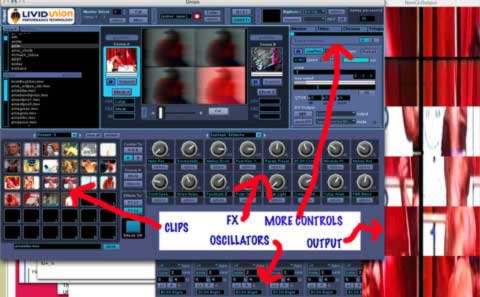
Last time sailing on seas of cheese to a Primus gig, you might’ve noticed a hot air balloon above the band with video projected onto it. Projections by Primus visualist ‘The Ape’, using a crazy real-time video app called ‘Union’, developed by Jay Smith & Peter Nyboer of Livid Instruments. Jay Smith’d be recognisable to some as the creator of the ‘Viditar’ – a midi based video control unit built into the body of an electric guitar, complete with LCD screen, clip and FX controls, and made for jumping around stage with. As expected then, Union packs in plenty of real-time punch.

Under the Union Bonnet
Complex controls, real-time triggering, advanced automation, sophisticated LIVIDweb.jpg
effects and reasonable frame_rates – how do they manage it? Being built on a bed of jitter objects helps, the video building blocks of the max/msp software shaping environment. Jitter objects are fast, optimised for real-time video modules – which bring power to the Union app, but also should mean Union can evolve rapidly alongside Jitter’s development.

Functions & Features
Union is unique in allowing both quick access to triggering of multiple clips, as well as advanced automation and sophisticated time based controls. Different clips can be quickly played on various midi or computer keys, whilst simultaneously complicated video processing can evolve and unfold or be adjusted as needed. These are a few of the ways it can happen:

Clip Controls
First-up Union has a well integrated way of accessing movie folders, which allows easy change between banks of clips, and scanning of thumbnails for quick triggering on keys. Clips can then be routed through to one of two sides of a mixer for combining – with a range of blending modes for mixing in different ways. Each clip either side of the mixer can be finely tuned in relation to it’s speed, direction of playing, position along timeline with easy setting of in and out points for quick loop making on the fly. Scrubbing / scratching and all of these functions can be controlled by keyboard and mouse or by midi – meaning you can control with external knobs and sliders on a midi box.

Effects
The Union FX bank is impressive and responsive, especially say – Meta-image – resizing the overall image into many smaller images which make up the whole and streak-blur which extends images fluidly. It also has a range of resizers, vertical slicers, video-on-3D object controls and considerable colour and image controls. Each effect has various parameters, any of which may be assigned to key or midi controllers, or synch-ed with oscillators which provide a few different ways of smoothly and incrementally adjusting values by themselves.

Automated controls
As well as the oscillators, there is an another auto-function which allows tempo-based ( BPM ) ‘events’ to happen, such as jumping to a random frame within a clip, changing clip or speed of clip. Works well, but is a little clumsy to get to within it’s tabbed interface. Also buried within the tabbed interface are some masking controls, tempo measures, text titling, chroma keying, camera and audio controls & the capacity to synch it up with certain modified turntables – delivering actual terror wrist ‘scratch vidi-yo-yo-yo’.

Live Camera Input & Audio Analysis
Aye, point a camera at something, or play a tape through it – and Union can treat that as a mixing source against a bank of clips from your hard drive. This also includes a range of useful camera input refinements. The audio analysis can be tuned to detect certain frequencies and then provide ‘event triggers’ whenever these are heard – so a bass drum might be used to change clip position or speed, or to another clip. In future releases it is expected this will include triggering of FX as well.

Requirements:
Mac G4 400Mhz OS X 256 MB of RAM – though real-time video with UNION would surely be kinda taxing on such a machine. PC version available “in the future”. US$249

Verdict?
Union’s unique combination of quick sample based triggering and complex automated processes makes it a very powerful and flexible real-time video processor. Has plenty of depth though, so it’d take time to get to know it’s ways, and customise it to really make it a useful live video tool. Some of it’s functions are a bit hard to easily access, although apparently this is eased much when using a midi device. Similarly the interface has a few bottlenecks, which are being ironed out during fairly regular upgrades. If looking to mash video, then definitely worth a test drive, get your demo keys here : .
www.lividinstruments.com

See Also : VJ Software round-up

by Sean Healy, September 20, 2004 1 Comment

Christo DVD, Graphic Agitation 2 coffee table book

Wrapped In Fantastic
Know what music was playing on Laura Palmer’s headphones when they found her? Wasn’t Ice-T, nor NWA. What do you think it was? (Get back to me on that ) Aside from the sound, the memorable bit about her being so dramatically discovered on that spooky Twin Peaks riverbed, was the drawled revelation… ‘she’s wr-a-p-ped in plastic’. Another long-time ponderer of the mysteries implicit with such hidden shapes /forms (aside from the donut chomping David Lynch) is of course Christo, wrapper of large scale land-forms and buildings and renowned large scale environmental artist – or kookbag – depending on your take.

Sydney’s Little Bay met Christo in 1968-69 – when he produced ‘Wrapped Coast’ – completely covering a cliff-lined shore area approximately 2.4 kilometers christo_coaster.jpglong, 46 to 244 metres wide, 26 meters high at the northern cliffs, and at sea level at the southern sandy beach – with a cloth fabric!! It was all paid for – like all of his works – by Christo & his partner Jean Claude who pay for all of their multi-million dollar projects through the sale of related artwork and preliminary sketches etc. There’s more than a good dozen of these crazy projects under their belt now, with the next planned for New York’s Central Park in 2005 ( see www.thegateswork.com if you are interested in applying for a temporary job working on it ).

There’s more to these projects than meets the bemused eye, when say looking at a Miami island surrounded by kilometres of pink fabric – and friends and film-makers Albert & David Maysles have been capturing some of the fascinating processes involved with these projects for over 30 years. The fruits of this extensive documentary making are now available in a collection of films across 3 DVDs on the quite cool plexifilm.com DVD label ( distro-ed in oz thru stomp.com.au ) and include a video interview with the Christo & Jeanne-Claude, an 82 page booklet with essays, project histories and exclusive photos and a lot of behind the scenery stuff : where the real merits of the projects shine – the ways they manage to engage, provoke and interconnect communities, the ways they manage to navigate the endless bureaucracies of ze modern world to complete their projects and of course the sheer scale and spectacle of the works themselves. In the midst of passionately debating the artistic merits of the very bridge (just wrapped ) they are standing on, one Frenchmen brings a pause when he says:
“If this bridge wasn’t wrapped, we would never have spoken to each other, ever.”

www.christojeanneclaude.net

Graphic Agitation 2:
Social & Political Graphics in the Digital Age

Hair is often described as our ‘cosmic antennae’ – while this doesn’t explain much about the ebb and flow contemporary hair fashions amidst saturated airwaves and people going wireless bananas, it’s a cute idea. Similarly cute is the idea that the ‘Digital Age’ somehow finds us more politicised, more able to voice our concerns, more able to express our views, more able to mobilise communities and more able to organise and interconnect alternatives to events, decisions or power structures we may not like. I like that cute idea, but whether it is making a difference is another whole… on second thought of course it is. Liz McQuiston has just released a huge compilation through Phaidon ( in oz thru bookwise.com.au ) of the changing nature of political and social graphics as we sink into interface world a little more. Think adbusters, reclaim the streets, warstopping, animal lib, more vegans than you can poke a stick at, graffiti, schnews, mclibel, the united colors of benetton etc etc and tis easy to imagine flipping thru the 236 large full-colour pages of activist-porn.

Chapters lead us with text and themes from the last 3 decades of protest graphics, to ‘eco-wars and resistance to capitalism’, ‘satire, subversion & subvertising’, ‘perceptions of war’ and ‘fighting for human rights’. It’s a powerful read, and almost heartening to look at so many people striving for a better world – though plenty of the gags reasonably just rely on taking the piss. The title is a little misleading though, for despite all of the cleverly / kookily photoshopped posters snapped on the streets, there’s little coverage of the vast body of electronic artists who aren’t using the print medium. Plenty of history and context surround most pictures and campaigns though, and so aside from finding a large picture of Hilary Clinton in bondage gear on page 99, or Marlboro man worrying about chemotherapy, or other gags, there’s much to be chewed on when you find yourself nestling in a certain couple of pages. It’s a gorgeous design book too, so if peeps be browsing through the likes of this for inspiration, the more the merrier.

Arnie Quote of the week:
Fresh from persuading US voters to re-elect Bush, Arnie took time out to send Technoscape this Rolling Stone Magazine interview snippet from his bodybuilder days:
“I feel you only can have a few leaders,’ [Arnold] says in a guttural, confident voice, ‘and then the rest is followers. I feel that I am the born leader and that I’ve always impressed with being the leader. I hate to be the follower. When I was a little boy’. I didn’t think about money. I thought about the fame, about just being the greatest. I was dreaming about being some dictator of a country or some savior like Jesus . . .”

by Sean Healy, August 20, 2004 0 comments