Mobile Projection Unit ( roaming streets of Melbourne, projecting our event signal onto walls, and a video camera feed of that back to our event.. )
Broadcasting to the web with built-in chat client at Melbourne time 8pm-1am, Oct 9th : http://www.mogulus.com/netlag
( Click through mogulus link, and ‘video on demand’ to see example footage from test gig on sep 25th )
Send twitter messages to netlag, which will scroll across the bottom of our webfeed :
( http://www.twitter.com/netlag or send messages to @netlag )
2008 marks a decade of the TINA festival, which each year brings together people from all ends of the country ( and globe) to Newcastle for a weekend of gigs, workshops, exhibitions, installations, panels and general mayhem. It’s actually an umbrella for Electrofringe, National Young Writer’s Festival, Sound Summit and more, and this time round is happening from Thu 2nd Oct to Mon 6th Oct.
As usual, there’s too much going on ( and much of it simultaneously ) for any one person to catch all of, so best bet is prioritising those sessions you really want to attend, and remain open to being swept along by the tides of stuff happening afterwards, be it the official sessions or the impromptu jams / meanderings / debates / disc swapping frenzies spread across the unique charm ( Baghdad as country and western surf town?) of Newcastle’s central business district.
Renewable Energy
Nice to note a festival in the steel city and one of the world’s biggest coal ports, running a trio of sustainable energy related workshops :
Going Green: Solar Power for Electronic Arts & Culture –
Learn about benefits of solar power for artists, media makers, researchers & others involved in electronic arts & culture. Get equipped with all the information you need to assemble an environmentally responsible & creatively liberating solar power system.
Windmills workshop –
Lock-up & Electrofringe artist-in-residence Chris Poole presents a hands on workshop exploring self powered & sustained micro-projectors. Learn to use wind power for guerilla style public art. Chris will also demonstrate & explain his innovative laser based projector. ( & later – Chris will create & install wind powered micro-projectors around Newcastle over the course of the festival. Keep an eye out for kinetic light emitting sculptures anywhere a little breeze might be blowing … )
The End of Travel?
Peak Oil’s coming; time’s running out to jump on a plane & see the world. How will this affect our relationship to place? What literary possibilities are afforded by a radical change in pace? What will it mean for the processes of globalisation that inform travel writing today? (( Cheery, eh? Luckily there’s also bicycle repair workshops happening @ the festival. Really! ))
Gigalicious
Aye. Many. There. Are. Including, in venues such as The Anti-Social Social Club, the following acts in various states of emotional and literal undress :
Antony Milton, Ben Byrne, Cotti, Curse ov Dialect, Hosebeast, KK NULL, Lucky Dragons, Maruosa, Rose Turtle Ertler, Western Synthetics, Birchville Cat Motel, Tranny Cops Rave Safe Team, b12shot, Ultra Violet MC, Oojah & the Trash, Fannyfighters, Pig & Machine, Press Eject, DJ Svensimu, DJ Baku, Pikelet, Fabulous Diamonds, Jim Denley, Kim Myhr, Matt Hoare, Naked On The Vague, Mt Eerie / Microphones, Subsketch, Boxed Voices ( and yes, more.. ).
What Else?
Solder Girls is a soldering circle with a whiteboard, for those who got a doll instead of a physics kit for Christmas. Take a spoken word tour of some of Newcastle’s most fascinating hidden locations. Tired? Chances are you’re suffering from ‘Artistic Fatigue.’ Come to the NYWF doctor’s surgery. Checkout an overview of Interactive Cinema Projects from the iCinema Centre for Interactive Cinema Research at University of New South Wales. Explore ways computer based systems can interpret, track & relate movement through a camera. Quartz composer? Two workshops. ( see also workshops for pure data, reaktor, ableton live etc ) Soda_Jerk launching Killer Mix Vol 2 & discuss their remix-based art practice. A midi controlled animatronic penis mask. Join Lucky Dragons (U.S.) as they workshop ideas on collaboration & theories behind participatory art making. Flipbooks & locked groove vinyl? Tick. Publishers from Neural.it (Italy) & Metamute (UK)? In the house. Large slabs of white plasticine to create depth & distortion for a projected image? Uh huh. Interactive video installation reframing real life as a classic noir comic book? You know it. Information Aesthetics? A chamber recital for robots? A chorus composed for 16 bluetooth enabled mobile phones? Japanese festival screenings? Etc etc etc…
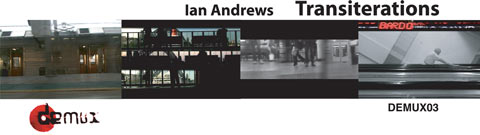
Another disc launches out of the demux audiovisual label, this one the collated efforts of Ian Andrews, long-time Sydneysider sonic manipulator / video perculator.
Twentieth Century Warehouses
Aside from the factories filled with people making / printing Kurt Cobain tshirts, Sydneyside warehouses in the nineties were often filled on weekends with Pink Floyd scale light and sound systems and thousands seeking to lose themself in that sensory overload. Glancing back at a catalog of flyers for these, and many events of a more intimate and experimental scale, Ian Andrews can be found under many guises :
on the video front, he was part of the seminal Video Subvertigo act with John Jacobs and Marco Fante ( whose video rigs were in spectacle in themselves, a literal truckload of electronics improbably clustered in the corner of a space for one night only ), working the speakers, Ian has been known alternately as Hypnoblob ( frenzied drum ‘n bass ), Disco Stu, Dormative Hypothesis, and The Horse He’s Sick.
Plus One
Fast forwarding to the current millenium, Ian’s purchase of a small 3 chip DV camera in 2005 delivered him the ability to capture banal events in everyday life, at quite reasonable quality – something he sought to exploit with a series of what he prefers to call ‘video field recordings’ rather than film shoots. By locking a shot off and having no camera panning or zooming, whatever comes into frame, whatever sound happens at the time, is in a sense, Ian argues, found. Having settled on a range of formal rules to limit what he may find, and using no additional music or sound effects, Ian gathered his found footage and pursued the challenge of wading through this material, editing it according to sound and image qualities, then arranging and repeating it in rhythms. ( hence Transiterations – iterative capture and cutting of sound and images in transit. )
Leaving the DVD on in the background, the sounds drift over you… levels and tones ebb and flow, occasionally cutting in and out in more jolting fashion, with an overall effect akin to rain on a roof, or rain on the windscreen of a car halfway between two distant towns on a country road, a long country road, mostly straight, with only the slightest of bends to challenge your desire to sleep. Which is to say, given only recorded location sounds have been used, some nicely choreographed ambience flows over time.
Visually, the DVD sticks to its rules, displaying a range of banal everyday moments, each of the dozen clips exploring a few simple visual editing techniques over time. “A collection of fragments, manipulated field recordings, gradual transformations, and banal repetitions” – isn’t going to be everyone’s cup of tea no matter how well edited, but to his credit Ian manages to coax compelling moments out of his micro-slices of Sydney life, slowly working through a range of editing ideas, the repetitive explorations building a cumulative impact over time, the gentle visual hypnotism reinforced by the swelling sounds.
Favourite clips include waterlevels – shot in harbour, perhaps from something bobbing in the waves, then letting camera panning vertically to emphasise the water’s rise and fall, then playful extending that when the camera approaches the sky, another view of the sky pushing the original image down the screen, and when the camera pans back down to the water, this image is pushed upwards, by other footage shot of the water. Simple, but nicely executed. Platform 2 allows draws on harbour footage, splitting the screen vertically three times to present views of the Sydney harbour bridge in the distance from Circular Quay train station, being interrupted by fast moving trains, allowing nice layers of edited rhythms to emerge. The bells uses silence and black nicely to build rhythms and pedagogy repeats a loop which is probably only one second long, but retains interest by continuing to compose and crop it in various ways, jumping between these in ever more complex patterns over time.
(Ye Olde tech-book review, written in 2008, added in 2016, because well, it may as well be saved somewhere it can be read)
Maybe architecture is a kind of frozen music. Your favourite abstract CD cover a mere snapshot in time. Forever hinting at moments before and after, a process in pause. Often the coherency and integrity, what makes an abstract image work for me, comes from the the way it resonates with a larger process, offers a a deeper ‘structure’. No surprise then, that under the belly of many a good abstract still, lurks a motion graphics package, or at least an approach to the image that involves rhythm and time, involves music. Understand the rhythm, understand the time, and your images will sing too.
Motion GFX
Musical notation itself is the simplest example of visually representing rhythm and time. And treat yer eyeballs, let the riddum hit ’em – what sounds can be read when you scan other imagery, other symbols? And conversely, embedding a little rhythm and motion in your graphics doesn’t limit you to making SBS news transitions, but can give you another way of ‘farming’ images – and giving a range of images grabbed from various stages of a sequence/process a coherency or even signature. VJ tools ( see www.audiovisualizers.com & www.vjcentral.com for overviews ) are ever-growing in number and capacity, and can be a great way to produce imagery this way. Similarly, video editing and FX programs such as After Effects, or animation programs can also be enlisted in a quest for creating rhythmically enhanced images. In the beginning though, image manipulators such as photoshop’ll get you far, especially when combined with some:
Vector Buddies
Instead of containing a bit in the file for each bit of a line drawing, a vector graphic file describes a series of points to be connected, resulting a much smaller file. This also means you can resize them, or zoom in on them easily without any pixelation. Designers be liking them then, for making various purpose logos and such, and tend to use Illustrator for print vector gfx or Flash for small-file-sized web vector gfx.
Light & Dark : Photoshop & Illustrator
(www.friendsofed.com/4×4/illustrator)
The Friends of Ed 4×4 book series is a quite cool collection, aimed at curious experimenters dulled by the usual software manuals. 4 artists explore a theme, expose their processes, construct and de-construct a work, give feedback to each other, and remix each other’s work. The books all come with extensive comments, a CD-rom showcasing the files and templates discussed, and a website where readers can upload, download and remix these examples. Theme for the illustrator and Photoshop book is Light & Dark, explored by the artists behind goingonsix.com, prate.com, and rare designers without webpages – Nick Higgins & Adrian Luna. Each artist’s process reveals a different approach to the nuances of illustrator and vector graphics, and how they integrate or use the scalable capacities in combination with photographic images – be they scanned drawings or leaves, or well cropped photographs. It’s easy enough to learn the basics behind these programs elsewhere, and much more rewarding to see the artists remix each other, and read their discussions about it.
Time : Photoshop & Flash
( www.friendsofed.com/4×4/flash )
If you like your pixels in motion, freeze-framed or not, the place for spreadinem like SARS, b.on the web for sure. Flash offers great creative potential and control for pixel manipulation on the web, though it’s not without detractors ( see www.anti-flash.co.uk/why.html etc etc ), who criticise the way Flash affects webpages and the default cliches designers revert to with it. Being able to get under the designer bonnet in this book, helps understanding of how much room there is to actually use Flash in an innovative way, and in what unorthodox ways Flash can be bent to provide you an image-tooler. With time under the spotlight, I expected more of a tweak with Flashes interactive and animation muscles, but most of the crew seemed to combine tools with the aim of generating an unusual end image. Each step of their flash scripts are screenshotted where used, and carefully explained – in the words of the artist too, and not a textbook writer. No CD, but deserves cigar.
Rich Media : Video & Sound In Flash (Studiolab )
( www.friendsofed.com/books/studiolab/richmedia )
Pitched as a ‘laboratory’ for combining and optimising flash with video and sound, this is the book of the 3 you’d probably thumb the most, despite it’s now creaky 2001 vintage. Alongside comprehensive tutorials ( formats, compression, using after FX with flash, html, dynamic sound, etc etc ), multiple authors provide background topic chapters on digital sound theory, understanding MIDI & cubase and ways media can be used on the web. We’re talkin around 500 pages of crisply honed guidance through creating webbed multimedia from scratch. Doubleplus good. Like the others, it’s distro-ed in OZ from : www.mcgraw-hill.com.au.
While we can enjoy the fruits of being hyperconnected today – we have each other’s reading, listening and viewing habits at our fingertips, we can distribute globally on a whim – what creative performance options exist for real-time collaboration?
Remember ResRocket?
As long ago as 1997 ResRocket was developed by Willy Henshall (Londonbeat), and Tim Bran (Dread zone), as software to allow musicians to jam online, each represented by an avatar, and able to either play along in real time or perfect their part locally and add it to the mix later on – as long as you were playing MIDI instruments or traditional instruments rigged up for MIDI protocol translation. Some 65,000 users later in 2003, it was shut down by the Steinberg company who had bought it earlier. Various ex-rocket members cobbled together http://www.jamwith.us in 2004 which continues extending online jamming software to date.
Rocket tangent? During their Australian tour in May 1999, Cold Cut agreed to perform a netcast from London to the Electrofringe festival in Newcastle Australia in October that year. Through a stroke of luck, the ISP sponsor for the festival had recently bought a warehouse beside the gig venue, and said “netcast? no worries, we can run a fibre optic cable across the carpark into the venue..” Bandwidth sorted ( which delivered us a 100kbs real video stream, luxurious at the time ), Cold Cut suggested doing an online jam at the end of their set with Resrocket. We hooked them up with beatmakers from Elefant Traks, who had been playing with their own online jamming software DASE ( Distributed Audio Sequencer Environment ), and the two groups jammed for a few months beforehand in preparation. On the night the ColdCut stream went fine ( with some of the loudest cheers for the text being written at bottom of screen ), but when it came time to have the jam, the Resrocket studio was inaccessible. The problem? Apparently a participating Resrocket sound engineer in San Francisco had fallen asleep, and the others couldn’t log into the room with the way he’d set it up.
Online Jamming Today?
Compared to Resrocket, the http://www.jamwith.us/ software is more a song production tool than a jamming tool, allowing musicians to synchronize and exchange audio material with most DAW platforms. “It has communication features to simplify the production process and keeps track of your tracks. You don`t need to be online at the same time as files are hosted on servers. The file exchange is optimized by compressing via the lossless flac algorithm.”
http://ninjam.com (Mac OS X and Windows) is a program to allow people to make real music together via the Internet. Every participant can hear every other participant, and tweak their personal mix to his or her liking. Since the inherent latency of the Internet prevents true realtime synchronization of the jam, and playing with latency is weird, NINJAM provides a solution ( as did DASE back in 1999) by making latency much longer. The NINJAM client records and streams synchronized intervals of music between participants. Just as the interval finishes recording, it begins playing on everyone else’s client. So when you play through an interval, you’re playing along with the previous interval of everybody else, and they’re playing along with your previous interval.
Similarly, ejamming.com imposes a delay on your instrument to keep you in sync with other musicians. The amount of delay is bandwidth and distance dependent. The better everyone’s upload speed and the closer the other players are to you, the lower the delay. The site recommends connecting with musicians close to you so you can adapt to the sync delay, and with their capslock on :
“DO NOT TRY TO CONNECT TO MUSICIANS 5000-10000 KILOMETERS OR MILES AWAY THE FIRST FEW TIMES YOU TRY EJAMMING.” They also recommend headphones to minimize the sound level in the room of your instrument so you can focus on the delayed sound of your own instrument and the sounds of the other players coming over eJamming AUDiiO.
http://networkjamming.com is an Australian developed networked interactive software application aimed at introducing schoolchildren to play in a virtual ensemble and jam with audio and video.
Beyond Midi And Timezone Drift Open Sound Control (OSC) is a protocol which attempts to transcend the limitations of MIDI, and provide a way of connecting machines more suited to modern networking technology, bringing with it greater interoperability, accuracy, flexibility, and enhanced organization and documentation. Much of today’s audio ( eg audio mulch, reaktor ) and VJ ( eg VDMX ) software is OSC capable, so online jams can include advanced ways of connecting parameters on machines located in different places. More sophisticated patch based software such as max/msp and pure data multiplies these capacities, as exemplified by the likes of Max Neupert’s Video Sampler where remote artists are both able to control an interface and see the other’s simultaneous adjustments, allowing a live remote jamming ( based on both sides having the same local set of media to start off with ).
And aye, haven’t even touched on games, the vastness of online multiplayer games somehow daunts me. I like to think though, there’s a bunch of rastafarian orcs singing acappella tunes together in some hidden corner island of World of Warcraft, a gathering of Grand Theft Auto gangsters making music with avatar gunclicks, and others tweaking out weird audiovisual levels with unreal tournament game engines.
And all kinds of remixing media possibilities have emerged with the widespread adoption of media storage sites online. Using a specific tag such as ‘melb2008digitalfringe’ on media uploaded @ pool.org.au, flickr, blip.tv or vimeo.com allows contributing artists from different locations to remix each others work during performances ( see below). Most media storage sites also tend to feature RSS feeds of media that can be subscribed to and utilised within software, and API‘s ( programmer friendly code which provides database access to media for custom uses ).
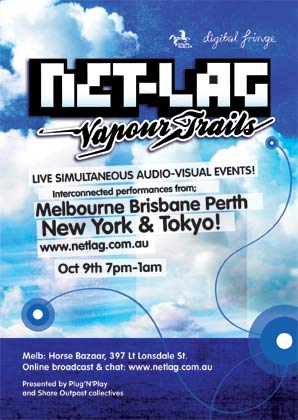
And So..On Oct 9th – NetLag : Vapour Trails
In the Digital Fringe leg of the Melbourne 2008 Fringe Festival, Plug N Play Melbourne, and Share Outpost will be hosting an event simultaneously with others in Brisbane, Perth, Tokyo and New York, where we’ll be trying to milk some of the collaborative possibilities, and trying to provide some introductory way of linking our events. Aside from a range of performances that night @ Horse Bazaar, we’ll be using the streaming software at mogulus.com/netlag, to select feeds from the other cities at various times, and to send an overall mix out to the web and to those at other events. The mogulus software allows live chatting via web, and anyone watching can also send twitter messages from their phone or web to twitter.com/netlag and these will scroll across the bottom of the netcast.
The Mobile Projection Unit will be wandering around Melbourne projecting some of this, and also beaming back to the venue, and web, camera views of these projections. Crazy kinds of feedback loops possible to play with there – artists painting walls in NY say, being beamed through mogulus to our event, we select their feed and send to the mobile van, to project their art onto walls around Melbourne, video camera sends footage of this back to us, and back to the web, where the artists in NY can see how their work is being recontextualised in Melbourne, and adapt to it. The mogulus software is pretty good too, for allowing easing cueing and transitioning from feed to feed, so each member can send a feed to the web from their location, and the admin user can easily select which feed becomes the main feed. Should be fun at least, to cut in snippets from elsewhere, to our event in Melbourne, and hopefully fun for others to receive some of ours. And fun to see what kind of remixes emerge from the tagged media everyone has access to.
In the end, just an experiment at linking events, but will be interesting to see where it goes… ( esp with the end of travel being predicted and all.. )