
Joining The (Paik) Dots

nam june paik ripDeath renders all the world’s technology meaningless.

So it goes.

Pioneering electronic visual artist Nam June Paik passed away from natural causes on January 29th in his Miami home. That the web now overflows with tributes to the mischievous 74 year old provocateur, is testament to his abilities for transcending tech-worship, and instead doggedly pursuing how technology could be used to describe anew, the human condition, or our human connections. Plus, he was very funny.

A Short Biography
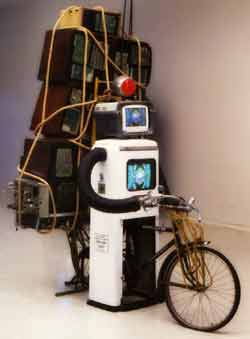
Nam June Paik was born in Seoul June 20, 1930. He first found interest with music and learnt piano at age 14, then moved to Hong Kong in 1950. In Germany he received tutoring and inspiration from the seminal composers Stockhausen & John Cage, and began to expand his ideas of composition and performance, eventually developing an obsessive interest with the electronic moving image and media technology, and how they might re-shape composition and performance. In 1964 Paik moved to New York and throughout the 60s, 70s and 80s carved a considerable reputation with his experiments with television, video and especially installations which combined them in public spaces. ‘That guy who did lots of weird stuff with tv sets’ was married to Japanese-American Shigeko Kabota, and in 1996, he was left partially paralyzed by a stroke.

Some of his more famous works include ‘TV Buddha’, which presented a buddha statue facing both a surveillance camera, and a monitor displaying both the recorded buddha, and the viewer of the artwork and passers by.
TV cello – an attempt to produce an audiovisual instrument, which consisted of television sets mounted to resemble the body of a cello, and attached to a neck, string and bridge of a real cello and electronic pick-ups which also sent electronic signals to the screens.

Fluxus
Nam June was a key member of the Fluxus movement, one of those notorious twentieth century art movements whose photos jump out of the history books with their absurdity and daring. Some of these photos may include shots of Marcel Duchamp, John Cage, George Maciunas, Joseph Beuys or Yoko Ono, perhaps in the midst of some “action” event, some attempt at unhinging the traditional artworld, or expectations of artists.

Nam June Paik Quotes:

“Art is just fraud. You just have to do something nobody else has done before”, he famously declared during an interview with a Korean newspaper..

“I make technology ridiculous.”

“I am a poor man from a poor country, so I have to be entertaining every second.”

“It is the historical necessity, if there is a historical necessity in history, that a new decade of electronic television should follow from the past decade of electronic music.” (1965)

“Without electricity, there can be no art.” (ca. 1976)
nam june paik nomad
Paik is thought to have coined the terms “information superhighway” and “the future is now,” as well as having global influence with his work.

Nam June Paik Online:
His official site, has an extensive image gallery, bio, essays and more.
The Nam June Paik Museum is under construction in Korea.

Read about Paik’s exploits within the free online PDF book of >> Gene Youngblood’s “Expanded Cinema” (1970)via ubuweb.

Paik mp3 recordings – via banana nutrament.

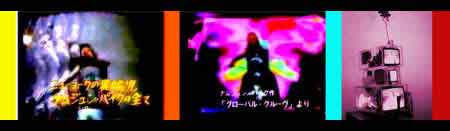
Paik Video – on 2 x half hour TV shows in 86 ( found via youtube.com)
nam june paik video

Update via DV Blog : Friends in Memory of Nam June Paik – Yoko Ono ( video memorial)

tags: , ,

by Sean Healy, February 1, 2006 4 Comments
Wrestling Resfest 2005

Review of the Resfest Short Film Festival, Nov 17-22 2005, ACMI Melbourne.( Printed in Real-Time magazine ).
( Update: added some pix and links to watch movies mentioned. )

For better or worse, Resfest comes through town like the dinosaur chase scene in King Kong, and we stumble out at the end of it – exhilarated, overwhelmed by the feast of technical delight, and yet somehow wondering why we are covered in cheese. That said, the Resfest condensed program of ‘short films, music videos, features, motion design, live music and speakers’ inevitably contains breathtaking moments – where the obsessive pursuit of novelty actually leads somewhere, where the technical wizardry transcends the sum of it’s intricate parts, where bedroom creatives kept chipping away on a piece that no-one could ever elevator pitch, where brats with a handicam nailed the perfect moment, or simply while holding your hand, where the film-maker-animator-designer gradually takes you outside of yourself, and what you thought possible. Continue Reading →

by Sean Healy, January 28, 2006 1 Comment

John Waters Vs ‘Large Hairy Men’

john waters bear
Pink Flamingos in 1972 set a new benchmark in trash cinema, sealing a notorious reputation for director John Waters with one scene in particular – crossdressing actor Divine eating a freshly squeezed dog turd. Plenty of other outrageous films and scenes followed, with writer William Burroughs proclaiming Waters the ‘Pope of trash’, but none have outdone that early Divine moment. Most recently Waters had produced the less controversial but still highly amusing Hairspray, Cry-Baby and Serial Mom, but bounced back nearing 60 with last year’s ‘A Dirty Shame’. Featuring Tracey Ullman, Johnny Knoxville, Selma Blair, David Hasselhoff and Chris Isaak amongst others, the film peels back the suburban facade to find all the kinky fetishes that lay behind. And it’s near encyclopaedic in it’s cataloguing of deviant desires (see also, where you fit on this outrageous map).

Amongst the sexual persuasions, kinks, fetishes & esoteric practices lampooned includes of course the ‘bears’ which according to wikipedia, refers to gay males “who possess physical attributes much like a bear, such as a heavy build, abundant body hair, and commonly facial hair.” Nice to see Wikipedia includes gay bears, as well as the Grizzlies, Sloth Bears and Spectacle Bears. And via the wikipedia gay bear entry, there is also ( of course ) bearornot.com, which follows in the footsteps of hotornot.com, gothornot.com, ratemymullet.com, ratemedownunder.com, amiaminger.co.uk and afrohotornot.com in rating user contributed photos. Off you go.

tags: , , , ,

by Sean Healy, January 23, 2006 0 comments

The Grizzle Shizzle : Werner Herzog

werner herzog grizzly bearGrizzly Man (2005), is the most recent eye-opener to hit the screen from Germany’s renowned and relentless documentary maker Werner Herzog. With his trademark ability to zoom in on the most eccentric and obsessive of characters, Werner crafts a compelling tale of a Canadian bear-lover who camped in the wilderness each of 12 summers to ‘protect’ the bears. Werner’s task was helped in no small part by the 100 hours of video footage recorded by the bear-lover, up to and including the sound-only of his eventual mauling by one of the bears. One line from Werner stays ringing in my head, who in typical style, fades down our bear-lovers narration to interject with his own Germanic tones: ” … I beg to differ with him here… I do not see any kinship with the bears, only the cru-elle indifference of nature.” He continues at times to offer his own perspectives on nature, and the chaotic violence it can unleash. A thoroughly intriguing film, compiled with respect, packed with insight. And if you’ve already seen it – enjoy Werner chatting about the making of it, in a Pop Matters interview, including how he stared the original proposed director in the ye and said “No, I will direct this”, and how he made the whole thing in 29 days!
Werner’s obsessions are as noteworthy as those of his film subjects however, with a trail of over 50 features under his belt. Some highlights include Lessons of Darkness (1992) – an abstract visual exploration of the post-Kuwait oil fires after the first Gulf War, Even Dwarfs started Small ( 1970 ) – an entire cast of dwarfs running riot, Heart of Glass (1976) – an entire cast hypnotised while being filmed, Werner Herzog Eats His Shoe (1980) – where Herzog cooks and eats his shoe after losing a bet with then fledgling director Errol Morris, Wheel of Time (2003) – a meditation on the Tibetan buddhist creation of sand mandalas, The White Diamond (2004) – a mad scientist exploring the Guyana rainforest canopy with a novel flying device-the helium-filled ‘Jungle Airship’, Incident at Loch Ness (2004) – a mocumentary exploring the myth of the Loch Ness monster, and The Wild Blue Yonder (2005) – a cine-poetic sci-fi collage of outer space imagery and scuba divers under the ice-sheet of Antarctica. Werner is currently in post-production on Rescue Dawn (2006) (post-production) – a US Fighter pilot epic struggle of survival after being shot down on a mission over Laos during the Vietnam War. Busy boy. And watch out for Werner’s hilarious cameo in Harmony Korine’s ‘Julien Donkey Boy’. Werner @ imdb.com

Update: Check this Grizzly Man movie parody ( 37mb, via WFMU ).

tags: , ,

by Sean Healy, January 23, 2006 2 Comments

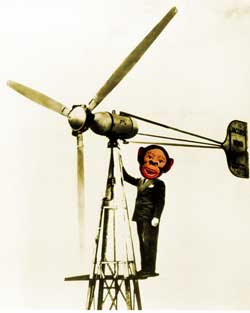
Lovelock’s Apocalypso Now

windmill

“He is to science what Gandhi was to politics. And his central notion, that the planet behaves as a living organism, is as radical, profound, and far-reaching in its impact as any of Gandhi’s ideas.”

– New scientist.

James Lovelock, the scientist behind the above Gaia theory has just published a controversial article in the Independent (UK) – which argues that, as a result of global warming, “billions of us will die and the few breeding pairs of people that survive will be in the Arctic where the climate remains tolerable” by the end of the Twenty First century. He also suggests that “we have to keep in mind the awesome pace of change and realise how little time is left to act, and then each community and nation must find the best use of the resources they have to sustain civilisation for as long as they can.”

It’s a bleak read that packs a certain punch, coming from a scientist with Lovelock’s status. With a projected population of 9 billion people by 2050, it’s clear we have our work cut out to provide food and energy for all whilst retaining as much biodiversity and quality of life as we can. In some ways Lovelock’s argument ( a prelude to his upcoming book : Revenge of Gaia ), global warming and the recent ‘Peak Oilmovement, merely provide a convenient framework for helping us to understand the scope and scale of the overarching sustainability challenge we face as civilisation in the 21st century.

Some however, are disappointed with what they deem as Lovelock’s pessimistic approach, preferring to frame our situation in terms of what we can and should be doing now to alter our destiny. Lovelock’s sobering article is well worth a read though, and contextualised by the heated debate over at the slashdot trenches ( in betwween the usual mac-pc-linux flamewars ), and the constructive rebuttals over at World Changing. Maybe it’s time to run some data through Sim Earth and figure it out once and for all.

Now Listening to: It’s the End of the World As We Know It (And I Feel Fine)-REM

Mood : ‘Need Some Shopping Therapy’

tags: , , ,

by Sean Healy, January 23, 2006 0 comments