Can u describe ‘the mixer’?
“The Mixer: The Ultimate Skate Activity Center” is an installation laid out like a skate park. People can play on the ramp, triggering samples from “Tony Hawk’s Pro Skater 2” over headphones. Because they have headphones, the skaters seem to be oblivious to what’s going on around them, and relate to the ramp as if no one else was in the space. Watching the kind of “dance” they go through trying to “map” the aural space of the ramp is great entertainment!
What inspired it?
The idea for an interactive 1/2 pipe with sensors and sound samples was there for a long time. All my skater friends seemed into Atari video game noises. When I first played Tony Hawk 2, I was overwhelmed by the soundtrack. It was like a skate video/ video game. I realized that the connection of music to skate culture was essential and the project grew from there.
What were your aims with it?
Generally my work is about social systems, communities and conversations. With the Mixer I wanted to address my relationship to the skate community and their relationship to the larger social group of this city. I hoped the installation would be an approachable space for pro and anti-skateboarders to interact in some way.
What intrigues you about the skateboard as a technology?
I like the simplicity of the skateboard and its relation to the body. It’s the sort of technology that is overlooked and can therefore slip between the cracks and go places other sorts of technology can’t.
Do u skate yourself? ( How high can you ollie? )
Mmmmyah. Started skating when I was 17. I’ve pretty much given up trying to ollie my long board (ouch my shins!). On a regular board, about knee high.
So you dig skate-video games?
I’m not very good at video games (because I’m too embodied in the physical world?) but I like Tony Hawk 2. Tricking in the new games is really cool and exciting, if totally unrealist–you actually pick up speed when you grind.
If skaters were super-heroes, what’d your special-power trick be?
I’d grind and slide along the window sills of big, institutional buildings and rescue all those lonely, alienated people from the corporate structure by breaking their hermetetically sealed windows and throwing in loads of yummy food, good music and coupons for hugs.
Your weirdest skate dream?
Dreamt once I was getting head from the 16 year old boy who works at the skate shop, and one of my students kept barging in to talk to me about her project. I was like, hey, do you mind? Can’t you see I’m getting head?!
Future interface plans?
I’m not satisfied with the slow reaction time of the photo-resistors, so I’m going to install pressure sensors in the ramps. I have a few projects in the works that involve more of a tinker toy/clockwork technology.
Ever wanted to fake your own moonlanding? Interested in the terraforming of mars to create conditions suited to life? Wondered what it’d be like if other planets filled our views in the sky? You might like science fiction, and coincidentally may also dig the newest kid on the video software block, weighing in hefty in the mac corner, ladies and gentlemen, VDMX 2.
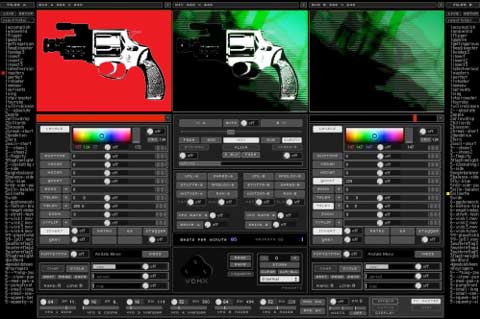
Written with the video programming language Nato, VDMX2 is an impressive software video mixer and real-time effects processor from the vidvox.net stable. Vidvox tackle a range of experimental art and online projects, installations, and software, of which VDMX2 is their finest moment, hitting the mark well and solid.
Breakin’ It Down
So how does a real-time software video mixer work? VDMX2 is broken up into 3 columns, each with a small video window. The left and right windows display selected movies of live camera input, and a range of real-time effects parameters underneath. The middle window contains your output screen – eg what’s being delivered to your video projector, and a range of mixing controls, playback controls and time based functions underneath.
Video performance with VDMX2 can be as simple as loading up a bank of clips to channel A+B, selecting clips for previewing in the left and right monitors, then adjusting effects and colour or motion controls on either clip, then cutting or mixing between clips, adjusting as you go. Its well thought out interface allows this to be grasped quickly, while also offering much greater depth, complexity and flexibility as it becomes more familiar.
Neat Stuff
As music visualisation software continues to flourish, VDMX2 brings to the table several features which distinguish it with unique capacities and flavour. Although it has several cool effects which are fun and easy to use, it’s strengths lie in it’s unique and well-thought out functions. Vidi-yo breakbeat automatically cuts up clips into 32 parts, and allows specified parts of the clip to be played in particular order as time progresses, bringing real-time visual breakbeat to your fingertips with ease. Alongside this, are several motion based controllers which manipulate clip playback in a variety of ways, and movie playback control by clicking and dragging on the top or bottom half of the middle screen. Dragging on the top half allows playback direction to be changed or the place on the timeline, while dragging on the bottom half allows to quickly adjust the playback rate of the clip.
‘BPM’ detection happens by tapping the return key while listening to music you are making video to, and allows automated control of a range of effects. These effects are also controllable by VDMX2’s video oscillators – which link the effects parameters to their randomly generating numbers and allowing software control of parameter changes.
VDMX2 has excellent colour control, with each of red, green and blue levels easily adjustable, as well as saturation, a ‘font synth’ which cycles your fonts and texts through one of the channels, a recently added looping function, a vagabond mode which randomly cycles through parameters, the capacity to save overall settings as global presets, and easy recording to disk of mixes for reuse and further remixing. Enough? There’s more, but if you’re into video, hopefully you’re already checking this out.
What You Need to Run VDMX2
This mac only software needs a G3 or G4 computer to run it, and tested fine on a g3/333mhz machine with 384mb of ram. They recommend 512mb of ram though, and allocating 300mb as a ram disk for faster access and processing of clips. You will also need US$495.00.
Pros
Intuitive and easy to make trouble with, VDMX2 offers a great depth for keen vid-fiends, and enjoys a very effective interface loaded with useful and flexible features. Has been developed directly for live performance and it’s thoughtful construction has paid off. Updates to the program, and new bonuses are also frequent.
Cons
VDMX with it’s live processing of multiple video streams, can sometimes slow a computer and the resulting frame rate of clips outputting very quickly, particularly if several effects have been layered. It’s also a little slow in changing clips.
VDMX developer, Johnny Dekam happily answered the following: What are your favourite VDMX features?
The “Video Frequency Oscillators” are similar in theory to LFO’s in audio synthesis. They are number generators which can be driven by the master clock, and assigned to any parameter. One VFO is a realtime pixel analysis module, which generates controller data based on the content of the image – one can create extremely interesting data feedback loops. (image is analysed, the results are effecting the image, which in turn is analysed again etc). Another killer feature is the breakbeat video module… a 32×32 ‘time matrix’ which allows the user to cut up the video rhythmically and with complete control.
And your next software project – metamov?
Metamov is similar to vdmx except it features non-realtime rendering at high resolutions, and extra effects and controls. I’m very interested in this because while artists, vj’s and musicians have for a long time understood the ideas of ‘realtime’ and ‘generative’ — the graphic and motion design community (which is substantially larger) is just starting to desire these kinds of tools.
What interests u in the emerging ‘VJ scene’?
That VJ’s are being recognised in their own right as ‘artists’ and less and less as ‘lighting technicians’. The most interesting work is where so called ‘VJ’s’ are actually complete multimedia groups doing original sound, video and stage performance at the same time.
vidvox.net
Check screenshots, a thorough run through VDMX, sample movies and online projects.
http://bootsquad.com/nato
For those keen – this nato tutorial shows a glimpse at the possibilities of the NATO programming language that built VDMX.
“I’ve got a time-bomb in my ass”. Character who uttered this was neither terrorist nor high grade drug smuggler, butt a friend in last night’s dream. Hopefully it’s a phrase which will make it’s way into common usage, suitable both for sign posting a sense of urgency and referring to the genetic decay we all bow to in the end. It was so funny to hear last night it woke me clean up, laughing out loud. This week then: dream machines.
So Tha Story Goes
One Brion Gysin was travelling in a bus to Marseilles, circa 1958, when he passed a long row of trees and closed his eyes against the setting sun. An overwhelming flood of intensely bright patterns in supernatural colours exploded behind his eyelids: ‘a multidimensional kaleidoscope whirling out through space’.
You Spin Me Round
From here the effects of strobing light were researched and a simple flicker machine was constructed: a slotted cardboard cylinder which turned on a gramophone at 78rpm with a light bulb inside it. Again the kaleidoscopic visions returned, and this time ot was found after extended usage, perception of the world around had increased very notably, and all conceptions of being ‘dragged or tired had dropped away’.
Repetitive Light
What seems to be happening is of course, that the constant rotation and repetition of the light source in a dream machine, promotes and regulates the production of electrical brainwaves, in particular ‘alpha waves’, through the rhythmical stimulation of the optic nerve and visual cortex. Alpha waves are associated with a state of relaxed wakefulness, of receptivity without concentration, and have a frequency of between 8 and 13 cycles per second.
DIY Zen turntables
You’ll need a record player that does 78rpm, a globe and a cardboard design which you’ll find at google.com. Bear in mind this ain’t no pokemon epilepsy triggerin type scenario, just potentially a nice way to relax, a nice party gimmick, or if u believe the mystical hype: an opening to a sea of inner visions and transcendental experience which will forever change your life and you got it all from a free street press you picked up from beside a softdrink machine.
The Wait There’s More Dept..
Oh what a dream machine is a cluster bomb. Cluster bombs are bombs that contain many smaller bomblets designed to saturate a wide area. Each bomblet contains metal shrapnel designed for maximum human casualties and equipment damage. a typical cluster bomb would weigh 500 pounds and carry 247 bomblets. Unfortunately as with all detonation devices, the fuses are not 100 percent effective. There are always bomblets left unexploded. The current US variety are bright yellow and the size of a large can off food. The current food aid packages being dropped for displaced Afghans are painted the same colour to make them easy to find. Don’t worry about the children though, the US military are dropping fliers with every bombing raid to explain the differences. And there’s music in the next paragraph.
Underwater Trumpets
Androids may dream of electric sheep, but they listen to underwater trumpets. Hopefully there were plenty of androids in attendance at a recent Rephlex Records night in London where Pierre Bastien amazed the crowd with his mechano percussive beats and underwater mini-trumpet playing. It’s no wonder London attracts so many androids, what with a recent Stockhausen festival and the extraordinary surround sound system playback of many of the early works of this pioneering composer. His show was introduced by the man himself in an unforgettable white safari suit, and followed by the padded sounds of an Aphex Twin gig where all wandered around wearing wireless headphones in silence.
ciao bunnies!
Sidebars: www.google.com
Here you’ll find easy to replicate designs for your own dreammachine – using the keywords ‘dream machine’ , ‘brion gysin’ and ‘flicker’.
www.strangereports.com
Choose a topic from the left hand column, and answer a few questions… voila! A realistic web site is created with a great selection of fake news stories using the names of your
friends! Try it, they fall for it (for a minute) every time!
www.indymedia.org
Great reading for cluster bomb fans and others interested in multi-perspectives on the terrorism being perpratrated by both the US & its attackers.
Concept is this: get enough people to aim their toy red laser pointers, at the same time, at the moon, and see if together, they can paint it red. Thanks to modern web technology, ideas like this can get the audience they deserve. Yes, it’s real, and yes it’s from the states. The brains behind this particular venture belong to one Jim Downey, a writer who hopefully appreciates just how many 3D readers own red laser pointers.
Were your eyes popping out of your head at a rave when you thought of this, or is there some other explanation?
No artificial stimulus involved. I’m naturally like this. It frightens my friends a little… but they seldom get bored around me. 🙂
How many people do you think participated in your first moon attempt?
Hard to say. I had about 100,000 hits to my website that weekend, with a LOT of press attention worldwide leading up to it. Directly, I heard from about 300 people who wrote to tell me they participated, almost all of them with friends. So, the number was at least in the thousands, possibly tens of thousands or more.
What sort of feedback did u get from that attempt?
Almost everyone who wrote me said that they enjoyed it. Most folks had a little party (I had about 60 people at my business), then went out to give it a try. The most common theme was that they enjoyed doing something a little crazy at the same time as everyone else, which was my goal: a shared dream.
Heard about any other weird group laser projects since you’ve started?
A lot of people have suggested doing something like lighting up the Statue of Liberty, that sort of thing. But no one has yet organized such an activity to my knowledge.
Some of the scientific reactions to your idea?
Almost without exception they say it won’t work, but most of them find it charming and say they are going to participate nonetheless. Real scientists understand the need for this kind of intellectual play, of daring to imagine things outside the accepted bounds. I find it refreshing that they and artists have so much in common in this regard.
What motivates you to try it in the face of this?
Because the technical aspect is only a small part of the conceptual project. The whole thing is more about human hopes and dreams than it is about photons.
What are the main obstacles to painting the moon red?
Let’s see…the power of the little laser pointers…atmospheric absorbtion and disturbance… the reflectivity of the lunar surface…the glare coming off the lit portion of the moon…and aiming the little things. Yeah, I think those are the main obstacles…
Have you factored in that the man on the moon might be wearing reflective sunglasses?
Be cool if he was, it’d help the light get back to us better.
What’s next if you succeed?
No idea what’s next – whatever happens. Hell, 7 months ago I didn’t know I was going to be doing this. We’ll just have to see what odd and wonderful ideas pop into my head, and which ones strike my fancy. You can’t force creativity, and usually you can’t even control it. You just gotta roll with it, take it where it leads you.
Sidebars: www.paintthemoon.org
Join in the world’s largest collaborative work of art, or at least learn a bit more about the physics of painting the moon red.
www.givewater.org
Thames Water (UK) has set up a website associated with Water Aid – and if 2 million people click on it, they’ll donate 150,000 to provide safe drinking water in Africa and Asia for 10,000 people. Only a few weeks left and 250,000 more clicks are still required to meet the target.
Hypnotism and jellyfish have more in common than most people realise. Discovered this being recently seduced by a sunset snorkel, but my freewill(y) knew it was surface time when I was overwhelmed with desire for a cheesecake seeming to bob in the waters ahead of me. Swim, swim, but not too fast or your lungs will pop like a batman caption. And who better to talk about the surface of comics, than Diana Ward founder of Melbournes’ Digital Media Collective who produced the most excellent C.Run seedy-rom? Jean Poole takes up the bait.
What inspired the Digital Media Collective?
We were all friends and doing different multimedia art projects around each other. I guess it seemed like a natural progression to band together and all contribute to one common outcome. We had big plans for a new breed of comics that could be more involved and multilayered than just something that was printed.
Why self produce digital comic compilation rather than turn to artworld for funding?
We spent about 2 months looking into the grant thing and writing proposals and statements of purpose and so on and we looked into heaps of funding bodies and what their criteria was. We actually came to the conclusion that there weren’t any funding organisations out there that were willing to fund a collective in the way in which we operated. We decided that trying to bend over backwards and change what we were on about to please the arts funding people would just end up bastardising our work. We eventually decided that the best way to say what we wanted to say in the way we wanted to say it, was simply to try and get the money together ourselves.
How well does digital media tie together your different creative interests?
I only really began to be interested in computers when drawing and design programs became common and easy to use. I have been cartooning since I was small, as well as producing electronic music. I guess digital media ties them all in very well. I use a wacom tablet so now I just draw straight into the computer. Since working with digital media I have got heaps more into animation, because there are so many tools out there for animators, it is the obvious next step.
What do screen based comics have going for / against them?
Well I guess when you get right down to it, it’s the content that is important and the medium could be anything. Screen based comics allow for more elements to be incorporated into the mix, like sound, animation and interactivity. For the web the advantages are more about ease of delivery- you bypass all of the bullshit involved in looking for a publisher, distributer and so forth. If people know where you are on the web, you have the ability to reach a huge global audience.
Against the screen based delivery is the fact that I think people like to have something tangible to hold and own. It’s instant satisfaction, opposed to all the various drawbacks from computer hardware such as memory issues, download speeds, compatible systems and all that. Also you actually have to own a computer, or have access to one, to be able to view the work, which is a big financial issue for many people.
How has C.Run been received?
We’ve had great responses so far. We are actually planning a second run pretty soon.
How do you think the surge in digital media has benefited the arts community?
I believe it is just art evolving. Art is always evolving and new movements are born and growing. It’s just art catching up with technology or technology catching up with art.
Do u think the popularity of South Park, The Simpsons & Flash technology has opened up animation possibilities for comic makers?
Definitely. I think that heaps of comic makers out there aren’t concerned with making comics simply for “kids”. Shows like the Simpsons and SouthPark prove that comics and cartoons have much more of a universal appeal, and aren’t just restricted to the Saturday morning kids slot. I think that tools like flash have taken away a lot of the painful grunt work involved in animating. It has enabled someone with a modest budget and a computer to potentially create a show that can be received by a large audience.
Sidebars:
Digital Media Collective www.netspace.net.au/~van/dmc
If you’re ever in this part of town, you’ll find acool collection of comics and animation by some of Melbournes best independent comic makers. Nice interfaces too, these kids know what’s goin on.
Electric Sheep www.e-sheep.com
A wikkid collection of comics which explore digital terrain well, including a recently added ‘Apocamon’ series, looking at the apocalypse pokemon style.
Just So you Know… http://tealdragon.net/humor/facts/facts.htm
More info to stuff in your mental filing cabinet for later. Did you know a jellyfish is 95% water, hypnotism is banned by public schools in San Diego, and Donald Duck comics were banned from Finland because he doesn’t wear pants?
www.elefanttraks.com
Where the elefants regain their hitpoints. Browse through various mp3s, electronic art uploads and read about the latest elefant news.

 Sigh. Keepin it wheel in North America is one Sandee Moore, who for the exhibition