
Absynth 1.2 Vs. Sun Ra

Steadily growing a reputation in the softsynth (software based synthesiser) world is Absynth by Native Instruments, now available for mac and PC. Famous for his other-worldy compositions and claiming to be from outer space, Sun Ra was the greatest jazz cosmonaut from 60’s & 70’s afro-psychedelia. Today, it’s ok to love them both.

The Basics
Absynth has a crazy array of sound-sculpting possibilities, offering easy intuitive control to synthesise sounds, or tweak and customise the extensive presets to get a synth sound you can’t help grinning at.

Sun Ra performed with The Arkestra, and his music was typified by counter melodies, off-key horn barrages, polyrhythms, titanic organ and synthesizer solos, dissonant note clusters, and a giant cosmic tongue in his cheek.

Features
Absynth can be used as a stand alone app, or as a VST plug-in, allowing it to be used inside an app such as Cubase. Absynth has a huge range of presets, delivering you diverse and very customisable textured or rhythmic sounds to use with a synthesiser. Some of these presets are even named after the artists they’re inspired by, such atom heart, mouse on mars, or autechre, but of course the software’s greater merits is in it’s capacity to radically tweak these presets or to create your own.

Sun Ra fused a very strange melding of jazz, Egyptology, primitive electronics, numerology, color theory, intergalactic fascination, and anagrammatic obsession. He recorded around 200 albums and distributed them at gigs and a few choice record stores. They were usually packaged in white sleeves with wild homemade cover art.

Abysnth’s graphical waveform and spectrum editors allow for fantastic real-time and varied control of sound, as well as oscillators, filters, ring modulators, Fm synthesis, an envelope function generator for tempo-based rhythms and nearly every parameter can be modulated by MIDI controllers, aftertouch, velocuty and note number.

Sun Ra and his Arkestra staged incredible live concerts with a strong visual presence that was equal part ancient Egypt and NASA. He staged at least three 100 piece concerts, including a memorable one at the pyramids in Egypt. Said Sun Ra “There’s five billion people on this planet, all out of tune. I’ve got to raise their consciousness.”

System Requirements
Absynth: Mac – PowerPC 300 / 64 MB RAM as stand-alone application / 128 MB RAM if used with other programs / MacOS 8.6 or higher. Has just been released for PC but couldn’t find system requirements online for PC. Native-Instruments like email tho.

Sun Ra, 1956: “In tomorrow’s world, men will not need artificial instruments such as jets and space ships. In the world of tomorrow, the new man will ‘think’ the place he wants to go, then his mind will take him there.”

In Summary
Absynth: Awesome presets/ very intuitive controls, esp the graphic editors / great performance / great quality of sound and real-time manipulation.

Sun Ra: Leaving a great vinyl legacy, Sun Ra died in 1993. When he was admitted to hospital, he listed his address as “Saturn.”

Absynth: www.native-instruments.com
Sun Ra: www.holeworld.com/stellar.html
Absinthe (Includes. recipe): www.erowid.org/chemicals/absinthe/absinthe.shtml

by Sean Healy, June 5, 2003 1 Comment
Anatomy Of An Elefant Vidi-yo Clip

X-ray specs have been enlisted in the fight against the smuggling of exotic animals. Alongside super-intelligent beagles, X-rays represent formidable barriers to wanna-be smugglers. For example, take Jessica Dean & Marc Eiden of TukTuk Productions. While they’d struggle to smuggle large zoo inflatables full of dental grade nitrous oxide into the country, they have no trouble juggling the complexities of video. Behind the scenes then we go, to see how they made their ‘77%’ film clip for the Herd (from ‘An Elefant Never Forgets’ – Elefant Traks).

Pitch your clip / plot / animation in 25 words :
Jess: John Howard walking a mile in the shoes of those he has disrespected. First he morphs into an aboriginal and then a refugee.
Marc: He’s very sorry!

How many hours went into making your clip?
Marc: The clip is five minutes long and it took us about three months and 250 cups of coffee. Not sure how many hours, just every spare moment in between our nine to fives.
Jess: We now look like Jon English.

How’d u approach the Herd lyrics & beats to devise a clip?
Jess: First of all we loved the lyrics and wanted to do a clip for this song.
Marc: We animated all the sequences then edited it to the beats. We wanted a story that would stand on its own, but still compliment what The Herd were saying.

How much storyboarding went down, and to what sorta detail?
Marc: The story was scripted first and then every shot was storyboarded.
Jess: We then improvised and came up with other ideas as we were animating.

What were the key processes, once u got started?
Jess: We wanted the animation to look different, so we experimented with various textures. First we drew each scene and character in Flash then we scanned in felt material, which gave it a child-like feel.
Marc: Next we cut out the scenes and characters from the felt and layered it over the vector drawings. Then the animating began. We outputted the animations as Quicktime files and edited them to the music in Final Cut Pro, combining live Herd footage from their Sydney and Melbourne gigs.

Pleasures & painz of the software you used?
Marc: Flash was great, but our files were so huge like 150MB for three seconds. We couldn’t see them in real time until we’d exported them as Quicktimes. We’d only animated vector files previously.
Jess: The only pain I guess is that in Flash you are dealing with unlimited layers, so after three months we started dreaming in layers, seeing everything in layers, it creeps into your subconscious. It’s quite strange.
Marc: I totally recommend it. Final Cut Pro was a treat. It did everything we wanted and more.

What features would u invent in new animation / vid-editing softz?
Jess: Plugging your brain straight into your computer Cronenberg style, so everything you imagine would be perfectly and instantly created!
Marc: We haven’t worked with every animation and editing software available, so this might already exist.

Where can peeps catch the vid?

Marc: It’s being streamed on the Elefant Traks website: www.elefanttraks.com. We’re hoping for TV play and at various film clip festivals worldwide.

Future vid + music plans?
(Jess & Marc in sync almost aggressive, Marc beating chest): We want to keep making clips for bands and artists we find interesting / stimulating. Our aim is to get stories told visually through music. We want to engage the audience, make the experience interesting and stay away from boring cliches.
Marc: ‘Careless Whiskers’ the debut album by Moustache will be out very soon. And keep your eye bugged out for ‘The Greys’.

by Sean Healy, May 19, 2003 0 comments

Sci-Tech Art

Sometimes when you get very, very close to someone elses’ eye, and focus on the reflections gliding on the surface, you can reach a certain hovering point where the eye-life gets all slithery and magnified. As though you’ve become privy to some secret pondlife choreography. If you’re reading this on a bus, or in a cafe, it’s important for your inner artist, and your inner scientist, to try this immediately on someone nearby. Delve deep enough, and you might find yourself profiled by Stephen Wilson at one point, author of Information Arts: Intersections of art, science, technology (MIT Press ).

Mapping the New Media Constellations
Key to Stephen’s book is the idea that the technological imagination and scientific inquiry is ‘a kind of poetry, weaving of ideas and sculpture of matter to create new possibilities’. What you get then, in a majestic 943 paged sprawl, is a seriously comprehensive mapping of the ways artists are exploring science and technology – a breakdown of various scientific disciplines, discussion of relevant theories, a huge resource list, and the bulk of it snapshotting artist projects from all over the globe. bookinofarts.small.gif

Art-kids delving deeper with the likes of ‘Biology, microbiology, animals and plants, ecology, medicine and the body, physics, non-linear systems, nanotechnology, materials science, geology, astronomy, space science, global positioning systems and cosmology, algorithms, mathematics, fractals, genetic art and artificial life, kinetics, Sound Installations & Robotics, telecommunications and Digital Information Systems / Computers’. And each of these headings of maps an even more intricate listing of weird-science topics. Check the crazy links list if you’re curious: http://online.sfsu.edu/~infoarts/links/wilson.artlinks2.html

Strike a (New Media) Pose
Artists experimenting with science and technology tend to take things down the garden path, lefter than left field. Tis dizzying to peruse this book and take in the diversity and weirdness of artists out there tweaking machines, and our ideas of what can be done. Even a quick flick through the book, will put you in touch with mice bred to eat computer cables ( Uli Winters rewarded mice that ate cables, and selectively bred them), transgenic dogs created with green flouroscent protein ( Eduardo Kac ), a robotic tree that moves at the pace of plants ( Bruce Cannon ), VR recreations of our earliest known cave paintings (Ben Britton ), face analysis and emotion recognition ( Jeff Cohn ),self-flying robot-copters ( Jim Montgomery), living sculptures ( Yves Amu Klein’s Octofungi) GPS soundmapping experiments (Ian Mott), Lightning Field sculptures ( Walter De Maria), Orlan’s plastic surgery reconstruction to mimic traditional paintings, living mouse cell sculptures ( Oron Catts ) and so much more.

Along The Way
As well as delivering a great overview of fascinating and provocative sci-tech artists, Info_Arts also provides insight into the issues these artists deal with, be they ethical dilemnas, worries about societal implications of their work, or on a practical level – problems such as the diffculties of working at the atomic level, pattern finding within ecosytems and natural processes and extending the conventional interface of mouse and keyboard to include other ways of body and data interaction.

All in all – if you’re interested in carving an electronic arts niche of some sort, and want to build on the shoulders of those who’ve wandered before you, this is a fantastic resource – either for your shelf, or to order in at your local library.

by Sean Healy, May 19, 2003 0 comments

Maria Island: Frying the Solar Circuitry

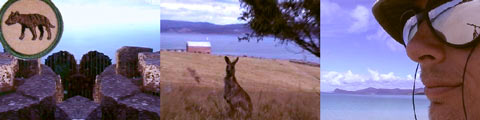
maria island, leroy black with the beach-shades
Understandably most hairdressers are psychic. Hair is your cosmic antennae after all, only one head-click away from the information supergooey. Yet monks are bald, so one has to wonder about the benefits of separation, of cutting connections with the rest of the known universe.

The Rest of The Known Universe
Tasmania’s Maria Island, as visiting new media artists find out quickly, is without easy net access. Options include park ranger seduction, or tapping into the global hive mind while dodging all those pesky Californian patent-pending pop-up banners. Tassie’s East coast more than makes up for this of course, with raw disk island power. Easily enough to feed the 30 or so ‘Solar Circuit’ artists gathering to mesh their southern and northern hemisphered antennae in this data wilderness.

In This Data Wilderness
Used to connecting machines with fun(k), the deeper opportunities of a remote residency seemed to be the chance to synthesise new thoughts / approaches to the triangle of technology, culture and ecology. And maybe the lush location lured a little too. Great place to kick zen outta beta. As we drift towards the great global uncontrollables, wondering whether radical preservationism or sci-tech ecology management will save the day, perhaps remembering our own place within it all, can provide the clarity we need.

The Clarity We Need
As the days revealed the layers, an exquisite collection and calibre of people and projects emerged. Introducing the mountains of Europe to the mountains of Tasmania, spanking machines, solar powered insects sound-blurring the natural artificial soundscapes, jobless robots, light painting in the midnight forests, stretching the tassie devil’s growl into sub-satanic terrain, inventing languages derived from the local surrounds, convincing a village to do ‘nothing’ for a week and making a film about it, retracing tales and journeys of Tassie aboriginals, the redcoats and the tassie tiger, and so on. Eco-themes were well threaded through these projects, and the tailors soon out sampling the island raw with a considerable arsenal of camcorders, mini discs and all-weather microphones. Mood-capture on the island happened slow, but even with lazier heartbeats, most itchy kids were soon ready to remix.

Ready to Remix
Verandah tea stories at some point revolved around plans to reintroduce the Tassie tiger with the preserved dna of a foetus in the Tassie museum. A museum member on hand relayed the plans, related camps of thought and it’s slim likelihood of success. Better perhaps than the two convicts chained to each other who tried to swim to freedom from Maria Island, one drowning halfway and the other taking a literal dead weigh to the other side only to die himself from exhaustion. Better, but still slim.

Still Slim
Did a lot of walking on the island. Stretches of beach, forest paths, mountain trails. Isolated places. Wild places. Is this wilderness? What is wilderness? At the remotest point of the island, chewing a fish caught by Spanky from Sydney, soaking the fire and ambience, we were reminded of the human touch in all places as a satellite passed overhead in the dusky sky. Hours later a fishing trawler echoed it’s engine through the evening, undoubtedly a few short of their catch quota from their legal fishing areas. Park rangers boasted the availability of electronic tracking methods that could trace a penguin to within a metre. Cost enough to buy a small car every week or so, but it added to a gradual sense of awareness that nothing is untouched despite it’s seeming isolation or rugged good looks.

Rugged Good Looks
Someone emailed me the other day:
‘Do you think a productive new media arts residency would involve a structured exchange of skills and technologies? Or do you feel that a more informal, friendship-based exchange of language, culture and ideas is sufficient to create a productive residency?’

Solar Circuit was definitely the latter, though I felt could have benefited from some on-site provocation with debates, forums or presentations to tickle each day’s exploration. Measuring the productivity of an informal residency should look at the long term conversations begun, the (re)combinations of cultures, skills, styles, experiences, but in the short term there was a snapshot available, Hobart exhibitionz, screeningz and island-glitchez, and shortly, projects at: http://www.solarcircuit.org

Jean Poole collects sky noise polaroids, vidi-yo calluses and writes for 3D mag.
((This article was printed in Real-Time, April 02.))

by Sean Healy, May 5, 2003 0 comments

Laptop Cinema, Anyone?

Scientist’s have found the part of our brain that responds when someone else’s similar sounding mobile phone rings. Turns out the test-subject even had a memory structure that mimicked an automated answering ‘service’. The kind that says ‘Press 1’ – if you’re interested in making short films, video clips or even features, ‘Press 2’ if you disliked Blair Witch, but were encouraged by the possibilities, and ‘Press 3’ if you’ve got one of those giant itches that say sk-k-kratch me please, scratch me allover, I got me a cinematics dying to get outta my skin.

Anyone
Without any student’s means now, is the capacity to make and edit a videoclip, short or even feature film. The higher the technical standards you set, the more time you’ll spend haggling to borrow equipment – but the camera’s, the computers to edit, and now the reproduction and distribution channels are all there. Burn a few discs on campus, or at a friends house, add a simple website, and you could be starting your own DVD label today~!

Pixels in Lycra
Hype aside, remains the merit of your ideas, your abilities, and perseverance in executing them. Can’t help that, except for maybe suggesting to czech out ‘Rebel Without a Crew’ by Robert Rodriguez, one of the best books on micro-budget filmmaking. What we can do here, is provide a light aerobix routine to get you in shape for effective pre-production, production and post-production. Know your tools and give your creativity it’s best chance. Sweating today mostly on Final Cut Pro, which is becoming the industry standard video-editing software for good reason – but PC editors can do just as well with Adobe Premiere. Vegas on PC ( www.sonicfoundry.com ) is also fantastically equipped to specifically match vision to music, and down that path one could also play with capturing the live output of VJ tools such as Vjamm(.com). Arkaos version 3.0 (out soon), and vdmx 3 for OSX (soon2), also promise strong performance and unorthodox production methods.

Revolutionary Final Cut Pro 3 ( Digital Post Production )
( www.friendsofed.com/books/dvision/rev_fcp3_dig_pp )
Fine flavoured intro to the merits and capacities of Final Cut Pro as editing software, compositor and post production tool. 5 authors offer their combined experience in final cut processes, editing techniques, system configurations, filters and effects, workflow and organisational interfaces, broadcast standards and internet & dvd delivery. While geared sometimes towards professionals who want to integrate FCP into their projects, the book offers a wealth of advice, tips and tricks for the first time user wanting to get their head around how to get their own lil vid together. Well toned, enthusiastic without overkill, and straight to the point succinct info. Also includes a DVD with all the source files needed for the tutorials scattered through the book, and extra material linked from their website. Book it in at your library.

The Complete Reference: Final Cut Pro 3
Richard Schrand
Billed as the ‘definitive resource for maximizing fcp3’, and put together by an Emmy winner, this book promises even more detail with it’s 700 odd pages and CD-rom. True enough, it delves into editing concepts, offers introductory mini-essays at the start of each chapter with the author’s anecdotes and advice nurturing a sense of understanding and at times inspiration. It comes across a little dry sometimes, but in the end for a reference manual, it’s full of much more than technical info. Also very well worth a book and borrow.

Revolutionary AfterEffects 5.5
( www.friendsofed.com/books/dvision/rev_after_effects )
Think photoshop in motion, the capacity to effect and manipulate visual imagery over time, and you’re almost thinking After FX, the perfect companion to Final Cut Pro. Available on mac and PC, this is a compositing tool with immense power, and a total of 7 cats outline here, it’s considerable scope. Building layers, compositing, introducing 3D, filters and effects, rendering, and overall managing of projects are all covered in rich detail, complemented by a CD-rom and case studies. The case studies show practically effective ways to use the program, and feature extensive walk-thru tips – showing how to generate elements, constructing scenes, produce and export characters, web site banners ( after fx & flash work well together ), and enhance clips set to music.

All above books available through www.mcgraw-hill.com.au

by Sean Healy, May 4, 2003 0 comments