Worlds in Flux DVD by Semi-Conductor

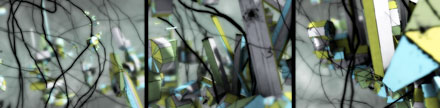
Mythic religions and deepest science use quite different language to say the same thing : the world we leave our little footsteps in, is a shimmer of light and vibration. Zooming in and out on that vibration, Semiconductor present a compilation DVD of their animations to date: “Worlds in Flux”.
worlds in flux

Getting To Here And Now
Semi-Conductor = Ruth Jarman and Joe Gerhardt and their PR blurb claims ‘obsessive interests in landscape, architecture, geology, geography, chaos / systems theory and artificial intelligence’. In practical terms (over the last 5-6 years) this has encompassed:
– exploring a large array of digital and analogue animation techniques and processes, combining where possible.
– many residencies, installations, exhibitions and live cinema performances
– ‘Hi-Fi Rise’ – an art DVD compilation in 2001 with an innovative interface, and featuring the work of many artists including People Like Us and Amon Tobin.
– 3 music videos, 4 live cinema pieces and 6 short films.

Spinning The Disc
‘Brilliant Noise’ is perhaps the highlight of the “Worlds in Flux’ DVD, featuring gorgeous black and white time lapsed animations made from close up photographs of the sun’s flicker and dance. That these photographs were sourced from a solar observatory and left unmanipulated was quite a surprise to read, a conscious decision to let the sun’s crackling glory stand on its own. 11 possible soundtracks can be chosen to accompany this dazzling monochromatic display, from artists including Cristian Vogel, Max Richter and Antenna Farm, each adding it’s own sense of atmosphere.

200 nano-webbers is another delicious animation, this one created as a visualisation for Japanese act ‘Double Adaptor’ using custom-made scripting to generate a lovely hybrid of seemingly drawn squiggles and complex structural behaviours and movements. The tangle of elements oscillate with the music and shift towards density interconnection as the song washes along. Very re-watch worthy.

Hooking up with the British Geological Survey nabbed a range of seismic data for Semi-conductor, which they exploited to great effect within ‘All the time in the world’. Converting the data into sound, they used this to jolt portions of a coastline into life, animating segments within a scene and slowly shifting from one location to another, drawing attention to the crust of the earth along the way. Particularly captivating were the fluttering sparks of light that hovered above one section of coastline, illuminating nooks and crannies as they travelled in and out of coastal rock formations.

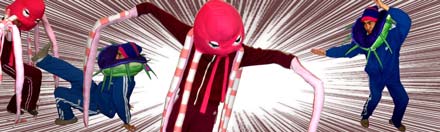
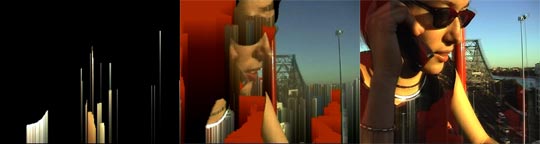
As well as with my favourite pieces above, the clips on the rest of the disc string together nicely as a range of experiments, each showing a different side of Semi-Conductors fascination with the micro and the macro, the buzzing life within structures that we take for granted most of the time. Notable mentions go to ‘The Sound of Microclimates’ which nicely superimposes animations on top of urban surrounds, ‘Inaudible Cities’ which reaches a stroboscopic, shuddering climax, Green grass of tunnel’ for mum, and ‘Earthquake films’, an earlier piece which reanimates a series of earthquake photos with a variety of masks, 3D experiments and collage play.

On another note, Fatcat records who are releasing this DVD, have of course made it region-free. What makes any larger label believe someone should have to buy another copy of a disc to watch it in another country is beyond me.

by Sean Healy, May 18, 2007 0 comments
Orinoko Flow

Like cyclone ravaged banana prices returning to ‘normal’, the subtropical delivery of Brisbane’s finest electronic musicians should be greeted with open arms by Melbournians this week.

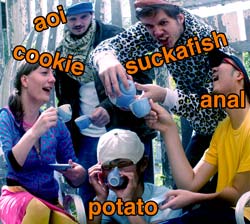
orinoko Orinoko Flow = Suckafish P Jones (MC + beats producer), Anal Cookie (noise terror hiphop duo) , Potato Masta (Osaka)(beats and the fastest Japanese rapping you’ve heard) and Aoi ( beats weigh a megatonne ). Seems they figured was best to combine forces for a tour of ‘bass-bin ruin’, and so the south gets em from May 17-20 ( details below ). Suckafish ( who also runs the radio show Forcefed Fistfulls on 4zzzFM ), jumped on the promo wagon:

If this is a ‘super-group’ – what super-powers does each member have?
Anal Cookie (Two Pants Rotation and Babymachine) – Stupendous gag reflex, ninja turtle flykicks and scare tactics
Aoi – Lazer eyes, fingers of steel!
Suckafish P Jones – summonin up the juju in yr underpants
Potato Master – Can open portals to parallel dimensions when funny dancin’

Having notched a fair bit of East Coast touring perspective, what distinguishes Brisbane, Sydney & Melbourne hiphop?
In Brisbane it seems like everyone’s a bit more fluidly involved in other scenes – so you get rock kids, electro wierdos and staunch hip hoppers comin to shows, whereas in sydney and melbourne peeps seem a bit more niche in their tastes. Music wise, again, its hard, but i’d say in brisbane we retain that tropical upfuckery that makes everything a lil more sweaty and wild…

Is it getting easier or harder to translate production into live performance?
Easier! I remember when we used to have to bust this out with cheap cd-rs and a couple of discmans… now its all laptops, trigger fingers, final scratch… i think there are more and more options for live sample playback, loops etc. meaning that hip hop and electronic performance is becoming waaay more dynamic

Recent inspirations musically / lyrically?
Growing obsessed with Grime and Dubstep – it’s a pretty regional sound (UK), but I feel like that energy in Grime really works in Australia… when it gets hot here, we get crazy, and the whole hyped up, souped up tempo thing is just on fire! It’s just got an energy and immediacy that is missing from Hip Hop at the moment, it’s got that really new, raw and exciting quality that’s unavoidably infectious. That, and an unhealthy obsession with early 60’s electronic music and international machine obscura keeps me awake late into the early morn with the headphones on.

So how does the tour work – you all playing together?
We’re comin to melbourne as more of a sound system, broken into individual acts, but even when we don’t play together in a single set our sets will collide with one another… Potato Master brings his patented trans-global gameboy ragga humour to the plate while Aoi stirs the pot with stuttering boom bap and clunky drums, suckafish increases the pressure with bass, lyrical absurdities and a lil bit of voodooand Anal Cookie tear the whole place apart and bleed neon from their scabs

What’s your own current live set-up, and what would you like to improve about it?
Generally ableton live, triggered from an MPC=like controller, the Trigger Finger, with vocals from guest MCs or myself if the occasion calls for it… I’m always wanting to integrate more live instrumentation, particularly percussive elements to make the show more and more visceral

Gigalicious
Thursday May 17 – Potato Master at Uber Lingua w/ Suckafish on DJ duties as the Fishmonger General
Friday May 18 – Suckafish and Aoi play Rogue State at th North Bazaar in Northcote (while Anal Cookie play down the road w casionova at the afterdark!)
Saturday May 19 – Anal Cookie, Potato Masta, Suckafish P and Aoi play with Curse ov Dialekt, Makkenz (Japan), MC Purple Duck and more at the Corner Hotel for the ‘Ockerchino Variety Show’
Sunday May 20 – AOi and Suckafish play w heapsa cats at ‘Rap Sabbath’ at Bar Open, ( launch party for El-P’s ‘I’ll Sleep When You;re Dead’).

Videoclip featuring Potato Masta & Alan from Anal Cookie here.
giant idiots

by Sean Healy, May 11, 2007 0 comments

Collaborative Films

All films with two or more people are collaborative, but there’s a wide range of films trying new ways to exploit current technologies for film production and distribution.

sky noise polaroids

Pssst Pass It On
The mission of PSST? “Produce original short films through the collaboration of different teams of designers, directors, and animators. Each film is comprised of three sections produced by three different teams. This process is the whole idea behind PSST! – a technique derived from the Dadaist game of Exquisite Corpse and the children’s game Telephone and applied to the arts of motion graphics, animation and film-making. There are nine films made through the collaboration of different teams of designers, directors, and animators.” Gorgeous range of styles too.

The 1 Second Film
A non-profit collaborative film being produced by thousands of people around the world. Anyone can help produce this film by donating as little as $1. Worth a look, this is quite an involved project with five phases… which starts with a 1 second film and ends up with an 11,111 Second Film – a narrative movie lasting 11,111 seconds (approximately 180 minutes). The film will be divided into two parts, a 90-minute animated feature film followed by a 90-minute credit-sequence with ‘making of’ documentary. The 90-minutes of animation will be narrative, with an original story to be written by an established screen writer. The 90-minutes of animation will be made during thousands of simultaneous events around the world, with each event making one-second or more of the animation.

Swarm Of Angels
Good range of creatives gathered on this, with good momentum. The plan is to create a £1 million film and give it away to over 1 million people using the Internet and a global community of members. Key features:
* Participative – Vote on major decisions, including which of two scripts goes into production. Post on the forum.
* Open source – Contribute to development and production through script input, materials creation, or be part of our distributed film crew.
* Creative Commons-licensed – Freely share the film. Sample project visuals for your own work.
* Crowdsourced – Feedback into the production, use your expertise, and become part of the team.

The Basement Tapes
“Everything we know about copyright has been turned upside down. From mash-ups to filesharing, creation to distribution, everything is in flux.Thats what I want to explore in this documentary…. it needs your help to be made – thats why Open Source Cinema exists – to faciliate online collaboration – to create a participatory way to discuss these issues.” Script viewable here – http://www.opensourcecinema.org/wikifilm

Your Broadcaster
“A test whether a film can be done with most of the major production decisions made through an online social network.”
Members of the YourBroadcaster social network can become involved in 5 different movie projects ( bollywood, horror, thriller, drama and comedy ). Members will be able to upload scripts, auditions, characters, etc that will be voted on by all members to determine what will be used in the movie project. Subscription fee of $10 (one project) to $35 (multiple projects) is required for full participation. Advertisers can also get in on the movie making action with opportunities of product placement within each movie.”
David Lynch had a nice line on product placement in a recent interview : ” Bullshit. Complete fucking bullshit.”

XIFilm
XIFilm is one of many films claiming to be ‘the world’s first feature film created entirely over the Internet’, but interestingly offers the option of joining a Production-Assistance Team (non-artist types who can offer “idle” computer time for the production team by downloading and installing the XIFilm screensaver).

Awesome, I Fuckin Shot That!
Bustin’ wide their camera crew list to include 50 members of the audience, this Beastie Boys concert doco was made with footage from a few higher quality cams on stage and 50 video cameras handed out to audience members with instructions to ‘keep on shooting’.

Echo Chamber Project
“An open source, investigative documentary about how the television news media became an uncritical echo chamber to the Executive Branch leading up to the war in Iraq. By developing collaborative techniques for producing this film, then this project can potentially provide some solutions for incorporating a broader range of voices and perspectives into the mainstream media. To that extent the project is well documented, there’s an interesting and complex diagram explaining a collaborative filmmaking workflow and a rant on the implications of being able to export Final Cut Pro projects into an XML format. Which means – ‘because Final Cut Pro supports XML, you are no longer limited to creating clips, bins, and sequences within Final Cut Pro. This means you can create your own Final Cut Pro projects outside of Final Cut Pro, using any software or platform you want, as long as you generate a valid Final Cut Pro XML file.’ Or in other words, potentially an open source content management system like Drupal could be used to collaboratively edit a film.

There are three end products for The Echo Chamber Project:

1.) A collaboratively edited 90-minute documentary film about how the mainstream media became an uncritical echo chamber during the lead-up to the war in Iraq.
2.) A set of open source tools and methodologies for participatory journalism and collaborative film editing that is sustained through a viable business model.
3.) An online, interactive collection of transcribed video segments that are annotated and filtered with user-contributed context and meaning at www.echochamberproject.com.”

by Sean Healy, April 30, 2007 4 Comments

Half A Ferris Wheel

Hovering in late night carnival shadows offers many flavours of revelation. In Melbourne recently : the actual construction into being of a Ferris Wheel, later propelling peeps into the sky. In Sydney currently : an underbelly of provocative performers brought to the surface with Autonomous Improvisation v.1 : a video exhibition by Wade Marynowsky @ Artspace (19 April – 19 May 2007).

autonomous spanky

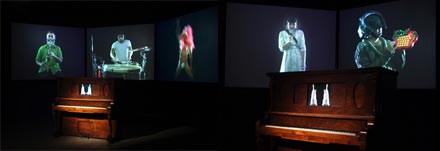
From left to right : Jim Denley, Robbie Avenaim, Trash Vaudeville, Singing Sadie, Toy Death.

“Le Spanky”
Anyone who has seen Wade (aka Spanky, aka AC/3P, aka The Geek from Swampy Creek ( etc etc ) and most recently a founder of the Demux live audiovisual DVD label) perform with his *wearable-sample-triggering-kangaroo-suit* will understand his long connections with all shades of colourful and crazy. This history is woven together nicely with Autonomous Improvisation v., where Wade has video-recorded a range of performances in a studio environment, then arranged 3 channels of audio-visual projection to orchestrate video sequences – which are triggered by a prepared pianola linked to the network of computers playing the clips in an ever-changing composition. Messy sentence, well exceuted concept. And word on the wire is that the show = rad, which is to be expected with people like Matthew Stegh, Toydeath, Lucas Abela, Singing Sadie, Robbie Avenaim, The_Geek_From_Swampy_Creek, Adrian Bertram, REV. KRISS HADES, Kristina Harrison, Jim Denley, Dallas Dellaforce, Shannon O’ Neil, Peter Blamey & many, many more involved. More info : www.demux.org

Video Software Updates
Another batch of video production software overhauled recently, with both Apple & Adobe announcing new releases. Final Cut Pro Studio 2 brings a host of changes to the Final Cut Pro editing software : a new ‘open format’ timeline which allows footage of different formats and frame rates to be edited together in real-time, a new uncompressed HD format for editing with, 5.1 surround sound output and better integration with other tools. Motion, their motion graphics package is upgraded to 3.0 and features more particles, vector based paint strokes and very easy to use 3D motion graphics. New to the stable? An application for colour grading, called ‘colour’ except spelt the yankee way. A dedicated tool for colour grading at all levels of resolution, suited for developing ‘signature cinematic styles’.

Adobe’s After Effects 8 / CS3 delivers new shape layers, better photoshop and flash integration and a puppet tool which includes many ways of intuitively bringing to life animated characters. ‘Brainstorm’ adds a new interface to offer animated variations based on selected design and animation parameters. Alongside AE, Adobe has re-introduced the editing software Premiere for the mac, the competition hopefully proving fruitful over time. Photoshop CS3 includes a major upgrade to everybody’s benchmark image manipulation tool, but also a new capacity to import video onto an ‘animation timeline’ for painting on top of ( or rotoscoping ).

Downloadables
www.vidtaker.com provides yet another way to more conveniently download online videos from video hosters such as youtube, break, google video, myspace, etc etc. Download the Firefox extension, this enables right clicking on any page with a video and then gives a pop-up selection via for downloading the file as an editable avi divx.

by Sean Healy, April 30, 2007 0 comments

VJ Book ( Yet Another.. )

vj book
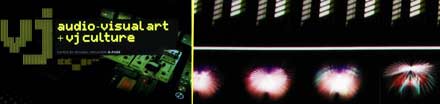
Next up on the coffee table >> VJ : audio-visual art + VJ culture, edited by Michael Faulkner / D-Fuse, published via www.laurenceking.co.uk, with bonus 130 minute DVD.

“For many, vjing is a dirty word. artists view it as eyecandy for the clubbing generation; musicians view it as a secondary accompaniment to their music. at best, vjing is regarded as audio-visual wallpaper, not worthy as a serious consideration. yet to my eyes, the best vjs are creating a new fluid interface between sound and image – one that is genuinely mould-breaking and aesthetically invigorating, and one that deserves to be recognized as a 21st century art form.”
– Michael Faulkner

Michael Faulkner aka D-Fuse is primely perched to edit/curate a book on VJing – well travelled as visual performer and graphic designer, an extensive array of profile gigs under his belt, and well hooked into the sprawling VJ networks. Coming from an artist inside the ‘scene’ then, the book is packed with useful insights, laid out with visual flair that respects the work ( and in full colour throughout too! ).

Alongside various new media / video art / motion graphics books that squeeze VJing into a few pages, ‘VJ : audio-visual art + VJ culture’ also slips onto the bookshelves next to a few books dedicated to documenting the global VJ practice. The VJ Book ( from Feral House ) included many interviews by a journalist with an outsiders view, but suffered from a lack of visual displays of the culture and processes it discussed. Live Cinema Unravelled ( available as a free PDF ) managed much sexier design, was written by someone immersed in VJing and came bundled with a lot more theory – aiming to dissect the role of the VJ against such topics such as ‘technological mobility, audience, environment, and codes of the medium’. Thumbs up, full review later.

Interviews with VJs the globe over makes up the bulk of VJ : audio-visual art + VJ culture, artist interviews from a significant spread of nations complemented with a range of live performance photos, and video stills, laid out stylishly and vividly demonstrating the diversity of aesethetics and approaches with live video. The DVD immerses even further, with a range of live performances, videos and documentaries of The Light Surgeons, Cold Cut, Hexstatic, D-Fuse and more. It’s a compelling package, the artist interviews supplemented by a range of specialist articles written by various VJs.

Bram Crevits whirlwinds us through an historical overview of ‘the roots of VJing’, taking in the expanded cinema of the 1960s, fluxus video art of the 60s and 70s, the ‘magic lantern’ (an oil lamp, with lens and pictures painted on a glass plate, creating live animations back as early as 1671 ), live animation devices of the 1800s, the development of cinema, the evolution of music videos, concrete music, electronic media, the graphical user interface in 1984 and gives good context to today’s pixel manglers.

Adrian Shaughnessy, further contexualises contemporary VJing (Last night a VJ zapped my retinas) :

“The digital artist is really an editor. We can generate imagery ad infinitum; the skill is to know what is good, what should be kept and what should be discarded. This is the art of editing and it is also the art of VJing. .. VJs often have to do their editing live, in front of an audience. It is one of the factors that makes VJing such an exhilarating ride for both the audience and the VJ.”

“Science and technology multiply around is. To an increasing extent they dictate the language in which we speak and think. Either we use those languages, or we remain mute.” – J.G Ballard ( as quoted in Live Cinema Unravelled )

Chris Allen of the Light Surgeons scribes a piece on sampling, arguing it is a technique that “allows us to see the components of our language in isolation – the bricks that then may be used to construct new meanings.”

The overview of technology and creative process by Vello Virkhaus is comprehensive and insightful, documenting processes from storyboarding with clients / collaborators through to venue design and live performance.

Elliot Earls, who looks like he has an intriguing live show, talks of need for VJs to work more closely with musicians, or better yet, to compose music themselves, if they are to move beyond merely being in service to musicians in a manner resembling ‘info-burger flippers’. Robin Rimbaud’s (aka scanner) article “listening to pictures” might provide some help in that regard, offering tips on a/v from a sound perspective.

light surgeons rig
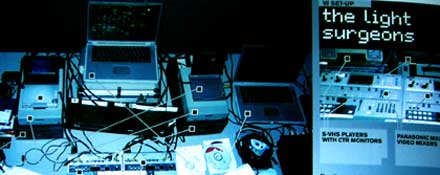
The book rounds out with a decent coverage of hardware issues – different screens ( shapes, sizes, materials ) , advice on projectors, mixers, midi, computers, and graphics cards etc, a less potent software overview (only 8 of the dozens available profiled ) and an excellent selection of personalised diagrams profiling a dozen or so onstage-set-ups for major Vjs around the world. These are especially fascinating, usually a blend of hi and lo tech, expensive and cheap gear, to help create their custom look and processes.

by Sean Healy, April 16, 2007 3 Comments