Standard Operating Procedure

errol morris

Deconstructing the photographs of Abu Ghraib with Errol Morris.

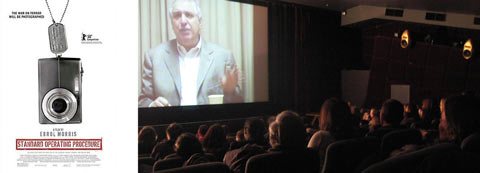
Melbourne’s Cinema Nova recently screened the latest Errol Morris documentary, and a few minutes after it finished, cut to the director on the screen, who chatted and answered audience questions enthusiastically for some 45 minutes via satellite ( or skype / ichat ). Felt quite the privilege to have such direct access to Errol, straight after his compelling and confronting exploration of events at Abu Ghraib, hearing his clarifications and reasonings behind his film making decisions. And felt surprisingly natural to have the director on screen at the audience’s disposal, a pretty effective way of distinguishing a cinema house from a home theatre, likely something we’re going to see more.

“Cinematic interventions? Oh, that makes me sound like some kind of psychiatric social worker.. ( much audience laughter ), ” was his response to an early question about his use of heavily stylised renactments within the film.
“I liked to think of them as ‘visual moments’ .. and the most important is that the filmmaker seeks truth, then the techniques available can be used in service of this.”

The truth Errol seeks in Standard Operating Procedure is the wider context and realities surrounding the events in the Abu Ghraib prison in Iraq. The prison received global attention in 2004 when photographs were released detailing many instances of humiliating and degrading behaviours and events seemingly being orchestrated by U.S. prison guards. Central to Errol’s film is examining these photographs with a range of interviewees ( including several of the guards ) and forensic experts and trying to piece together what actually happened, and to what extent the individuals charged and imprisoned were acting according to their own impulses or to instructions from above as part of a larger system.

A few key points jumped out from the screening :
– although a military prison, the majority of those imprisoned were local males of ‘fighting age’ who had been gathered from the streets for various minor or alleged offences.
– The photographs shown were from the ‘softening process’, something that was used before the prisoners were sent to be tortured. This was a preparation phase, and the public hasn’t seen photos from the ‘torture phase’.
– the guards repeatedly described how they had arrived into and were consistently given instructions from above.
– No-one higher in rank than the low ranking officers witnessed in the photographs has been charged or imprisoned, despite one of the photographs containing the dead body of a man who had died during torture, effectively having been murdered in prison.

The film is disturbing on many levels, and achieves it’s power in part from the way Morris interviews his subjects – he uses what he calls the interrotron ( see diagram : http://tiny.cc/iSgsv ), a camera technique he invented using a teleprompter to show the interviewers face in front of the camera lens, which allows the interviewee to make eye contact with the audience. And so much of the film involves U.S. military prison guards detailing explicit and depraved scenarios but while seeming to stare across with coffee table intimacy. In the Q+A afterwards, Morris was asked about this and pointed out that the person asking that very question had to choose between looking into a camera and looking at Errol on the screen, but couldn’t do both, hence Errol was seeing video of someone who was looking off to one side

Errol’s Got A Pedigree
The Fog of War – about the life and times of former United States Secretary of Defense Robert S. McNamara, won best documentary academy award in 2004, but several of his earlier documentaries weren’t nominated as his various experimental techniques ( in the service of telling the story ) caused concern with the oscar givers.

The Thin Blue Line – investigated the murder of a police officer and famously helped someone facing the death penalty in texas get released, and introduced stylised renactments as a controversial technique for documentary making back in 1988.

A Brief History of Time – documented the life of physicist Stephen Hawking.

Fast, Cheap and Out of Control – a lion trainer, a topiary sculptor, a mole rat specialist, and a robot scientist, got the specialised Morris doco-treatment.

Mr. Death: The Rise and Fall of Fred A. Leuchter, Jr – interviews with an execution technician (!) who is also a holocaust denier because he cannot conceive that the Auschwitz gas chambers were technically possible ( not that Fred has researched this much at all ).

Gates of Heaven – Errol’s first documentary about a pet cemetery business – and which spawned a short film in response : “Werner Herzog Eats His Shoe” in which the German director held up his part of a bet and cooked his shoe on stage with herbs and garlic then ate it upon Errol’s finishing the film.

by Sean Healy, July 10, 2008 0 comments
Kurt Vonnegut’s Oily Crystal Ball

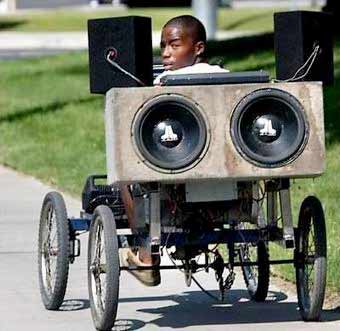
He’s dead now, but the legendary comic novelist Kurt Vonnegut has been predicting today’s ever-escalating oil prices for a long, long time.

“I once had a high that not even crack cocaine could match. That was when I got my first driver’s license! Look out, world, here comes Kurt Vonnegut.”
– K.V, 1994.

Kurt Who?
From Player Piano in 1952, a dystopian novel where human workers have been largely replaced by machines, through to a collection of post-humously published works in 2008 ( Armageddon in Retrospect ), the somehow simultaneously cynical and warm-hearted worldview of Kurt Vonnegut has been spilling onto the page of novels, film scripts, tv scripts, articles and essays. He’s funny too. And has an asteroid named after him ( 25399 Vonnegut – thanks wikipedia ). There’s probably a 2nd year arts student buying one of his books in a second-hand store right now. So he had it going on, wild leaps that were science fiction in scope, an ability to point out the absurdity of human endeavours, and as it turned out, he had a thing against oil.

Oil currently accounts for about 43% of the world’s total fuel consumption, and 95% of global energy used for transportation. Oil and gas are feedstocks for plastics, paints, pharmaceuticals, fertilizers, electronic components, tyres and much more. For every one joule of food consumed in the United States, around 10 joules of fossil fuel energy have been used to produce it. ( energybulletin.net )

Back in the Day
Part of what made Kurt Vonnegut unique his experiences in World War II. As later documented in the semiautobiographical ‘Slaughterhouse Five‘ ( novel and then a film), he had been captured by Nazis as a 21 year old and sent to Dresden, where the Allies dropped enough powerful new bombs to reduce the fireballed city to lava-hot rubble, and killing all of the mostly civilian population of 135,000. Incredibly, Vonnegut and 6 other prisoners were in a meatpacking storage cell during the raid, and emerged upstairs to a destroyed town. That’ll make an impression.

1973
This was the year Kurt had finished Breakfast of Champions, another book later to become a film, which explored the relationship between an insane car dealer and a pulp science fiction writer – whose plots for various stories were outlined throughout the book. 1973 was also the peak of the seventies oil crisis, and so it’s not entirely surprising that one of these sci-fi plots involved a dying planet called Lingo whose inhabitants resembled american automobiles. The planet is visited, and the idea of the automobile was brought to earth by aliens who “did not know that human beings could be as easily felled by a single idea as by cholera or the bubonic plague. There was no immunity to cuckoo ideas on Earth.”

“So what is the principle exactly underpinning your 5 cent a litre cut? If it’s to ease the pain to the tune of about $2.50 a week, what do you do when the price of petrol goes up to $2 a litre and then $2.50 a litre. Do you continue to ease the pain by coming up with another 5 cents a litre cut and another 5 cent a litre cut? Is that really smart policy when you look at the total global picture of what’s happening with oil as a diminishing commodity in a world where oil is contributing to greenhouse problems?”
-Kerry O Brien, on the 7.30 Report slowly grilling the Opposition Climate Change Spokesman, Greg Hunt.

2004
“Can I tell you the truth? I mean this isn’t like TV news, is it? Here’s what I think the truth is: We are all addicts of fossil fuels in a state of denial, about to face cold turkey. And like so many addicts about to face cold turkey, our leaders are now committing violent crimes to get what little is left of what we’re hooked on.”

– K.V, ‘Addicted To Oil And Violence‘.

So It Goes.

by Sean Healy, July 3, 2008 0 comments

Podcasting 2008 Stylee

What’s been happening in the world of audio subscriptions and downloads?

The Elevator Pitch
boombox Podcasting in a nutshell? The publishing of audio files online in a blog-like manner, which enables them to be subscribed to with podcast software ( eg getmiro.com, juice receiver or itunes ), for automated downloading, first to a computer, and then to an mp3 player if desired. Which means two things – firstly, it has become very easy to create what is effectively your very own radio station ( with global reach ), and secondly – there is a vast audio universe of delights awaiting your earbuds.

The Public Transport Pitch
Podcasts have been around for a while now though, so what has risen to the top? What’s worth listening to on that tram ride through the grey boxes? There’s a few problems finding out – so much exists, and then – the usual crap-to-gold ratios apply with podcasts just as they do in any other media, but audio is much harder to search through than text, so it’s harder to cover as much ground and find that uniquely satisfying quirky just-suited-to-you kinda thing. There’s a few audio search engines around ( eg http://audio.search.yahoo.com, woonz.com ) but not so many like podscope.com which allows searching for words inside of an audio podcast or video file. And then there’s the robots.

Useful if dizziness can be avoided, there’s also a huge range of podcast directories to allow browsing of categories :
podcastdirectory.com, podcastdirectory.com.au, podlounge.com.au, podcastdirectory.org, podfeed.net, podcastdirectory.org.uk, podcastferret.com, odeo.com. More specific directories?
Radio National’s MP3 audio and podcast service: abc.net.au/rn/podcast/default.htm
Several podcasts over at: sbs.com.au/podcasting and bbc.co.uk/radio/podcasts
50 public radio stations and producers with the National Public Radio in the states: www.npr.org/rss/podcast/podcast_directory.php – .
And there’s also the in-built podcast searching within itunes ( apple.com/podcasting ) which allows easy browsing, selecting and subscribing.

Much as giant impersonal databases are fun, actual humans are pretty useful for recommendations too. Two long lists of favourite podcasts : via Textism, and via Shannon O Neill ( Syd sound-scaper ).

Some of my recent faves :
( Podcast links below, right click to copy URL, paste into itunes or podcast software of choice )
Chasing the Tangent, fortnightly mix by Sofie Loizou, Plum Industries, fortnightly mix by Jen Teo, DJ Rupture’s Mudd Up! on WFMU, Dublab – Live sets by guest artists, Night Air – weekly collage soundscape eclectic themes, Ed Banger Records – occasional DJ mixes, Radio Lab.

Video podcasts? Find some of the Creative Cow Final Cut Tutorials, After Effects tutorials pretty useful :
And recently started pumping some video into this subscription friendly location : http://jeanpoole.blip.tv/rss/itunes

The Bedroom Pitch
Aye aye, DIY! Once audio files have been made, the trick with podcasting is just making those files published in a way that allows podcasting software can auto-detect and download them. This can be achieved with code ( adding an ‘enclosure’ to your feed ) or with simple plug-ins for a blog ( eg Podpress for the wordpress blog software ) that allow easy uploading and auto-embedding etc of mp3 files. Even simpler? Free hosts : libsyn.com, podbean.com, odeo.com and much more.

by Sean Healy, July 2, 2008 0 comments

Gangster-Free* Winter Arts in Sydney

underbellyUnderbelly @ Carriageworks
July 3 – 13, 245 Wilson st, Eveleigh, halfway between Macdonaldtown and Redfern stations.

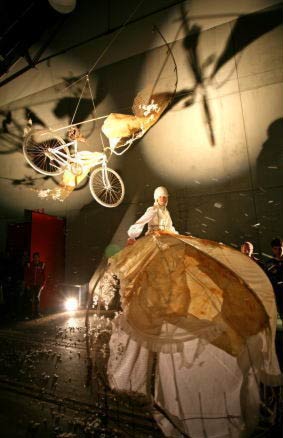
While at first glance, it might seem as enticing as a community mosaic mural event or an amateur bongo night ( both great for participants but not necessarily audiences), this actually looks like a lot of fun – a public lab from 3-10 July, where a large range of artists converge to create art projects under the public gaze, with the aim of performing and presenting their work within the 2day Underbelly festival Jul 12 ( midday – 11pm ) and Jun 13 ( 2-10pm ). What makes it look interesting is the calibre and diversity of artists involved, and the range of projects they are aiming to complete. Clicking ‘artists’ at the site, reveals AV tagteams performing sets in a geodesic dome, artists trying to ‘make the narrative film process physical’, theatre groups with flying machines, an inflatable sideshow theatre, experimental tactile mixing interfaces, aerial acrobatics against video, bicycle powered projections, shadow-puppets, multimedia hiphop, a Mekanarky industrial sculpture retrospective, hanging gardens and floating sculptural speech balloons, kamikaze couture and muchos moros. People are encouraged to wander in to see the works in progress during the lead-up ( hence ‘public lab’ ), and then witness the end result on the 12th+13th.

Sydney Biennale Highlights?
To be honest, whether the site is to blame or not, couldn’t find much of interest within it. There is a free collection of films screening at the National Gallery every Wednesday, 2:00pm and 7:15pm, and every Sunday, 2:00pm ( Hans Richter, Alfred Hitchcock, Robert Breer, Len Lye, Dziga Vertov, Michael Snow etc etc c’mon down… ). Also notable – a free ferry shuttle to Cockatoo Island in Sydney harbour every hour, seven days a week, in aid of getting people to various art events there. Might try and coincide a free harbour ride with the Shaun Gladwell talk on Sunday. Elsewhere? A bunch of talks and performances, exhibitions as you’d expect, but not much that really jumped out. Again, maybe the website wasn’t really selling it, which seems odd given the scale of the biennale…

(* ie not this )

by Sean Healy, June 19, 2008 0 comments

Aphids Reel Music Festival Jun 26-29

dvdtokyo
Tight little package of 4 events just about to launch in Melb – each event with its own twist on audiovisual interplay. The opener and closer are probably easiest to digest, live soundtracks being performed to films, though each with their own take on that. Opening night catches ‘Waiting to Turn into Puzzles‘, a hand processed Super8 film by Louise Curham being projected, while the five member Sydney ensemble Offspring perform music from hand water-coloured muscial scores that incorporate screen captures and imagery from the film. Closing night brings a classic 1928 Hans Richter animation to the screen, Vormittagspuk, accompanied by live score by Genevieve Lacey and Geoffrey Morris.

Skin Quartet on the 27th projects various skintones and textures by visual artist Louisa Bufardeci onto the screen, accompanied by David Young’s music, which, was created by CIA Factbook data on ‘ethnicity, skin colour and nationhood’, each note corresponding to an onscreen element visible on the skin. Where that places the project on the sliding scale from pretentious to profound, who knows?

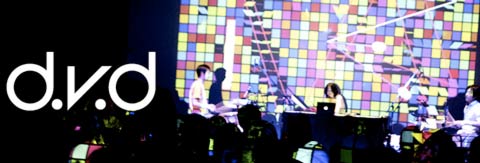
d.v.d from Tokyo bring a drum-triggered visual show on the 28th, which apparently finds tight sequences of retro-game animations launched by the drumming, each of the animations in turn bringing their own sounds, and determining the progress of the drumming.

ACMI, Melbourne. Thu 26 – Sat 28 Jun – 8pm, Sun 29 June – 4pm
$20 Full $15 Conc. Festival pass : All 4 sessions $50 Full $40 Conc
Tickets, full program details : www.aphids.net ( check the cool animated promo – 33mb tho )

by Sean Healy, June 19, 2008 0 comments