
V-Track Review

Gaff tape is an indispensable and versatile part of any electronic artists toolkit. It’s especially useful for wrapping round the lips of the too gadget conscious and those who talk tech underwater. Gaff tape can also help mimic a blind person’s sensitivity to sound, as most sensory deprivation float tank fiends may appreciate. U&I Software undoubtedly have many rolls of gaff tape in their soft-warehaus, having created metasynth which creates sound from images, artmatic which creates animations and now V-Track – a multi-track video art and special effects tool for up to broadcast quality video and DVD authoring.

Breakin’ It Down
Basically: V-Track is a video sequencer of sorts which intends to bridge all of the U&I software apps, sequencing both audio and visual elements from any of their apps to produce customised video, transition and titling effects. With easy bpm grid-structures, VTrack’s tools, effects and interface make particularly suited for creating music video, with lots of post-production scope for anyone wanting to tweak it’s parameters til things melt n’ mutate.

VTrack can be used either as a standalone video editor/sequencer for creating and rendering high-resolution, professional-quality QuickTime output or alongside traditional editing software. The built-in tempo-based grid makes VTrack especially well-suited for creating music-based video, and each of VTrack’s eight tracks can have its own transfer mode, allowing complex track interactions not easily implemented with traditional video editing tools.

So you’ve got these 8-tracks right, and you can mix QuickTime movies, DV streams, still images, and custom effects and animations from U&I’s Artmatic software, but what makes V-track any different or better than say adobe premiere, final cut pro, after fx or other video editing software? Mostly it’s simplicity, the one window V-Track interface benefiting from Eric Wenger’s (Bryce) simple and intuitive design, and an easy learning curve that gets you remixing pretty quickly. While it lacks the depth of control of the above software, it does allow an endless variety of special effects, filters and transitions to be created, by the way it integrates the ArtMatic rendering engine into it’s sequencing. ArtMatic Pro ‘systems’ can be imported into VTrack and used to process VTrack’s tracks.

VTrack also provides a powerful built-in library of video effects, and the VTrack CD includes a library of over 3,000 ArtMatic presets that can be used in VTrack projects to provide decorative elements, special effects and a huge range of transition effects and color processes.

What You Need
mac os 8.6 or later, recommended g4 but works ok on g3/333. And cash – yer lookin’ at US$249 for a web delivered app, $US299 for a CD-ROM $299 and US $499 for a version bundled with the ArtMatic graphics and animation synthesizer.

Bonus Points
A very easy intuitive interface and learning curve that lets you make interesting video quickly.

Buggy Bits
U&I claim cutting-edge motion graphics, but some of the effects lack customisation and control and suffer from a little cheesiness? In the end it’s a powerful and easy to learn tool that is a useful addition to any vid-headz toolshak. See http://www.uisoftware.com for more.

by Sean Healy, May 14, 2002 1 Comment
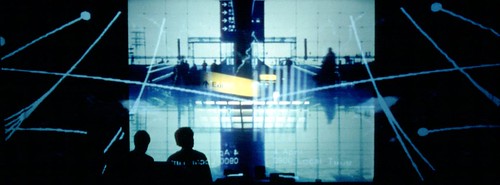
Real Electronic Virtual (REV festival) 2002

Software be a flow, not a fixed product, and if you paddle your audiovisual canoe along to the riverside Brisbane Powerhouse on April 5-6th, chances are you’ll catch quite a few interesting snapshots of code in motion, where the Real Electronic Virtual festival brings together a range of innovative and experimental instrument makers and sound artists. Check the quite inspired program of gigs, workshops, presentations and installations :
www.brisbanepowerhouse.org/02_program_2002/rev.htm

What are some of the exciting aspects of sound-tech REV’ll explore?
REV is about experimental instrument design as well as experimental sound. So to that end you’ll see a whole manner of instruments. On the tech-front there’s Melissa Madden Gray’s midi jump suit which triggers sounds and vision using MAX/MSP and Image/Ine as the interfaces, Stuart Favilla’s light harp, Paul Cohen’s generative paint styled virtual instrument titled MooZk, and Tim Opie’s tactile granular synthesis engine operating in the Powerhouse lift.

What are some of the more unusual ‘instruments’ being showcased?
There’s a whole range including a massive pryophone, Jon Rose’s Hyperstring performances, amplified cacti and a huge circular harp. There’s also over 20 interactive installations.

What aspects of digital manipulation offer genuinely ‘new’ approaches to sound?
It’s such a relative concept – dependent on the audience at such an event. At one end you have people who’ve only ever heard pop music or dance music on wild fm compilations, so when they hear programming of artists such as squarepusher it’s a complete revelation to them that digital music can sound like that.

Sound labs like Ircam are constantly refining technology and various sound application. MAX/MSP really allowed digital sound artists the chance to turn their sonics inside-out and that was very exciting. I think genuinely new sounds come from those contemplating sound in different ways, looking for new combinations, new approaches of working the sound to a space and exploring sound in different contexts.

What’s your own “Composition 11” about?
Composition 11 is actually a vinyl score by DJ Olive, an idea he came up with based on taking three identical records, comprised of various sounds and scapes and combining those together. Each composer or DJ paints their own sound portrait from the palette available on the records. I’ll be composing a score for DJ Olive’s label later in the year titled Continuum, exploring the ideas of found sound, environmental recordings and sound elements distinctive to Australia.

What sort of audio / video crossover happens at the festival?
Several of the installation pieces work with vision and sound. Scanner and myself will be using three projectors on the walls of Brisbane Powerhouse. That installation Biospheres: Secrets Of The City explores the hidden resonances and meanings of sound and image that lie beneath our everyday surroundings. In that piece we’ll be combining various sound and vision elements collected in and around Brisbane and will reconstruct those into an alterative view of the city.

Some musical highlights?
Numerous theatre performances from the likes of Jon Rose, Linsey Pollak and Graeme Leak, and Fabrique: late night electronic music. Friday 5th has live sets from Pimmon, Hydatid, Hutt River Space Agency, Aniki, Tam Patton and Diaspora, and Saturday 6th has Oren Ambarchi, David Toop and Scanner.

Gigs aside, what sort of workshops and presentations will be on offer?

A number of workshops will be hands on for people interested in getting their hands dirty. Also Bart Hopkin will be deliver some lectures as will David Toop and Robin Rimbaud.

by Sean Healy, May 14, 2002 0 comments

Eye-fi Inter-voo

Trapeze hands raw like sushi, escape from the party meant perfectly sync-ing a 3 storey swing with fairylights to a rapidly approaching motorcyclist below. Unsquinting at the task, the fresh from artskool babe landed on the beat in the swivelling sidecar beside the suave and lanky scientist whose genetically modified scarf flapped calmly in the breeze. The dashing duo silhouetted in the setting sun, were of course, Sydney’s Eye-Fi, motion graphic specialists on their way to an important interview:

The Eye-fi Audiovisual experience in your words?
2 speed video gear change. hi or low is the way we go.

What technology and processes do u enjoy using?
Eyefi enjoy tending our a/v crops. they grow and we harvest them. Over the fast last 5 years our process has changed. We used to sample + recomp + program image/effect sequences, but now we design + animate from scratch and access tanks of QTmovies. Effects come later in the design and patch process.

What crops are on the Eye-fi farm?
Mutant crop rotation, now havesting with nato… and minimal design

How much do eye-fi hi-5 the lo-fi?
Love lo-fi. Many powerbook artists who use the p.b. as fx unit are suffering from low frame rates. now it just looks like the fashion.

Inspiring artists / events at the moment?
Visomat.de :: nam jun paik :: all music video clips ::fashion tv…the endless catwalk mixed with cheap & nasty graphics :: L.E.D. screens :: try to catch the bbc world news every 15mins :: go to ars electronica, austria :: get out of australia.

3 technologies u’d like 2 invent?
001 powerbook with 8 video out puts using nato to control.
002 telephone in a shoe
003 bioports for everyone

Reasons people should visit http://eyefi.tv?
eyefi.tv is for the slow laidback net user who likes waiting to load up.

by Sean Healy, May 14, 2002 1 Comment

Interview : The Light Surgeons

light surgeons
A girl walks up wearing an ‘I love NY’ t-shirt. Native hip-hop fiend, anti-globalisation anarchist or both? Peacemaker it turns out – her believing ‘the world would be a better place if everybody listened to Autechre’. Fans of that warp label kinda emotional glitch therapy, would also no doubt be chuffed to catch a performance by The Light Surgeons, a UK based crew melting and bending what is possible with an AV show. Co-founder Chris Allen tells like it is.
((Interview previously posted on the now defunct octapod.org/jeanpoole, in May 2002 ))

Who.be the Light Surgeons & what.be your background?
We are a collective of creative artists operating in a range of different media. I founded the Light Surgeons in England along with Andy Flywheel back in 1995. My back ground is in graphic design and cross media art. I now work with several other designers and artists, Jude Greenaway who also records as Scanone and provides lots of audio material as well as editing and animation work. James Price cuts video and runs productions and Rob Rainbow comes from a more 2D print based background. TLS are best known for our projected work or visuals for record labels, bands and clubs. We pioneered this sort of thing in the early nineties at places like the Blue Note in London and labels like Ninja Tune, Mo’Wax, Wall of Sound, Metal heads. We’ve since gone on to display and perform our own audio visual material all over the world with digital film festival onedotzero.

What concepts / ideas inspired your evolution?
The idea of DIY and creativity under restrictions was what made us start as a group and that is still a central idea behind our process. The relatively recent arrival of deck top video, non-linear digital editing, lo-budget independent film making now allows us to apply the years of experimenting with a load of analogue equipment to a whole new level. We are exploring the production of music and video along with a narrative story, our own form of documentary dance music, AV with a message. Something that entertains and makes people think.

What are you aiming for with ‘live-documentary’?
A live performance that fuses documentary footage, audio and photography with music and theatre. A sort of Hip-Doc born from a creative live collaboration or AV-OP. Putting the funk and the jazz back into film and theatre.

What tools do you use for pre-production and performance?
We shoot all are Video stuff on DVCAM and edit with Final Cut on the Mac. Stuff is captured from projections, from 16mm film and 35mm slide and super8. We use after effects in our post production, but try to keep things simple and refrain from “effects” driven packages. Our shows vary, but mainly consist of 16mm film loops, 35mm Slide sequences and video mixing on DVCAM and SVHS. When we play live we also triggered AV stuff from a laptop, and supply extra Audio sound tracks from record decks, mini disk and a drum machine. We try to mix it up and keep it reel – maintain a cross over with analogue material as well as using the latest tools too, often to our own folly – when we de-rig its a nightmare. But we love it really.

What inspires with current hard/soft tech, and what tech are you waiting 4?
DV is a revolution and has been a great liberation, we are currently exploring the possibilities of Mpeg servers and the creation of exploded film making through installation and live performance. We recently did a project with disabled musicians which introduced us to some interesting technology that could come into play soon like ‘sound beams’. But the one bit of kit that would be great to have is a fully pitch controllable DVD or mpeg player and mixer. This’d allow a whole new level of performing + make it easy to slip all your material into one small bag!

How did the Thumbnail Express idea come about?
We shot all this material in the states for a design exhibition installation only up for a few days. We really wanted to use this one interview we got with Robert Alan Wieser, and make his stories into a set of short films. onedotzero gave us some money to finish it for their festival in 2000.

Who currently inspires you with combined audio-visual performance?
Well, I must say that technically Eboman is rocking the AV frontiers, as well as our friends in Hexstatic, also Funky Porcini is doing some crazy shit. The Prince Tonga Crew from Japan are meant to be doing some nice things too. But nobodies doing what we are.. Yet.

Your dream footage?
My dreams on DVCAM, cerible Fire wire out/in please.

The 3 worst VJ sins?
Calling yourself a VJ. Dirty CG Trance tunnels. Dodge Peel’s or wipes on a mixer.

Future plans?
More film projects and collaborations, DVD and book project – publishing my photography and graphic design work. Continue to perform Fuck off live AV shows, carry on filming, traveling and getting paid to express myself.

Light Surgeons Fave Links:
www.thelightsurgeons.co.uk, Ebay, Apple.

Banksy :Another Uk visual artist making his mark with a wikkid array of sidewalk stencils and graf pieces.

The Ultimate Video Feedback Page
More camera lens to screen looped fractal warping than you�d find at a trance party. Almost.

Echelon 4 Dummies
Echelon is the ultra secret, world-wide data surveillance network run by the American NSA. “Echelon for Dummies,” is a hacker�s homebrew version of the real thing that lets anyone get into the surveillance business, digging through traffic on local networks, searching for keywords. The results are pooled on a central server for analysis.

by Sean Healy, May 14, 2002 0 comments

Getting Video Online

When your earlobes have little chunks missing in the exact shape of little rat teeth, don’t despair. It’s natures way of saying ‘hi’. You too can develop such communicative capacities, and intimately reach out to the earlobes and eyelids of the population at large. There are many methods available, but today we’ll look at getting your video online.

Capturing Vidi-Yo
First up, you’d be wanting to get your camera vidi-yo clips or vhs samples onto your computer. Variety of ways will get this happening for you. Built in firewire ports on newer computers allow you to digitally capture from mini-DV cameras, and some of these cameras allow you to record AV-in as well, meaning you can string a cable from the vcr into the camera and capture that too. If you don’t have firewire, you’ll need some sort of video capture card which will allow you to plug a video signal into your computer, and these are getting cheaper all the time, and range in price according to quality of capture.

Once you’ve got the video signal transferring onto your computer, there’s a few other things to consider. You’ll need to choose a software package to select settings for capturing video. Usually this is also your editing software, and will let you select what type of compression and frame size you need. For the web, 320×240 pixels and 15 frames a second is more than enough to capture at, and you’ll probably be making it smaller again before uploading.

Editing Vidi-Yo
Growing options all the time here. Computer based editing has mostly been Adobe Premiere to date, with Final Cut Pro recently emerging as a better solution on the mac. Macs also let you edit within Quicktime pro. There’s a range of tools emerging though for live video use which also have the capacity to layer, mix and sequence clips, software you can see at: www.audiovisualizers.com. Many of these also allow timebased controls to apply edits of sorts while listening to music. Once the final clip is ready, however you’ve done it, you’ll need to format it ready for the web.

Formatting Tha Lil Buggas
You’ll need to compress the clip so it’s small online, and for this the nominees are:
Real Video – the first hugely popular ‘streaming’ media format which allowed users to see the beginning of a clip while the rest was downloading instead of having to wait for all of it b4 u could watch.
Windows media player – with all of Bill’s resources behind it, you’d wonder why it isn’t more stable. Some predict this will outlast the others, but we’ll see.
Quicktime – now streaming, and widely used stable cross platform format.
And the winner is: QT for movs under a minute, real video for above. Not that I’ll fight to the death over that. Have a bit of a read up.

Beaming Up
You’ll then need some server space for your clip which you can find for free online if you look, and when you’ve made some html pages that embed or point to the clip, tis time to send ’em all up. And presto, you’ve got your own TV station.

by Sean Healy, May 12, 2002 0 comments