
Sidebar Header

Sidebar Header

Sidebar Header

Sidebar Header

    Animals Really Are Funny People : Six Screen Panorama

    jp | Audiovisual, Video, Vj-ing, animation, electronic art, imagery | Friday, 12 June 2009

    animals really are funny people
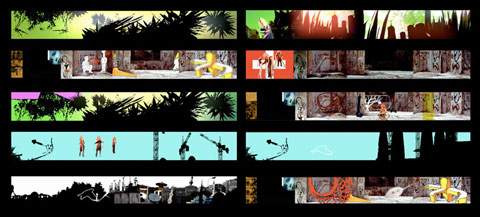
    Having been meaning to post a sample of this project for ages, but the arrival of Melbourne winter seems to be helping nicely. So yes, ‘Animals Really Are Funny People’ is a screen panorama made in 2007 while in Istanbul with artificialeyes.tv. We’re talking an 8:1 screen ratio, 20 metres of pixels sync-ed up using Dataton Watchout software, and the combining of hand-drawn animations, photos in Barcelona and Istanbul, various green-screened characters (( monkeys on (actual) segways, giant squids, giant plant-men, etc )). Making a 3 minute piece for six screens seemed to plague it with rendering bugs, DVD burning bugs and courier delivery bugs, but perseverance paid off, as it ended up winning the 2007 MONA Horse Bazaar International Panorama prize. Music : “Egg Yolks Yo” by Lewis Cancut( Full track available over in the scatterblog sidebar ).

    Below, a selection of highlights, crammed from six screens into one…

    Animals Really Are Funny People from jeanpoole on Vimeo.

    Meneo : Electro Gameboy Reggaeton in the House

    meneo

    Electropical? Bleepy cumbia? Such hybrids are inevitable, given a generation raised on candied synthetic computer game sounds, and the speed at which localised bass variations now travel from shore to shore. They are also core chunks of the Meneo sound, alongside ‘electro-gameboy-reggeaton’, which describes their recent CD, Santa Nalga ( mastered @ Mad Decent ), as well as their recent EP, Papi. Rigo Pex makes the music, Raul Berrueco makes the video, both use gameboys to do it. Music, videos, nude performance photos and more : http://www.entter.com/meneo/istheshit.html

    What’s your quick and easy definition of ‘reggaeton’ ?
    Rigo: Old School reggaeton= booty marathon with ass sweat dripping down your ankles. Current reggaeton= boring ego rap, with some exceptions to both.
    Raul: Atun Con Pan!!!! Yeah… it’s kind of a joke ’cause the rhythm sounds like saying in Spanish ‘atun con pan, atun con pan’ which literally means: tuna sandwich.

    I am gathering your happy blend with many other styles, which of these are you enjoying a lot at the moment?
    Raul: Gabba Lounge, nah kidding… we both love the new electronic cumbia made by artists like Uproot Andy and Sonido del Principe
    Rigo: Yep, all that comes out from the Zizek and Bersa labels…also dubstep never stops to amaze me.

    How does the Gameboy fit into your musical processes?
    Rigo: I use LSDJ, a gameboy sequencer made by Johan Kotlinsky.. It’s actually a tracker. I love the way you can alter the values that define the sounds to come up with noises that you never heard before, digital rawness.

    What kinds of tools and techniques do you use to get that chunky retro graphic style?
    Raul: At the beginning I go through a lo-tech process where I use applications designed by freaky programmers without girlfriends. I’m talking about ROM hacking and prehistoric hardware/software emulators, but I also use the pencil tool to draw pixel by pixel sometimes. When I put all this material together I use more conventional languages like Action Script while wearing my cool designer specs.

    In what ways do you collaborate / build performances / audiovisual sync / themes?
    Raul: we are into creative freedom, so mostly we don’t talk about doing this or that, we both do our own stuff with almost no feedback and then show it ’till we’re on stage…like some Dadaists did back in the day. In that way, we keep the surprise even to ourselves and focus more on feeling than acting. When we let go, things flow depending on the stage, public and energy.
    Rigo: Then there’s the part of capturing what happens on stage and communicating it through pics, blogs and overall media management, which is truly an important part where we really work as a military team.

    Nakedness seems to be a visual trademark too, care to explain some more?
    Raul: we usually do it if we feel good on stage, so if the sound and visual equipments are working all right, then they get a technical seal of approval… MENEO √.
    Rigo: It also means that we can safely climb up to the stage roof and then jump into the speakers while the crowd is licking each other’s sweat to a 280 bpms backward version of popcorn.

    Santa Nalga ‘was mastered by DJA at Mad Decent..’ What were you happy with about that album, and what differences are there coming up in your next release _Bitnik?
    Rigo: Santa Nalga was pretty much done in 2006, when reggaeton and 8bit was still something whacky for me, but since it was the first album it took some time to surface. Diplo liked us and pointed us to DJA, who was great for achieving that bouncy epileptic feeling we like. The soon to release BITNIK album has more of a band sound an less club breaks, since it’s mostly all 8bit coming from the game boys sound that shred more than a million distorted guitars and their marshalls put together.

    Your thoughts on the wii, iphone and other portable competitors to the Gameboy?
    Raul:
    In 20 years will say “wow, we were really into waving a stick in the air, like it was a tennis racquet…hahah!
    Rigo: there are no competitors to the gameboy… no portable game will stick around for more than 8 years these days… and even if technology didn’t changed so fast, it would be hard to achieve such a strong graphic and audio personality: the gameboy chip limits were it’s advantages.

    What would be your ideal gig, and who else would be playing at it?
    Rigo:
    Meneo playing on the greek coliseum with John Bonham on drums, the bass player from Primus, Milli Vanilli as choir…
    Raul: and a 3d screen so everybody could wear those amazing 3d glasses!!!

    Documentaries I Have Yet To Love

    jp | Cinema | Thursday, 11 June 2009

    For those bunkering down to a winter of movie watching, a shared list from my pixel horizons.

    On Paper Wings
    When I think of World War II and Japan, the first thing that comes to mind is the hibakusha, a Japanese name for the surviving victims of the atomic bombs dropped on Hiroshima and Nagasaki, that literally translates to “explosion-affected people.” Long ago a documentary exposed me to horrifyingly surreal half-melted bodies of some of these people – some living survivors, and others the victims of radiation birth defects. This was the tail end of The Manhattan Project, a 3 year, 100,000 person United States project to develop a bomb.

    On Paper Wings offers a little known flipside to that history. During WWII, the Japanese military developed a new weapon intended to strike directly at the American continent – the balloon bomb. High school girls across Japan were conscripted into factories where they built thousands of balloons made of paper. These balloons were then attached to bombs and launched into the jet stream to drift toward North America. On May 5th, 1945, a pastor, his pregnant wife, and five children departed on a picnic in Southern Oregon. When they found an un-detonated balloon bomb, the device exploded, killing the pastor’s wife and all five children. They became the only people killed on the continental U.S. as the result of enemy action during WWII.

    Forty years later, a Japanese American man who had spent his wartime years in an internment camp found out about these deaths. He knew several women in Japan who as young girls had been forced to work on the balloon bombs, and the news of these deaths shocked and saddened them. These women decided to fold a thousand origami paper cranes to offer to the families of those killed in Oregon, and the groups eventually all met face to face. The friendships formed since have helped citizens on both sides of the Pacific cope with the tragedies they experienced during WWII.

    On Paper Wings is the story of four Japanese women who worked on balloon bombs, the families of those killed in Oregon, and the man whose actions brought them all together forty years after WWII, and the balloon bomb project.

    Général Idi Amin Dada: Autoportrait
    Idi Amin, was a Ugandan military dictator and the President of Uganda from 1971 to 1979, with an estimates varying that 100,000 to 500,000 were killed during his rule. A confronting character for any film director to have to contend with, and with the constraints with which Idi Amin eventually placed on the film, French director Barbet Schroeder decided to call this a self-portrait by Amin. Upon release of the film, Amin sent a letter to Schroeder requesting additional cuts to the film. Schroeder refused, and Amin responded by rounding up 200 French citizens and confining them to a hotel surrounded by the Ugandan army. He also supplied them with Schroeder’s home telephone number and explained their release was conditional on the cuts. Within the 2 and a half minutes of cuts Schroeder inevitably made, he placed title cards crediting the gaps to Amin. These edits were restored after Amin’s fall from power.

    The documentary promises : Amin trying to demonstrate his psychic control of crocodiles, Amin supervising a war-game simulation of an invasion of Israel, Amin dressing down his ministers at a cabinet meeting (two weeks after this meeting, the foreign minister, whom Amin criticizes here, is murdered).

    Chris Marker – Vive la baleine AKA Three Cheers for the Whale (1972)
    Most famous for La Jettee, his 1960’s black and white sci-fi short film made almost exclusively from photographs and narration, Chris Marker is also a formidable documentary maker, a film essayist of sorts. This short 17 minute film explores the whaling industry over the years, featuring historic photographs and paintings of whales and the whaling trade as well as real-life footage of whaling and harpooning. Marker sides with the hunted mammals in this film, and hunts himself, what it means about us that we have pursued such a past-time.

    ACMI gig with Lewis Cancut, Thu Jun 4

    synnerz

    Many months of sampling and rehearsals with DJ Lewis Cancut culminate in a few days time, bringing together OJ Simpson, Prisoner, Molly Meldrum, Marshall McLuhan, Princess Diana, Jon Safran and assorted media luminaries into a 45 minute mix about television. It’s part of an ACMI series called Synaesthesia, curated by Eugenia Lim ( ACMI / Share Outpost ), which has already had great sessions by Robin Fox ( rocking the oscilliscope like no other ) and Abject Leader ( Brisbane’s infamous celluloid fetishists ), and with one further show still to come withQua (Jun 18, 6.30pm ) accompanied by visual work from Isobel Knowles and Paul Robertson. Great to have so many ‘live cinema’ events @ ACMI.

    We’re excited anyway, and looking forward to having the work on the big screen and speakers finally.
    Thu Jun 4, 6.30 ( with ACMI recommending to arrive before then to ensure a seat in small theatre )

    I’ll be triggering and controlling videoclips (with sound) through VDMX ( reviews ), Lewis will be on the decks, playing back sounds and scratching video withMix Emergency (review) , and both of our signals will be going through an audiovisual Mixer: Numark AVM02 ( review ). Like so :

    vidi-yooooooo

    Half the work has been trying to figure out a good audiovisual dynamic between the turntables and my laptop, jumping the various tech-hurdles on the way, and just trying to figure out what actually works best in a live setting. Still a work in progress, but hopefully there’ll be enough of interest on Thursday night…. Drop a comment if you manage to make it along : )

    UPDATE:
    And whille you’re there, check out the United Visual Artists installation opening that night as part of the Light in Winter program at Fed Square.

    Mapping Festival, Geneva, May 09

    No Swiss passport stamps for me, but Lucy Benson ( VJ Nosis / Melb – Belfast – Zurich – Berlin etc ) who has recently migrated to the Northern hemisphere, and is rad, found herself at the Mapping festival. And so, it seemed more than a good idea to let her have my technoscape column over at 3Dworld mag this week. Below is the edit to fit into print, over yonder, there are many more words, many more photos.

    **
    Over the last 5 years, Geneva’s Mapping Festival has earned a solid reputation for showcasing the world’s preeminent ‘Visual-Audio’ artworks and technologies, maturing into a lengthy 10 day event with a strong emphasis on live performative acts and VJ culture. Some highlights in 2009 :

    Kine TXT

    KineTXT is a live story-telling collaboration between *spark and another UK outfit, Novak that allows live-generated illustration, text and poetry to be composited together in realtime and manipulated via a wii remote to develop a meaningful progression of narrative. It’s a beautiful project and despite some last minute technical difficulties – including rain, the show delivers and the six busily active artists and live soundtrack make for an absorbing spectacle.

    KineTXT’s live camera action turns out to be indicative of a clear trend at the festival. Performers from all parts of the world embraced the potential of a live feed, human involvement celebrated on stage rather than hidden away behind screens and consoles and bringing to mind the emergence of a certain folk-like inclination amongst the artists. It also signified a lovely return across the festival to a human perspective of time, the most real real-time there is; the time it takes a body to move, breathe, think and react.

    Visual Feedback?

    The deceptively simple work, Inside/Out, by Croatian artist Klif is made up of 3 computer controlled cameras, eight monitors and five projectors. The cameras, feeding into the monitors, pan and zoom across the installation sending glorious cascades of feedback across the large room. The open mechanics of the work provide a fascinating centre piece to the installation and lend themselves to a variety of spontaneous interventions from visitors to the exhibition.


    Reflexus is Spanish audiovisual processing software developed in Open Frameworks for theatre productions, and allows live camera feeds to be processed with a variety of effects, linked to an audio synth (currently the project uses Reaktor GUI components) and played back to stage. Not exactly groundbreaking, but it allows dynamic manipulation of up to 80 or so(!!) layered video feeds. Without a single dropped frame. Impressive. And the hour long showcase performance, featuring seamlessly integrated dialogue and action between ten or so versions of an actor, was mesmerising and a real highlight (despite being delivered entirely in French).

    Collectif Akrylonumerik, France

    A collective of four or five street artists, dressed head to toe in white, a dj and a visualist on laptop projection. Starting with a blank white-papered wall, the artists build a foundation of graffiti and paste-ups for the projected illustration and video, creating a series of beautifully composed, continually evolving, hip-hop meets punk mise-en-scènes. The show is incredibly good at times, with an infectious street-party atmosphere and some mind-bending transformations between the physical artwork, the projections and the white-suited artists themselves. The real strength of the work however was in it’s thoughtfully constructed progression over the show’s duration.

    VJ performances

    The beautiful control and pacing evident in many of the performative artworks was sadly lacking here. Perhaps VJs are so used to their work being backgrounds that the tendency towards flashing, eye-grabbing graphics and technique, at the cost of meaningful imagery, is so ingrained it’s hard to break away from. One exception was Poland’s PussyKrew who built a controlled and considered show, utilising a restricted canvas area to great effect.

    Overdosing
    Noticed a surprising tendency for cheesy, overly-sentimental or effects-reliant material – often from an artist who a moment ago had been displaying something truly captivating. Perhaps as artists we all have our particular stylistic achilles heels – aesthetics that for some reason resonate with us, but leave everyone else scratching their head. Maybe something to be reckoned with as long as we are asking for a genuinely personal experience from these performers.

    Outdoor Projections

    Impressive video mapping technologies? French artists Exyzst certainly delivered with their closing night performance mapped to the riverside Façade de l’Usine. The piece was sonically and visually synchronised to that extent that stops you noticing either individual medium and simply transports you temporarily.

    Germany’s Videogeist also stood out, breaking the mould with some painterly generative art and an augmented version of the building that differed from the neon neo-futurist vision inextricably bound to this technology at present. Another French team, Digital Slaves, also went for a more organic aesthetic with some particularly nice moments, however were let down by the lack of synchronicity between the sound and vision – unfathomably for each of their short sets the audio abruptly cut out before the visuals.

    VIDEOHUAHUA
    Videoman (Fernando Llanos, Mexico) brought his own take on the festivals tagline ‘deviant electronics’ with his invention: the Videohuahua. That’s a chihuahua with a mini projector attached. Of course! Fernando and the Videohuahua (a very cute fellow named Chamacos) were an unmissable pair at the various evening events as well as the clubs and parties backstage. Little Chamacos won many fans, tottering alongside Fernando, beaming his art into the night and lighting up more than just the Geneva streets.

    (( Thanks to Lucy for the report, try her full version ( twice as long))))
    Stay tuned for another report, the next one from the home of mozzerella de bufala, over at the LPM festival in Italy. So many festivals, such little time~!