
Monolake plays Istanbul with The Field soon enough, and a quick visit to his page shows plenty of busy projects extending his music ( & Ableton Live involvements etc ). First up, he’s been writing “small max + jitter patches.. to create interesting video for my monolake concerts. The complexity is low, but all is generated in real time and constantly morphing, which is a very different asthetic than the usual live mixing of pre prepared video footage. but faster laptops will allow more complexity and higher resolution in the future.”

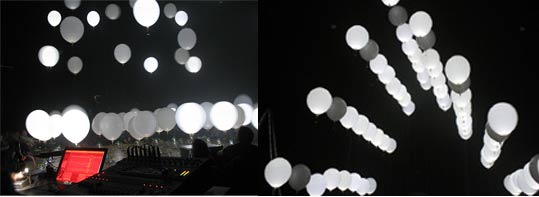
Screenshots look simple indeed, but undoubtedly match well the vast number of sonic parameters he relentlessly tweaks live. The Atlantic Waves project also features a heavy visual component, being a networked sequencing project that allows online remote jamming, and an intricate, stylised interface which allows audiences to see ( guess at?) the processes being played with. Most interesting though, is Monolake’s recent Atom performances – where balloons are arranged in a grid and connected to tubes that allow them to be filled with certain amounts of helium. The balloons also have LED lights inside, which can vary the brightness of the balloon. The end result is a computer controlled three dimensional display that can shuffle between arrangements in time with the soundscapes being triggered. The gallery of photos look great.
UPDATE:
Greg Smith points out in the comments, this related Monolake interview :
“VT: ‘How does visual representation of sound (i.e. waveform editors) changes our perception of it?’
RH: Visual representation of sound is evil. A waveform editor is an enormous help when editing sound but at the same time it has the potential to keep the composer effectively from listening. The visualization by nature stresses the abstract formal quality of a work but makes no statement about its content. The result is obvious, a lot of music these days works correctly according to a formal scheme but lacks beauty within. It takes quite some courage to work against the visual scheme, because oddly structured parts look so wrong. The timeline always tells us how long a piece is in bars or seconds but it knows nothing about our perception of time. We might think a part is too long because it looks long on screen but in fact it is interesting enough to be much longer and we would not shorten it if we could not see it but just listened. I often turn off the screen or close my eyes when listening to my edits because the visual representation is a false friend.”
It is nice to know that every four months I learn about a cool new iteration of Robert’s work! Nobody can accuse him of being a lazy artist. We interviewed him a while back about Atlantic Waves and some other recent work of his. Check it out if you are interested.
This is a great site, I was unaware of it until now. I’m looking forward to digging into your content! 🙂
[…] Monolake Atlantic Wave Balloons“Most interesting though, is Monolake’s recent Atom performances – where balloons are arranged in a grid and connected to tubes that allow them to be filled with certain amounts of helium. The balloons also have LED lights inside, which can vary the brightness of the balloon. The end result is a computer controlled three dimensional display that can shuffle between arrangements in time with the soundscapes being triggered.” { { { { – – Sky Noise — ]]] […]